
Official statement
Other statements from this video 11 ▾
- □ Does crawl frequency really affect your SEO rankings?
- □ Will Google crawl your site less often in the name of sustainability?
- □ Why Does Google Actually Ignore the lastmod Tag in Your Sitemaps?
- □ Is IndexNow Really Worth Implementing for Google Indexation, or Is It Just Another Overhyped Protocol?
- □ Should you really ping your sitemap every time you publish new content?
- □ Is Google really experiencing more downtime than before?
- □ Does HTTPS and page speed really matter for Google indexing, or is it just hype?
- □ Is Google finally fixing its confusing Webmaster Guidelines—and what does it mean for your SEO?
- □ Does Google really tolerate geographic cloaking without penalties?
- □ Is dynamic rendering really risk-free for Google?
- □ Will desktop Page Experience signals be a game-changer for your SEO rankings?
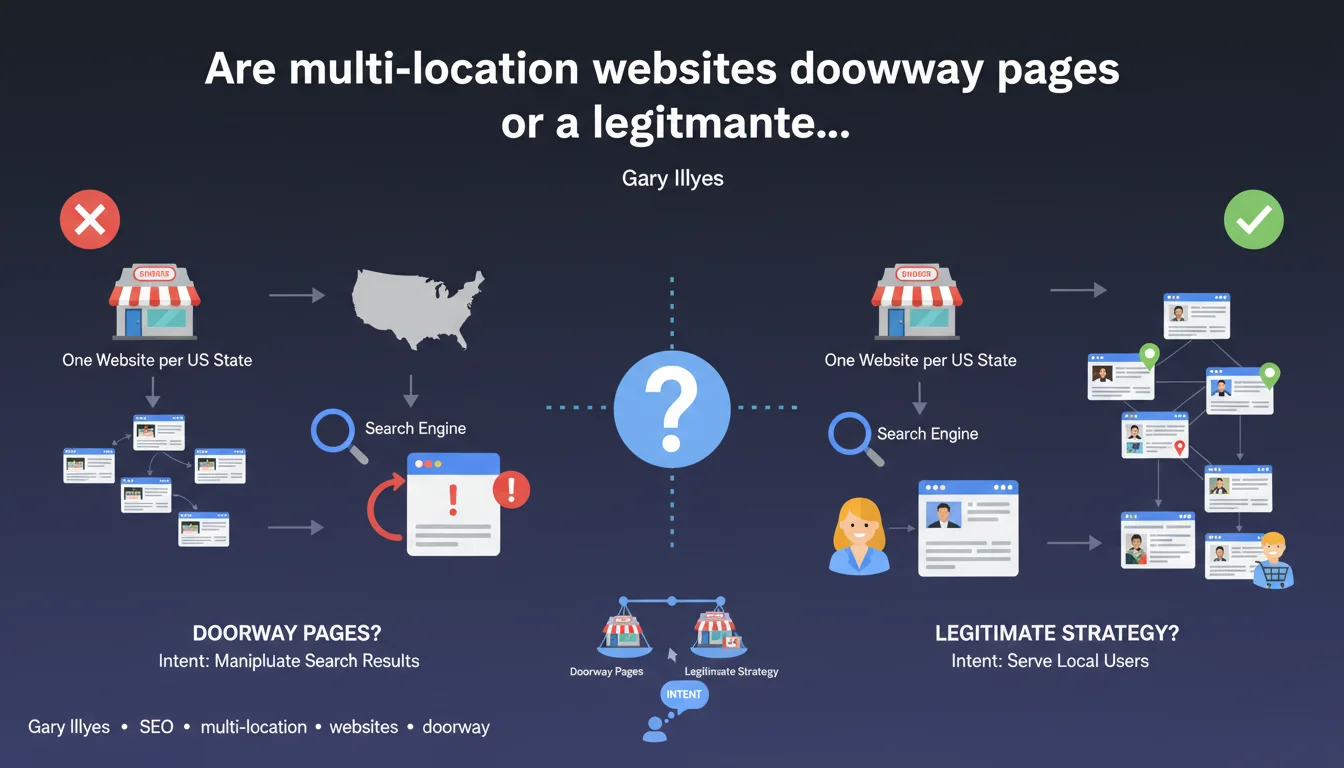
Google clarifies that having one website per US state because you own physical stores there can technically resemble doorway pages, but isn't necessarily a violation. It all depends on intent: if it's to serve local users and not to manipulate search results, it's acceptable. The boundary remains fuzzy and subjective.
What you need to understand
What is a doorway page according to Google?
Doorway pages are pages created in bulk to target specific queries and redirect traffic to a final destination. Historically, Google considers them spam because they add no value to users.
The official definition remains intentionally broad: any page created primarily to rank well for a specific query without real unique or relevant content. The problem? This definition potentially encompasses many legitimate SEO strategies.
Why does this Google statement change everything?
Gary Illyes introduces a crucial nuance: the intention behind creating the pages matters more than their technical structure. If you launch a website per state because you actually have physical stores in each state, Google may accept it.
This approach recognizes that a multi-location business legitimately needs geolocation pages. Real commercial intent trumps the strict technical definition of doorway pages.
Where exactly is the line between legitimate and spam?
Google doesn't provide measurable objective criteria — and that's where it gets tricky. The notion of "intent" remains subjective and depends on Google's human or algorithmic evaluation.
A competitor can create the exact same structure without physical stores and face a penalty. The difference? The existence of a real business behind each local page.
- Doorway pages are theoretically pages created solely to manipulate rankings
- Having a website per state with real physical stores can escape this definition
- Legitimate commercial intent is the decisive criterion according to Gary Illyes
- Google provides no objective metrics to distinguish between the two cases
- Validation remains at Google's discretion, without absolute guarantee
SEO Expert opinion
Is this statement consistent with what we observe in the field?
Yes and no. We do observe that multi-location websites with real physical presence are rarely penalized, even with very similar pages from one state to another. Google seems to tolerate this structure when the business is authentic.
However — and this is where it gets interesting — the definition of "physical presence" remains unclear. Does a shared office count? A business domicile address? Google doesn't specify. [To be verified] depending on your specific situation.
What nuances should be added to this statement?
Gary Illyes talks about "intent" without providing a concrete evaluation framework. How does Google detect this intent? Probably through indirect signals: Google My Business data, NAP consistency, local customer reviews, real traffic to these addresses.
Let's be honest: if you create 50 state-by-state websites with the same template, slightly modified text and no real local presence, you're playing with fire. Google may not penalize immediately, but the line is thin.
In what cases doesn't this logic apply?
If your only goal is to capture local traffic without real local value, you remain in the doorway pages domain. For example: creating a website per French city by just changing the city name in the text, with no local team, no local phone number, no real ability to serve that area.
Google detects these patterns through user behavior analysis: high bounce rate, absence of interaction, non-existent conversions. ML algorithms detect the difference between a legitimate website and an SEO clone.
Practical impact and recommendations
How to legitimately structure a multi-location website?
First rule: each local page must have a reason to exist beyond SEO. Verifiable physical presence, local team, dedicated phone number, specific opening hours, geolocated customer reviews.
Second rule: content must reflect real local specifics. Not just replacing "Paris" with "Lyon" in a template. Talk about local market particularities, regional events, local partnerships.
What signals should you send to prove your legitimacy?
Google cross-references data. Make sure you have perfect consistency between your website, your Google My Business listings, your local citations, your presence on professional directories. Any inconsistency raises red flags.
Geolocated customer reviews, real traffic to these addresses (measured via Google Maps), phone calls from these pages — all these signals reinforce the authenticity of your local presence.
What mistakes must you absolutely avoid?
Never create local pages without real infrastructure behind them. Google may tolerate a certain level of similarity between pages, but not the complete absence of local business. If you don't have an office, no team, no ability to serve that area, don't go there.
Also avoid pure duplicate content. Even with legitimate presence, if your 50 state pages are rigorously identical, you send a negative signal. Invest in differentiated content.
- Verify that each location has verifiable physical presence
- Create a Google My Business listing for each address with photos and hours
- Produce unique content reflecting real local specifics
- Obtain geolocated customer reviews on each local listing
- Ensure NAP consistency (Name, Address, Phone) across all directories
- Track user behavior metrics: bounce rate, time on page, conversions
- Avoid strictly identical templates from one page to another
❓ Frequently Asked Questions
Combien de sites locaux puis-je créer sans être pénalisé par Google ?
Puis-je utiliser le même template pour toutes mes pages locales ?
Une adresse de domiciliation suffit-elle comme présence physique ?
Comment Google détecte-t-il l'intention derrière mes pages locales ?
Dois-je créer un sous-domaine ou un répertoire pour chaque localisation ?
🎥 From the same video 11
Other SEO insights extracted from this same Google Search Central video · published on 20/01/2022
🎥 Watch the full video on YouTube →
💬 Comments (0)
Be the first to comment.