
Official statement
Other statements from this video 11 ▾
- □ Does crawl frequency really affect your SEO rankings?
- □ Will Google crawl your site less often in the name of sustainability?
- □ Why Does Google Actually Ignore the lastmod Tag in Your Sitemaps?
- □ Is IndexNow Really Worth Implementing for Google Indexation, or Is It Just Another Overhyped Protocol?
- □ Is Google really experiencing more downtime than before?
- □ Does HTTPS and page speed really matter for Google indexing, or is it just hype?
- □ Is Google finally fixing its confusing Webmaster Guidelines—and what does it mean for your SEO?
- □ Does Google really tolerate geographic cloaking without penalties?
- □ Is dynamic rendering really risk-free for Google?
- □ Are multi-location websites doorway pages or a legitimate SEO strategy?
- □ Will desktop Page Experience signals be a game-changer for your SEO rankings?
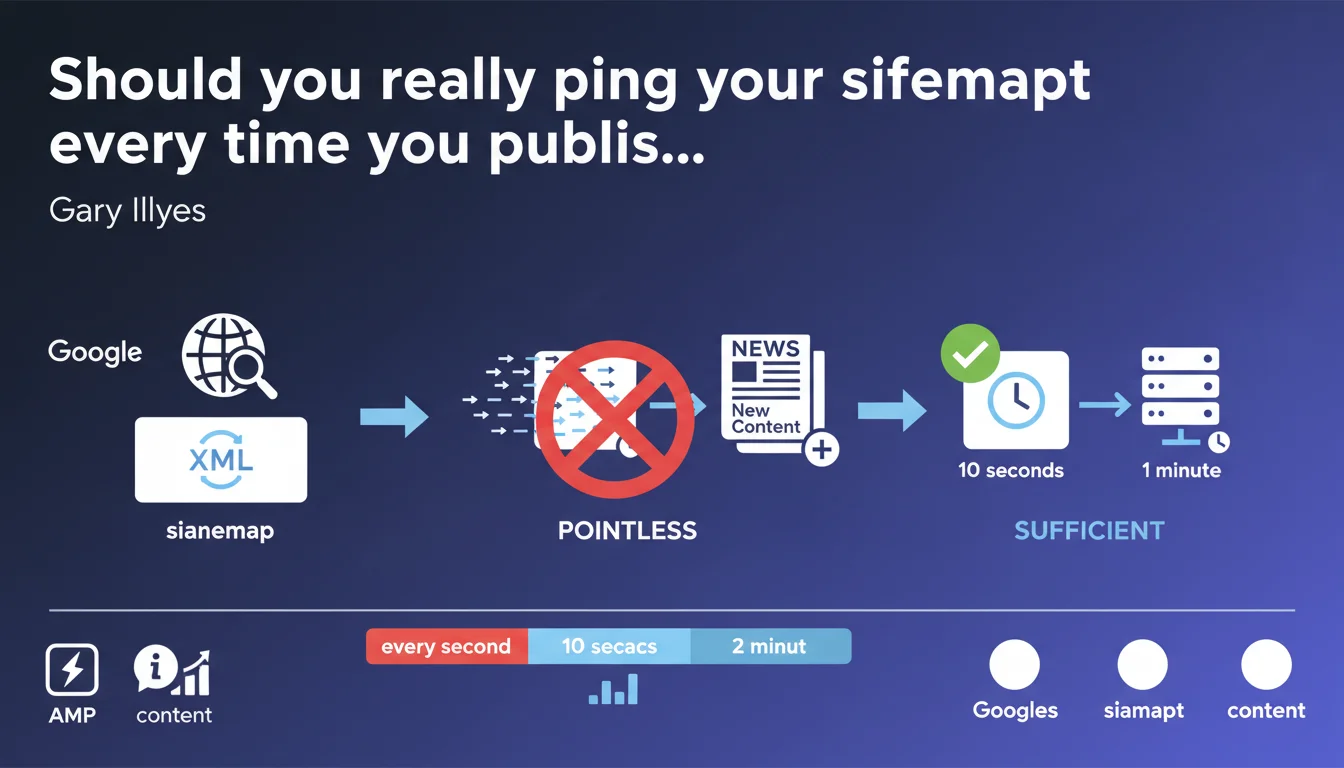
Google confirms that sending a sitemap ping with every new publication (every second for a news site) is counterproductive. A ping every 10 seconds or even once per minute is more than sufficient. Excessive pings don't accelerate indexing — instead, they unnecessarily clutter Google's systems.
What you need to understand
Why does Google advise against frequent sitemap pings?
The reason is simple: Google's crawl resources are not unlimited. Every sitemap ping triggers a server-side check to identify new URLs. If you ping every second, you generate unnecessary server load without any indexation gain.
Google already processes sitemaps in batches, with an unavoidable latency between ping receipt and actual crawling. Bombarding the endpoint doesn't change this queue — you don't get priority regardless.
What sitemap ping frequency does Google recommend?
Gary Illyes sets a clear threshold: at least every 10 seconds, or even once per minute for most sites. Even a news outlet publishing continuously has no benefit to going below this threshold.
The delay between ping and crawl depends on your crawl budget, your publishing history, and the perceived freshness of your content. Pinging more frequently doesn't reduce this delay — it's just noise.
What does this actually change for indexation?
A well-calibrated sitemap ping allows Google to discover your new pages faster than through standard crawling, especially if your site lacks strong internal or external links. But beyond a certain pace, you saturate your own crawl budget with no benefit.
- Excessive pinging: generates noise, consumes server resources, no indexation gain
- Optimized pinging (10s to 1min): perfect balance between responsiveness and crawl budget respect
- No pinging at all: Google will eventually crawl, but with potentially longer latency
- Pinging never guarantees indexation — it only signals an update to check
SEO Expert opinion
Is this recommendation consistent with field observations?
Yes, and it's actually generous on Google's part. On high-volume sites, I've found that pings spaced 5 to 10 minutes apart are more than sufficient with no measurable impact on indexation speed. The real bottleneck is never the ping, but Google's ability to allocate crawl budget to your domain.
News outlets pinging in real-time think they're gaining a few seconds — when in reality, Google prioritizes pages first based on internal PageRank, historical freshness, and quality signals. A site with low crawl budget gains nothing from frenzied pinging.
What nuances should be applied to this rule?
Google doesn't specify whether this 10-second limit applies to all sitemap types: main sitemap, dynamic sitemaps, image sitemaps, video sitemaps, etc. [To verify] on complex architectures with multiple distinct feeds.
Another gray area: the difference in handling between a standard HTTP ping and submission via the Search Console API. Some feedback suggests the API offers slightly shorter latency — but there's no official confirmation to date.
Are there cases where this rule might not apply?
If you manage a site with critical real-time constraints (breaking news, timing-sensitive financial data), you might be tempted to test more aggressive frequencies. But honestly, testing shows that the indexation gap between 1 second and 30 seconds is… zero in 95% of cases.
The exception concerns sites with exceptional crawl budget (like Amazon, Wikipedia) where Google crawls nearly instantly. But if you're in that position, you probably don't need to ping your sitemap at all — standard crawling is more than sufficient.
Practical impact and recommendations
What should you do concretely right now?
First step: audit your current pings. Review your server logs to identify the actual ping frequency. If you're pinging more than every 10 seconds, you're wasting resources with zero ROI.
Second step: properly configure your CMS or generation script. Most modern plugins allow you to set a minimum delay between two pings — set it to 30 seconds or 1 minute and you're good.
What errors should you absolutely avoid?
Never ping the same sitemap multiple times in succession for the same update. Some faulty setups send a ping with every draft save, then another on publication, then a third on cache — that's pure noise.
Another trap: poorly formatted or oversized sitemaps. If your sitemap is 50 MB with 50,000 uncompressed URLs, Google will take forever to process it — pinging becomes counterproductive. Favor segmented sitemaps with 10,000 URLs maximum, compressed as .gz.
How do you verify your configuration is optimal?
Three simple checks:
- Review your Apache/Nginx logs to spot calls to
google.com/ping?sitemap=— frequency should be >= 10 seconds - In Search Console, Sitemaps section, check the last read date: it should match your last updates without unusual lag
- If you use a plugin (Yoast, RankMath, etc.), disable automatic pinging and configure a custom cron job spaced 1 minute apart
- Test with test URLs: publish a page, ping your sitemap, and measure crawl latency via logs — compare with and without excessive pinging
- For very high-volume sites, consider a queuing system (Redis, RabbitMQ) that batches pings every 30 seconds rather than in real-time
❓ Frequently Asked Questions
Quel est le risque si je ping mon sitemap toutes les secondes ?
Est-ce que pinger plus souvent accélère l'indexation de mes nouvelles pages ?
Dois-je encore pinger mon sitemap si Google crawle déjà mon site régulièrement ?
Le ping sitemap fonctionne-t-il de la même manière sur mobile et desktop ?
Puis-je utiliser la Search Console API pour pinger plus efficacement ?
🎥 From the same video 11
Other SEO insights extracted from this same Google Search Central video · published on 20/01/2022
🎥 Watch the full video on YouTube →
💬 Comments (0)
Be the first to comment.