
Official statement
Other statements from this video 11 ▾
- □ La fréquence de crawl influence-t-elle réellement le classement SEO ?
- □ Google va-t-il moins crawler votre site au nom de l'écologie ?
- □ Pourquoi Google ignore-t-il la balise lastmod de vos sitemaps ?
- □ IndexNow et Google : faut-il vraiment soumettre vos URLs pour accélérer l'indexation ?
- □ Faut-il vraiment pinger votre sitemap à chaque publication ?
- □ Google est-il vraiment en panne plus souvent qu'avant ?
- □ HTTPS et vitesse de chargement : faut-il vraiment s'en préoccuper pour l'indexation ?
- □ Le cloaking géographique est-il vraiment toléré par Google ?
- □ Le dynamic rendering est-il vraiment sans risque pour Google ?
- □ Les sites multi-locaux sont-ils des doorway pages ou une stratégie SEO légitime ?
- □ Les signaux de Page Experience desktop vont-ils changer la donne pour votre référencement ?
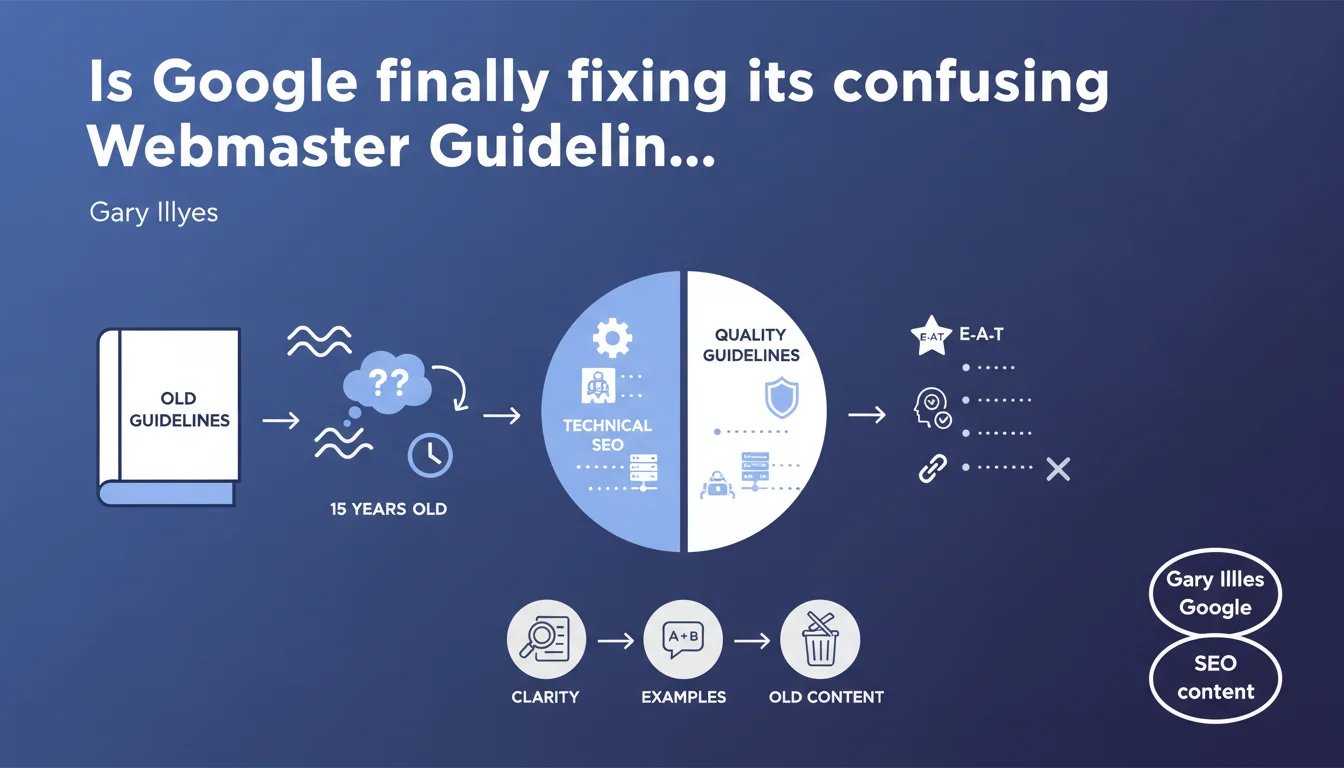
Google is planning a major restructuring of its Webmaster Guidelines by clearly separating technical directives from quality directives. The goal: clarify outdated language, add concrete examples, and purge 15 years of obsolete content that confuses more than it clarifies.
What you need to understand
Why is this overhaul happening now?
Google's Webmaster Guidelines have been accumulating directives for more than 15 years without any real overall coherence. Some formulations date back to an era when SEO practices—and Google's capabilities—were radically different.
Google is implicitly acknowledging that this layered documentary mess harms understanding. SEO practitioners juggle between technical recommendations (crawl, indexing, structured data) and quality directives (content, spam) without clear distinction. The result: confusion and divergent interpretations.
What exactly is changing with this restructuring?
The main evolution is the clear separation between technical and quality directives. Until now, everything was mixed together in one corpus, making it difficult to distinguish what belongs to infrastructure (robots.txt, sitemaps, canonicals) from what concerns editorial evaluation (E-E-A-T, duplicate content).
Gary Illyes also announces the addition of concrete examples—a recurring request from SEO professionals who criticize Google for overly vague language. Finally, cleaning up obsolete content should eliminate recommendations that no longer apply in the era of mobile-first indexing and Core Web Vitals.
What are the risks of such an overhaul?
Any major rewrite carries uncertainties. Nuances can disappear, historical formulations that served as reference points can be modified, creating new gray areas.
There's also the risk that this clarification will ultimately be... disappointing. Google tends to remain deliberately vague on certain aspects to prevent manipulation. A "clarified" version could simply replace old jargon with modern jargon without providing greater operational transparency.
- Technical/quality separation: finally a clear distinction between infrastructure and content
- Concrete examples: Google commits to illustrating its directives (the relevance remains to be seen)
- Removal of obsolete content: 15 years of outdated recommendations will be purged
- Language clarification: reformulation to avoid ambiguities inherited from the old web
SEO Expert opinion
Will this overhaul really make a difference on the ground?
Let's be honest: better-structured documentation won't change the fundamental nature of Google's algorithm. What matters is what Google actually does, not what it writes in its guidelines.
We regularly observe gaps between official discourse and algorithmic behavior. Sites that openly violate certain directives continue to rank, while others, impeccable on paper, stagnate. This documentary overhaul won't influence these inconsistencies—it will simply make them more visible.
The promise of concrete examples is seductive, but [To be verified]: Google has historically struggled to provide practical cases without falling into generalities. "Create quality content" illustrated by "good content answers user questions"—this kind of tautology risks persisting.
Is the technical/quality separation really new?
Not really. Experienced SEO professionals have made this distinction mentally for years. What's changing is the official formalization of this separation in Google's documentation.
The real question: will this new structure finally reflect how Google actually works, or will we simply have two silos of equally vague recommendations? Experience makes us cautious.
Should we expect algorithmic changes tied to this overhaul?
No. This announcement concerns only the documentation, not the algorithm itself. Gary Illyes isn't talking about new rules, but about clarifying existing ones.
However—and this is where it gets interesting—any major reformulation sometimes reveals future intentions. If Google suddenly emphasizes certain technical aspects in the new version, it could signal upcoming algorithmic priorities. But for now, nothing concrete on this front.
Practical impact and recommendations
What should you monitor in these new guidelines?
Once these restructured guidelines are released, compare line by line with the old version. Deletions are as revealing as additions: what does Google no longer consider worth mentioning? Which formulations have been hardened or conversely softened?
Pay particular attention to the concrete examples promised. If they're detailed enough, they could finally clarify persistent gray areas (pagination, syndicated content, internal vs. external links in certain contexts). If they remain vague, you'll know nothing has fundamentally changed.
Should you modify your SEO strategy as a result?
Not immediately. This overhaul doesn't change the fundamentals: a fast, well-structured site with relevant content and quality backlinks will continue to perform.
However, if you're relying on historical interpretations of certain guidelines to justify technical choices (for example on crawl budget or noindex usage), verify that the new formulation doesn't invalidate your reasoning. Sometimes a simple change in vocabulary can question established certainties.
How to use this clarification to audit an existing site?
Use the technical version of the guidelines as an audit checklist: robots.txt properly configured, clean sitemap, coherent canonicals, valid structured data. The technical/quality separation will facilitate identifying what belongs to infrastructure versus editorial.
For the quality section, compare your content against the new examples provided by Google. If gaps appear, it might be time to realign certain pages without waiting for a penalty.
- Compare the old and new versions of the guidelines to spot subtle changes
- Analyze the concrete examples provided by Google to validate or correct your current practices
- Use the technical section as the basis for infrastructure audit (crawl, indexing, structured data)
- Verify that your content complies with the new formulations of quality directives
- Identify removed recommendations and understand why they're no longer relevant
- Document gray areas that remain ambiguous despite the overhaul
❓ Frequently Asked Questions
Cette refonte concerne-t-elle uniquement la documentation ou aussi l'algorithme ?
Les anciennes guidelines seront-elles toujours accessibles après la refonte ?
Quand cette nouvelle version des guidelines sera-t-elle disponible ?
La séparation technique/qualité signifie-t-elle deux documents distincts ?
Les exemples concrets promis seront-ils suffisamment détaillés pour lever les ambiguïtés ?
🎥 From the same video 11
Other SEO insights extracted from this same Google Search Central video · published on 20/01/2022
🎥 Watch the full video on YouTube →
💬 Comments (0)
Be the first to comment.