
Official statement
Other statements from this video 11 ▾
- □ La fréquence de crawl influence-t-elle réellement le classement SEO ?
- □ Google va-t-il moins crawler votre site au nom de l'écologie ?
- □ Pourquoi Google ignore-t-il la balise lastmod de vos sitemaps ?
- □ IndexNow et Google : faut-il vraiment soumettre vos URLs pour accélérer l'indexation ?
- □ Faut-il vraiment pinger votre sitemap à chaque publication ?
- □ HTTPS et vitesse de chargement : faut-il vraiment s'en préoccuper pour l'indexation ?
- □ Pourquoi Google a-t-il décidé de refondre entièrement ses Webmaster Guidelines ?
- □ Le cloaking géographique est-il vraiment toléré par Google ?
- □ Le dynamic rendering est-il vraiment sans risque pour Google ?
- □ Les sites multi-locaux sont-ils des doorway pages ou une stratégie SEO légitime ?
- □ Les signaux de Page Experience desktop vont-ils changer la donne pour votre référencement ?
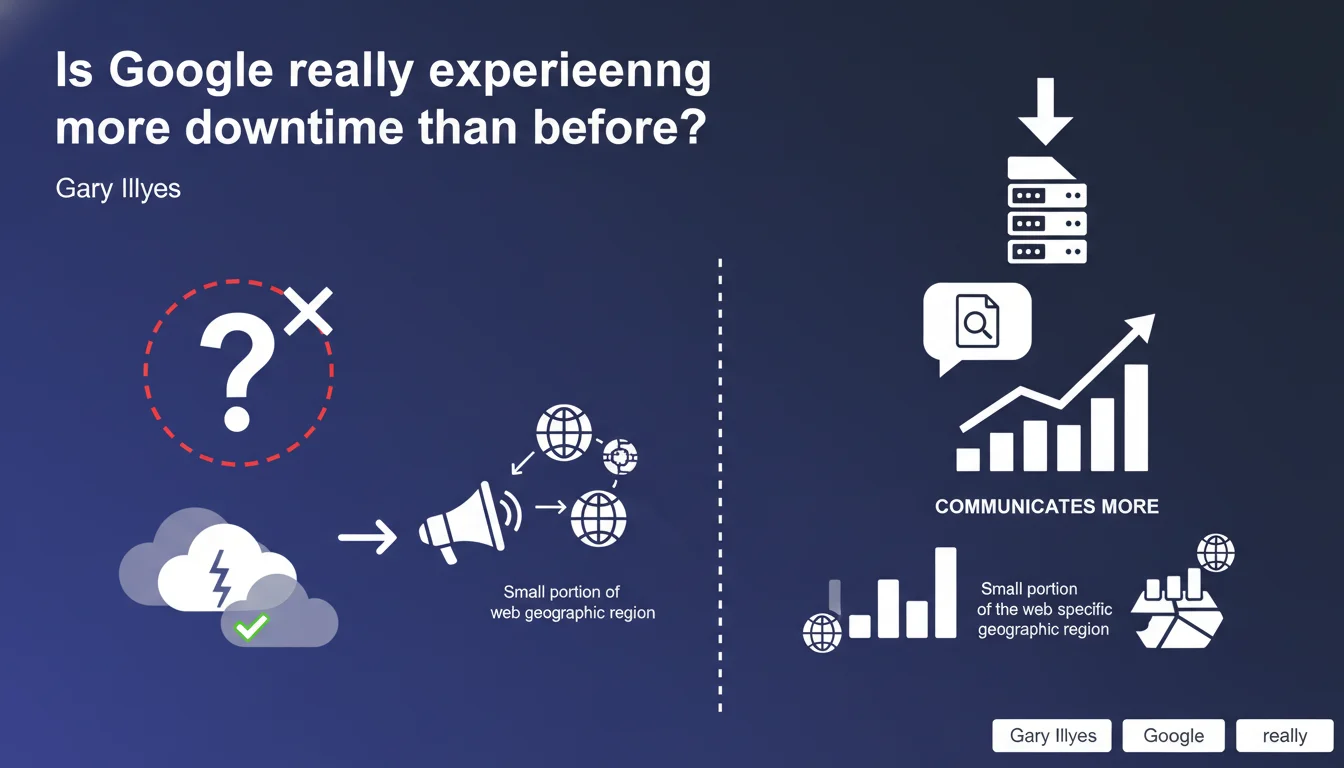
Google does not have more technical outages than it did previously. The impression of a multiplication of incidents comes solely from a change in communication policy: Mountain View now publicly documents incidents that affect only restricted segments of the web or specific geographic regions. Increased transparency creates a perception bias.
What you need to understand
Gary Illyes addresses a major perception bias: SEO professionals have the impression that Google experiences more technical malfunctions. This sensation is not based on an actual degradation of the infrastructure, but on a radical change in communication.
Why this impression of multiplying outages?
Historically, Google only communicated about massive incidents affecting its entire search engine or a large portion of the index. Minor disruptions — limited to one country, one data center, or a specific type of content — remained invisible to the general public.
In recent times, the company has been documenting these micro-incidents on its Search Status Dashboard. Result: every small technical hiccup now surfaces, creating the illusion of less stable infrastructure.
What has actually changed in Google's communication?
The Search Status Dashboard now publishes statuses on incidents that would never have been mentioned before. You'll find regional outages (an indexing problem in Germany but not in France), bugs affecting only certain types of pages, or temporary crawl slowdowns on specific segments.
This granularity of communication is unprecedented. It offers valuable field visibility for diagnosing unexplained fluctuations, but also generates information noise.
What are the implications for SEO diagnostics?
Before this increased transparency, a sudden drop in crawl or indexing often remained mysterious. SEO professionals would blame their own site — failing robots.txt, linking issues, slow servers — when it was sometimes a localized Google bug.
Now, the reflex should be to systematically consult the dashboard before panicking or making massive technical configuration changes. It avoids looking for overly complicated solutions.
- Increased transparency: Google now publicly documents minor incidents that were previously invisible
- Perception bias: The infrastructure is not less stable, it is simply better documented
- Geographic and sectoral granularity: Outages can affect one country, one type of content, or a specific data center
- Simplified diagnosis: Less time wasted searching for the cause of a fluctuation caused by Google itself
- Information noise: Every micro-incident now generates an alert, which can overwhelm attention
SEO Expert opinion
Is this transparency really a double-edged sword?
On paper, documenting every technical incident amounts to SEO public service. In practice, it introduces a new bias: that of hyper-vigilance. Every outage notification, even minor, becomes an excuse to frantically monitor your KPIs when the actual impact on your own site is often null or negligible.
The problem — and Illyes doesn't state it outright — is that Google doesn't always specify the real scope of an incident. "A portion of the web" or "a geographic region" remain deliberately vague formulations. It's impossible to know whether it affects 0.1% or 15% of the index. [To verify] by cross-referencing with field data from multiple sites.
Do minor incidents really deserve our attention?
Let's be honest: an indexing bug affecting exclusively German sites has no interest for a French SEO. Yet the notification appears in the global dashboard, generating information noise that dilutes attention paid to real emergencies.
Google's granular communication has a perverse effect: it normalizes malfunctions. After seeing "incident resolved" statuses pass by every week, you end up trivializing outages — including those that directly concern you. That's the paradox of excessive transparency.
Should you modify your monitoring strategy because of this new situation?
Yes, clearly. The historical reflex was to look for the cause of a fluctuation first on your site (technical, content, links), then possibly on Google's side if no explanation made sense. Today, you need to reverse this logic: check the Search Status Dashboard first.
But — and this is where it gets tricky — the dashboard remains incomplete. It doesn't cover all incidents, and its publication delay can exceed several hours after a bug begins. In other words, you may already be observing a drop in performance without any notification existing yet. Increased communication therefore doesn't eliminate the need for autonomous and reactive monitoring.
Practical impact and recommendations
How do you integrate the Search Status Dashboard into your monitoring routine?
The first reflex should become systematic: as soon as an unexplained anomaly appears in your data (crawl drop, partial deindexing, sudden position fluctuation), consult the dashboard before touching anything. This avoids hasty technical modifications that sometimes worsen the situation.
Set up an automated alert on the RSS feed or API of the Search Status Dashboard if Google offers one — otherwise, use a third-party scraping service. The goal: be notified instantly without having to manually visit the page multiple times a day.
What mistakes should you avoid facing this new transparency?
First common mistake: overreact. Not all documented incidents concern you. An indexing bug on Japanese sites has no impact on your French e-commerce business. Mentally filter notifications according to their geographic and sectoral relevance.
Second pitfall: assuming that the absence of notification equals the absence of a problem. The dashboard is not exhaustive, and Google can take hours to document an incident. Your internal monitoring remains the primary source of truth — the dashboard is only a complementary tool.
Third bias: abandoning all technical investigation as soon as a Google notification appears. Even if an incident is documented, that doesn't mean it explains all your fluctuation. There could be a coincidence between a minor Google bug and a real technical problem on your site.
What checklist should you apply when an anomaly is detected?
- Immediately check the Search Status Dashboard to rule out a documented Google incident
- Cross-reference with third-party sources (SEO communities, Twitter) to confirm that other sites are affected
- Review server logs to detect any unusual variation in Googlebot crawling
- Analyze Google Search Console: new indexing errors, coverage, Core Web Vitals
- Compare the evolution of rankings and traffic across multiple similar sites (if you manage several)
- Wait 24-48 hours before making major technical modifications: many fluctuations resolve themselves
- Document each incident and its resolution to build an internal knowledge base
❓ Frequently Asked Questions
Le Search Status Dashboard couvre-t-il tous les incidents techniques de Google ?
Comment savoir si un incident Google documenté affecte réellement mon site ?
Dois-je modifier ma stratégie SEO à cause de cette communication accrue ?
Pourquoi Google communique-t-il davantage maintenant sur les petites pannes ?
Une notification de résolution d'incident garantit-elle un retour à la normale immédiat ?
🎥 From the same video 11
Other SEO insights extracted from this same Google Search Central video · published on 20/01/2022
🎥 Watch the full video on YouTube →
💬 Comments (0)
Be the first to comment.