
Official statement
Other statements from this video 11 ▾
- □ La fréquence de crawl influence-t-elle réellement le classement SEO ?
- □ Google va-t-il moins crawler votre site au nom de l'écologie ?
- □ Pourquoi Google ignore-t-il la balise lastmod de vos sitemaps ?
- □ IndexNow et Google : faut-il vraiment soumettre vos URLs pour accélérer l'indexation ?
- □ Faut-il vraiment pinger votre sitemap à chaque publication ?
- □ Google est-il vraiment en panne plus souvent qu'avant ?
- □ HTTPS et vitesse de chargement : faut-il vraiment s'en préoccuper pour l'indexation ?
- □ Pourquoi Google a-t-il décidé de refondre entièrement ses Webmaster Guidelines ?
- □ Le dynamic rendering est-il vraiment sans risque pour Google ?
- □ Les sites multi-locaux sont-ils des doorway pages ou une stratégie SEO légitime ?
- □ Les signaux de Page Experience desktop vont-ils changer la donne pour votre référencement ?
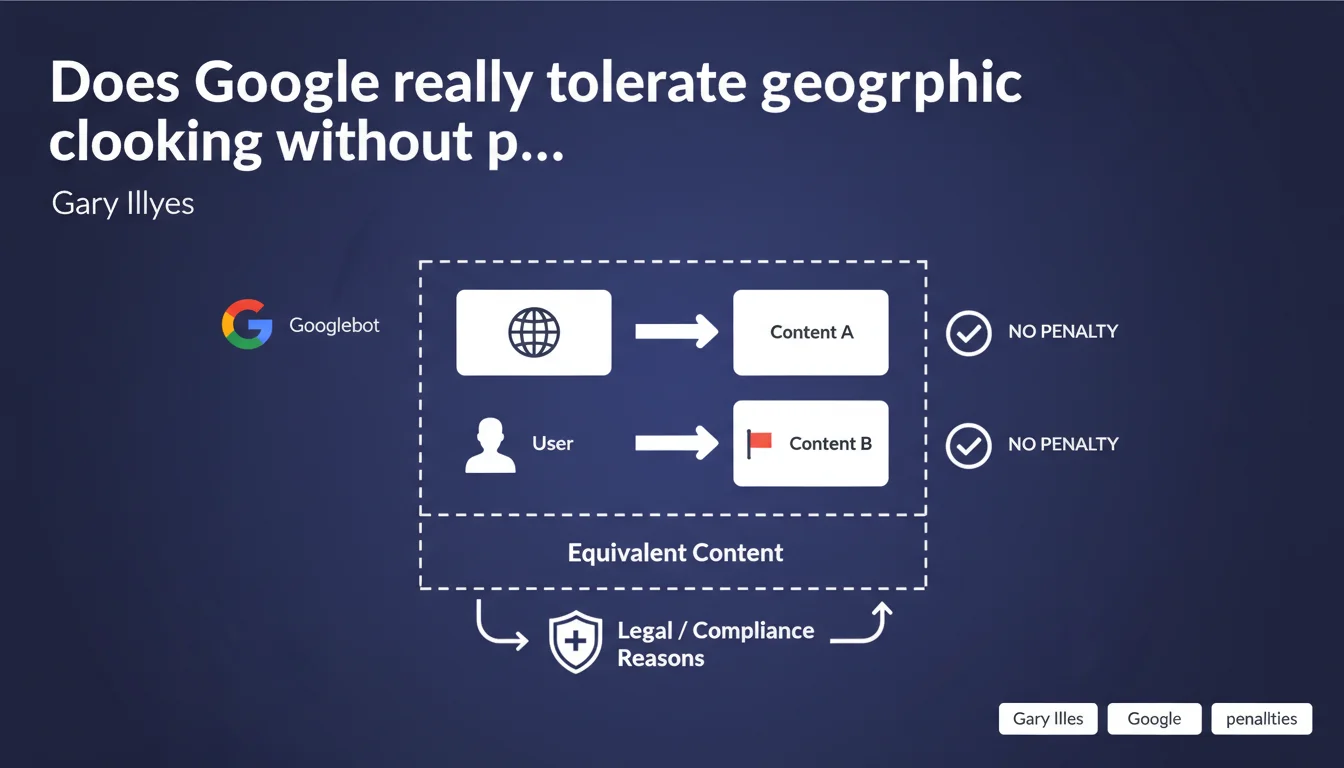
Google claims it will not penalize geographic cloaking if the content served to Googlebot and users remains equivalent, particularly for legal or compliance reasons. This tolerance applies only to legitimate geographic restrictions, not ranking manipulations. The nuance lies in the fuzzy notion of "equivalent content".
What you need to understand
What exactly is geographic cloaking?
Geographic cloaking consists of serving different content depending on the location of the user or bot. Technically, it's a violation of Google's guidelines since Googlebot doesn't see what the end user sees.
But — and this is where it gets interesting — Gary Illyes admits that certain forms of cloaking are tolerated. Not out of goodwill, but pragmatism: legal and compliance constraints sometimes require blocking access to certain content based on geography.
Why does Google tolerate this practice in certain cases?
The reason is simple: regulatory obligations. A streaming platform cannot broadcast a film in France if it doesn't have the rights. A sports betting site must block access from certain countries. Google understands that these restrictions are not manipulations, but legal imperatives.
The algorithm therefore makes an exception — provided that the content served to Googlebot is equivalent in substance to what an authorized user would see. The question remains: what does "equivalent" really mean?
What are the criteria for this cloaking to remain acceptable?
- Legitimate reason: legal restriction, GDPR compliance, geographic broadcasting rights
- Content equivalence: Googlebot must see a version similar to what an authorized user would see
- No manipulation: the purpose must not be to improve ranking by deceiving the bot
- Transparency: clearly display to blocked users why the content is not accessible
SEO Expert opinion
Is this statement consistent with practices observed in the field?
Yes and no. On paper, Google has tolerated legitimate geographic cloaking for years — cases of pure penalties for geo-restrictions are rare. But the devil is in the details: what does "equivalent content" mean?
Does a site that displays a message "This content is not available in your region" instead of a 2000-word article count as equivalent? [To verify] — Google provides no clear metrics. We observe that some sites with aggressive blocking maintain their rankings, while others drop. Consistency is not obvious.
What nuances should be added to this statement?
First nuance: "very likely not" is not "never". Google keeps a way out. If a site abuses the system by claiming legal reasons to serve over-optimized content to Googlebot, it risks serious consequences.
Second nuance — and this one sticks: the statement doesn't specify how Google evaluates equivalence. A geographic paywall that displays 10% of content to Googlebot and 100% to US users, is that okay? No concrete data to settle this.
In what cases does this rule not apply?
If the reason for cloaking is not legal or regulatory, it's out. An e-commerce site that displays different prices to Googlebot to manipulate rich snippets? Penalty guaranteed.
Same for a site that hides entire sections from users but shows them to the bot — unless justified by a documented legal restriction. The burden of proof rests on the site, not on Google.
Practical impact and recommendations
What should you concretely do if your site blocks content geographically?
First, document the legal reason for each restriction. If you block content in France, keep a record of the regulatory obligations that impose it. In case of dispute, Google may request justifications.
Next, ensure that Googlebot sees a representative version of the content. If a US user accesses a complete article, Googlebot must see that same article — not a generic error page.
How can you verify that your implementation won't be considered manipulative?
Test what Googlebot sees with the URL inspection tool in Search Console. Compare it with what a user in an authorized region sees. If the two versions are substantially different without legal reason, fix it.
Avoid borderline techniques: serving hidden text, deceptive hreflang tags, or conditional redirects that have no regulatory justification. Google doesn't specify its thresholds, but flagrant abuses are detectable.
- Identify all pages with geographic restrictions on your site
- Document the legal basis for each restriction (GDPR, broadcasting rights, etc.)
- Verify that Googlebot accesses a version equivalent to authorized content
- Test display with the URL inspection tool in Search Console
- Display a clear message to blocked users explaining the restriction
- Avoid any cloaking that lacks legal or regulatory justification
- Monitor organic traffic fluctuations on affected pages
Legitimate geographic cloaking is tolerated by Google, but the margin for maneuver remains fuzzy. The essential point: justify each restriction with a real legal constraint, ensure that Googlebot sees content equivalent to what authorized users see, and avoid any attempt at manipulation.
These technical adjustments — particularly verifying content equivalence and ensuring hreflang compliance — can quickly become complex depending on your site's architecture. If you manage multiple geographic versions with varying restrictions, considering support from a specialized SEO agency can help you avoid costly errors and secure your long-term visibility.
❓ Frequently Asked Questions
Google pénalise-t-il systématiquement le cloaking géographique ?
Comment savoir si mon contenu géo-restreint est considéré comme équivalent par Google ?
Puis-je bloquer entièrement l'accès à certaines pages pour des raisons géographiques ?
Le cloaking pour raisons de conformité RGPD est-il autorisé ?
Que risque un site qui abuse du cloaking géographique sans raison légale ?
🎥 From the same video 11
Other SEO insights extracted from this same Google Search Central video · published on 20/01/2022
🎥 Watch the full video on YouTube →
💬 Comments (0)
Be the first to comment.