
Official statement
Other statements from this video 11 ▾
- □ Does crawl frequency really affect your SEO rankings?
- □ Will Google crawl your site less often in the name of sustainability?
- □ Why Does Google Actually Ignore the lastmod Tag in Your Sitemaps?
- □ Is IndexNow Really Worth Implementing for Google Indexation, or Is It Just Another Overhyped Protocol?
- □ Should you really ping your sitemap every time you publish new content?
- □ Is Google really experiencing more downtime than before?
- □ Is Google finally fixing its confusing Webmaster Guidelines—and what does it mean for your SEO?
- □ Does Google really tolerate geographic cloaking without penalties?
- □ Is dynamic rendering really risk-free for Google?
- □ Are multi-location websites doorway pages or a legitimate SEO strategy?
- □ Will desktop Page Experience signals be a game-changer for your SEO rankings?
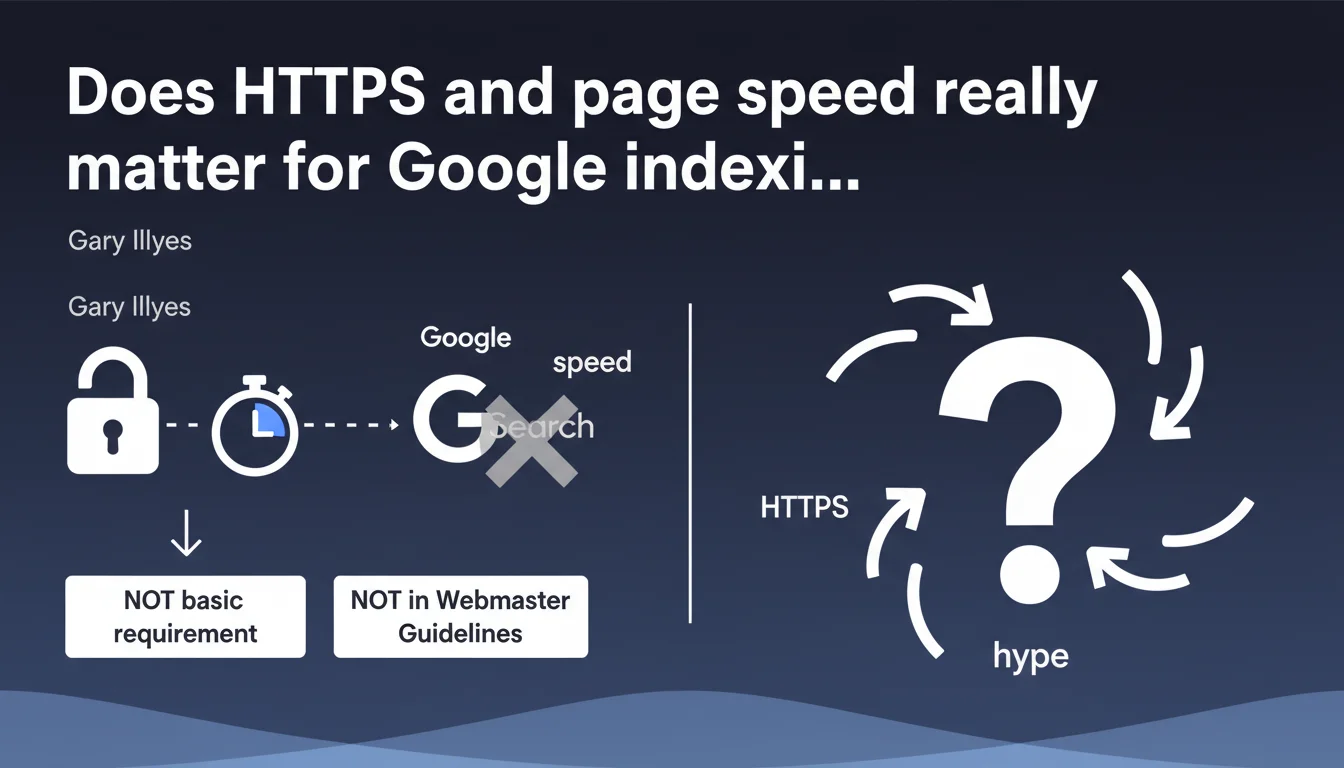
Google confirms that HTTPS and loading speed are not prerequisites for indexing. These criteria are ranking factors, not entry requirements for the index. A slow HTTP site can absolutely be crawled and indexed.
What you need to understand
What's the real difference between indexing and ranking?
Google makes a clear distinction between two stages: indexing (being present in the index) and ranking (position in search results). HTTPS and speed are ranking signals, not barriers to indexing.
In practical terms? A slow HTTP site moving at a snail's pace can be perfectly crawled and added to the index. It simply won't rank well against competitors who are faster and more secure. A crucial distinction that many still confuse today.
Why clarify this now?
Gary Illyes' statement addresses a persistent misconception among webmasters: many believe that without HTTPS or with weak Core Web Vitals, their site simply won't be indexed. That's wrong.
The Webmaster Guidelines (now called Search Essentials) define the minimum requirements: accessible content, no cloaking, no spam. HTTPS and speed aren't included — they're improvement factors, not survival factors.
What does this change for an existing site?
If your site is in HTTP and slow but still appears in results, that's normal. Google indexes it. However, if your SEO performance is mediocre, HTTPS and speed can be significant leverage points for improvement.
This statement should absolutely not be interpreted as "HTTPS and speed don't matter." They do — just not for getting through the front door.
- HTTPS and speed are ranking signals, not indexing criteria
- Webmaster Guidelines should not list these elements as prerequisites
- A slow HTTP site can be indexed, but will suffer in rankings
- The confusion between indexing and ranking remains widespread
SEO Expert opinion
Is this statement consistent with what we observe in practice?
Absolutely. We regularly index HTTP sites, sometimes with catastrophic load times. They're in the index — Google finds them, crawls them, stores them. But their organic visibility remains negligible.
The problem is that this technical distinction (indexing vs. ranking) changes nothing for the actual business outcome: a site indexed but invisible is as useless as a non-indexed site. The nuance matters for understanding how the engine works, less so for strategy.
What are the limitations of this claim?
Gary Illyes is talking about "pure" indexing. But in certain contexts, a very slow site can indirectly create indexing problems — notably through crawl budget. If Googlebot takes 10 seconds to load each page, it will crawl fewer pages during its visit.
Result: some pages may never get indexed, not because speed is a prerequisite, but because Google simply didn't have time to discover them. [To verify] on very large sites with thousands of pages and tight crawl budget constraints.
Should we downplay the importance of HTTPS and speed?
Definitely not. This statement in no way minimizes their impact on overall SEO. HTTPS is a trust signal, speed impacts bounce rate and user experience — two elements that indirectly influence ranking.
Let's be frank: a slow HTTP site in 2025 is a strategic aberration. Regardless of whether it's indexable, it will never be competitive. This statement clarifies a technical point; it doesn't challenge best practices.
Practical impact and recommendations
What should you do concretely if your site is HTTP or slow?
Start by checking your indexation status in Search Console. If your pages appear in the index despite lacking HTTPS or having poor performance, that's consistent with this statement. But don't stop there.
Next, analyze your average positions and your CTR. If you're consistently on page 2-3 for targeted queries, HTTPS and speed can be immediate improvement levers — especially against competitors who already check these boxes.
What mistakes should you avoid after this statement?
The classic mistake: thinking "Google says it's not required, so I'll ignore it." Wrong reasoning. It's not required for indexing, but it's nearly essential for being competitive.
Another trap: believing that switching to HTTPS or improving speed will magically boost your rankings. These elements are signals among many others. If your content is weak or your link profile non-existent, HTTPS alone won't change anything.
How should you prioritize these optimizations in your SEO roadmap?
If your site isn't HTTPS yet, that's the absolute priority — not for indexing, but for credibility and security. Browsers now display aggressive warnings on HTTP sites, killing your conversion rate.
For speed, take a progressive approach: first fix the critical blockers (render-blocking resources, unoptimized images), then refine. No need to aim for 100/100 on PageSpeed — target "fast enough not to frustrate users."
- Check your indexation status in Search Console
- Analyze your positions and CTR to identify priority levers
- Migrate to HTTPS if not already done — it's non-negotiable in 2025
- Optimize Core Web Vitals on your strategic pages (landing pages, main categories)
- Don't neglect crawl budget on large sites: speed can indirectly limit indexing
- Prioritize optimizations that also improve user experience (bounce rate, conversion)
❓ Frequently Asked Questions
Un site en HTTP peut-il être indexé par Google ?
La vitesse de chargement empêche-t-elle l'indexation ?
Faut-il arrêter d'optimiser HTTPS et la vitesse ?
Quelle est la différence entre indexation et classement ?
Les Core Web Vitals sont-ils des prérequis pour être indexé ?
🎥 From the same video 11
Other SEO insights extracted from this same Google Search Central video · published on 20/01/2022
🎥 Watch the full video on YouTube →
💬 Comments (0)
Be the first to comment.