
Official statement
Other statements from this video 11 ▾
- □ Does crawl frequency really affect your SEO rankings?
- □ Will Google crawl your site less often in the name of sustainability?
- □ Why Does Google Actually Ignore the lastmod Tag in Your Sitemaps?
- □ Is IndexNow Really Worth Implementing for Google Indexation, or Is It Just Another Overhyped Protocol?
- □ Should you really ping your sitemap every time you publish new content?
- □ Is Google really experiencing more downtime than before?
- □ Does HTTPS and page speed really matter for Google indexing, or is it just hype?
- □ Is Google finally fixing its confusing Webmaster Guidelines—and what does it mean for your SEO?
- □ Does Google really tolerate geographic cloaking without penalties?
- □ Is dynamic rendering really risk-free for Google?
- □ Are multi-location websites doorway pages or a legitimate SEO strategy?
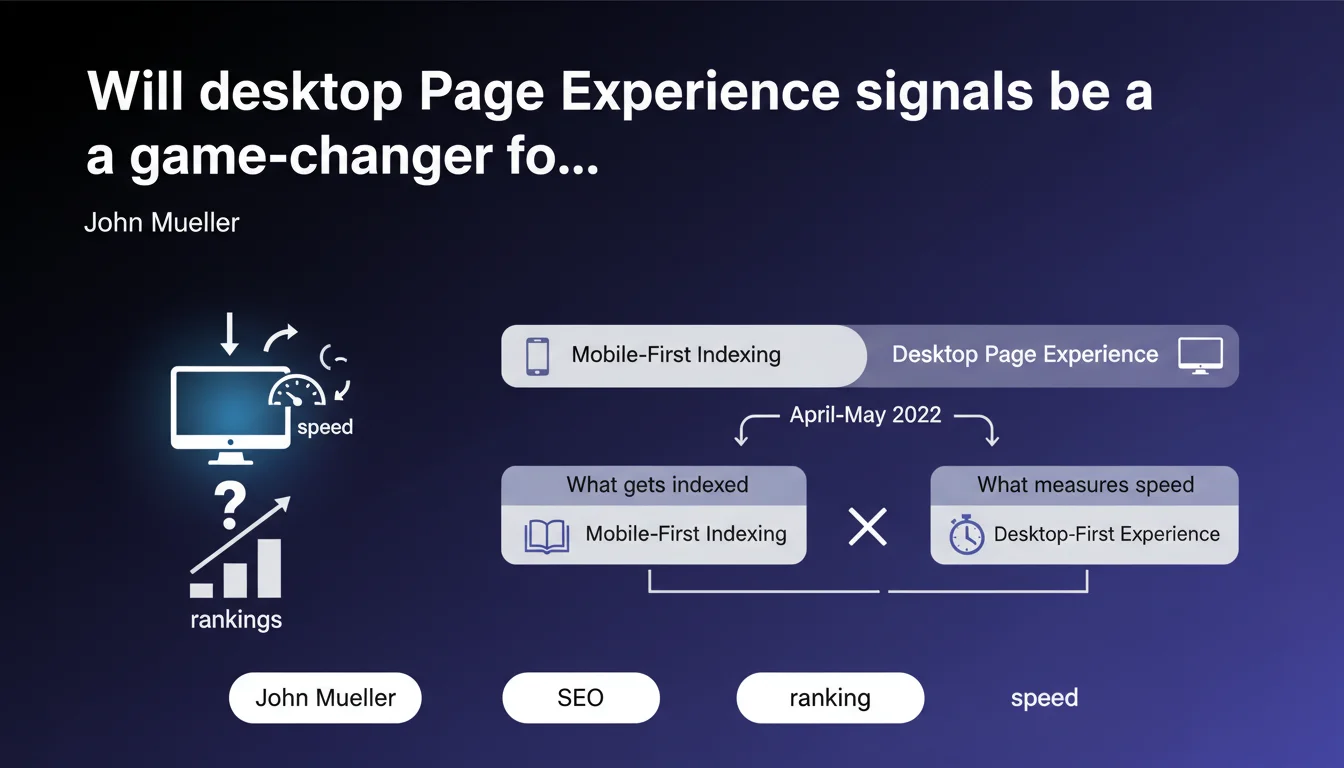
Google is rolling out Page Experience signals for desktop search results. This rollout is independent of mobile-first indexing: one concerns what gets indexed, the other measures performance. Two distinct mechanisms you shouldn't confuse.
What you need to understand
What does this desktop Page Experience rollout actually mean?
Google is extending to desktop search results the same Page Experience signals that already existed for mobile. We're talking about Core Web Vitals (LCP, FID, CLS), HTTPS, absence of intrusive interstitials, and mobile-friendliness.
This rollout doesn't change how Google indexes your desktop pages. It simply adds a layer of user experience evaluation to the ranking of search results performed from a computer.
Why does Mueller insist on distinguishing this from mobile-first indexing?
Because the confusion is widespread. Mobile-first indexing determines which version of your site (mobile or desktop) serves as the reference for indexing. Page Experience, on the other hand, measures the quality of experience on each version.
Concretely: even if your site is indexed via its mobile version, Google now also evaluates desktop experience when a user searches from their computer. Two systems, two objectives.
Which signals are affected by this rollout?
- Core Web Vitals: LCP (largest contentful paint), FID (first input delay), CLS (cumulative layout shift)
- HTTPS: site security
- Absence of intrusive interstitials: no invasive pop-ups
- Mobile-friendliness: even though we're talking about desktop, mobile compatibility remains a global criterion
- These signals add to hundreds of other ranking factors
SEO Expert opinion
Does this statement really clarify things?
Yes and no. Mueller cuts through a recurring confusion between indexing and ranking. That's welcome. But he remains deliberately vague on the real weight of these signals in the desktop algorithm.
We know that on mobile, the impact of Core Web Vitals remains marginal compared to content relevance. Nothing suggests it's different on desktop — and Mueller gives no figures. [To verify] in on-the-ground observations post-rollout.
Are desktop Core Web Vitals really different from mobile ones?
Absolutely. The thresholds are identical, but the measurement conditions change everything. A desktop typically has more CPU power, a more stable connection, a larger screen. LCP and CLS scores can vary drastically between the two environments.
I've seen sites with excellent mobile scores display catastrophic CLS on desktop due to poorly calibrated responsive layouts. Never assume your mobile performance automatically translates to desktop.
Should you really worry about this rollout?
Let's be honest: if your content is relevant and your competitors are in the same boat performance-wise, the impact will be limited. Page Experience signals remain tiebreaker criteria, not dominant factors.
Practical impact and recommendations
What should you audit first on your desktop versions?
Start by measuring your desktop Core Web Vitals with PageSpeed Insights or Search Console. Don't rely solely on mobile data: explicitly test the desktop version.
Then check these points:
- Your desktop LCP: poorly optimized hero images, render-blocking fonts, uncritical CSS
- CLS: missing image placeholders, undefined embed sizes, unstabilized ad banners
- FID: invasive third-party scripts, blocking JavaScript, overloaded event listeners
- HTTPS: valid certificate, HTTP→HTTPS redirects, mixed content eliminated
- Interstitials: newsletter pop-ups, ad overlays, poorly implemented GDPR modals
What common mistakes do you see on desktop versions?
The main one: assuming mobile optimization is enough. Many developers prioritize mobile and neglect desktop specifics. Result: images too heavy to matter on 4G but tank your LCP on fiber.
Another classic trap: unoptimized desktop carousels. They often load all slides at once, bloating initial load and degrading LCP. Lazy-load everything outside the initial viewport.
How should you prioritize these optimizations in your roadmap?
If your desktop scores are already good (LCP < 2.5s, CLS < 0.1, FID < 100ms), leave it alone. Focus on content and links — much more profitable.
If you're in the orange or red zone, and your direct competitors are green, then it becomes a priority. But never sacrifice content relevance to shave 0.2 seconds off LCP.
❓ Frequently Asked Questions
Ce déploiement concerne-t-il uniquement les recherches effectuées depuis un ordinateur ?
Mon site est indexé en mobile-first : dois-je quand même optimiser ma version desktop ?
Les seuils des Core Web Vitals sont-ils identiques entre mobile et desktop ?
Quelle est la pondération réelle de ces signaux dans l'algorithme desktop ?
Faut-il prioriser l'optimisation desktop ou mobile en priorité ?
🎥 From the same video 11
Other SEO insights extracted from this same Google Search Central video · published on 20/01/2022
🎥 Watch the full video on YouTube →
💬 Comments (0)
Be the first to comment.