
Official statement
Other statements from this video 11 ▾
- □ Does crawl frequency really affect your SEO rankings?
- □ Will Google crawl your site less often in the name of sustainability?
- □ Is IndexNow Really Worth Implementing for Google Indexation, or Is It Just Another Overhyped Protocol?
- □ Should you really ping your sitemap every time you publish new content?
- □ Is Google really experiencing more downtime than before?
- □ Does HTTPS and page speed really matter for Google indexing, or is it just hype?
- □ Is Google finally fixing its confusing Webmaster Guidelines—and what does it mean for your SEO?
- □ Does Google really tolerate geographic cloaking without penalties?
- □ Is dynamic rendering really risk-free for Google?
- □ Are multi-location websites doorway pages or a legitimate SEO strategy?
- □ Will desktop Page Experience signals be a game-changer for your SEO rankings?
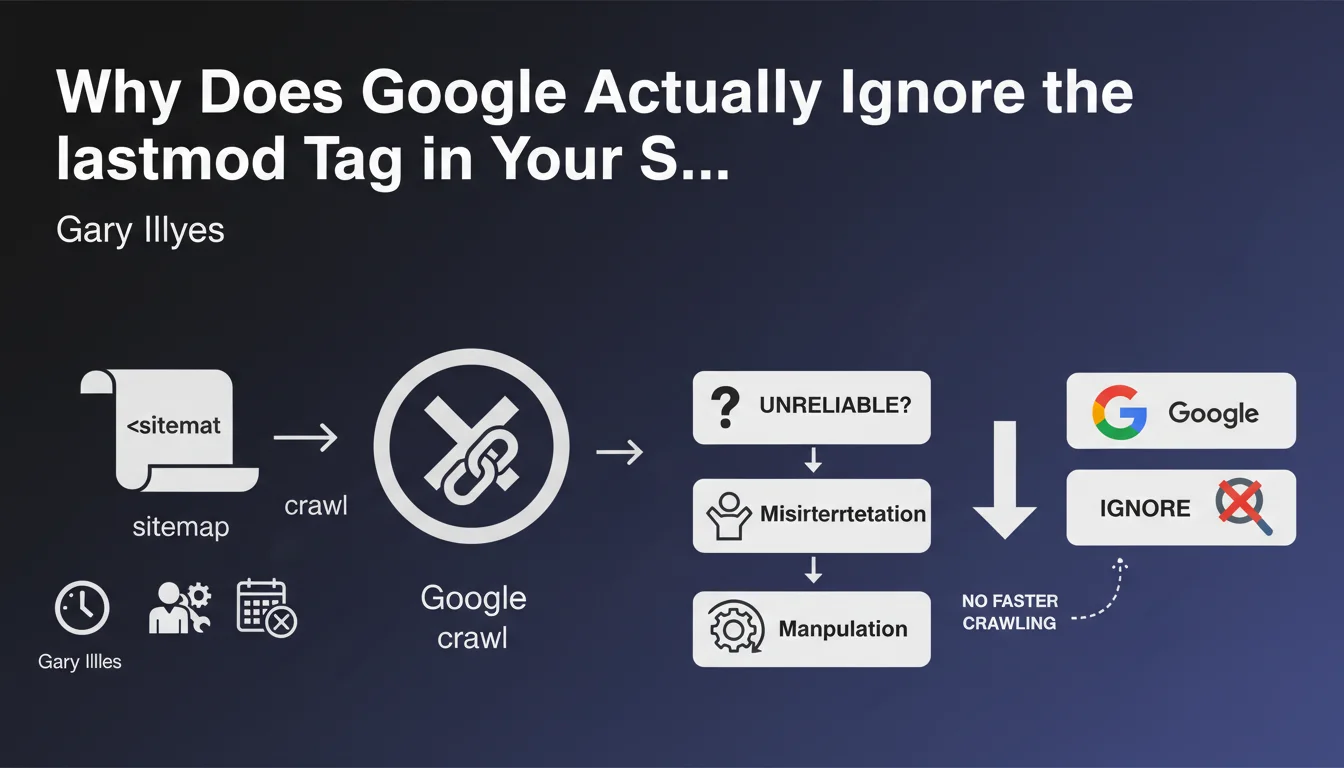
Google typically doesn't use the lastmod tag in sitemaps because it's unreliable. Webmasters often manipulate this date thinking they can force faster recrawling, which simply doesn't work. Understanding why this tag plays no decisive role in crawl prioritization can save you time on pointless optimizations.
What you need to understand
What's the theoretical purpose of the lastmod tag?
The lastmod tag in an XML sitemap is supposed to tell Google when a URL was last modified. The original idea: help the search engine prioritize crawling recently updated pages while avoiding wasting budget on unchanged content.
In theory, it makes sense. In practice, this tag has become an unreliable indicator that Google prefers to ignore rather than risk exploiting with potential errors.
Why is this tag considered unreliable?
Gary Illyes points out two main problems. First issue: misunderstanding what constitutes a real modification. Many CMS platforms or scripts update the lastmod date for insignificant changes — a click on "save" without actual content changes, a server timestamp update, a moderated comment.
Second problem: intentional manipulation. Some webmasters artificially modify this date thinking they can force rapid recrawling. Google detected this practice at scale, which rendered the tag unusable as a trust signal.
Concretely, what does Google do with this tag?
Google generally doesn't rely on lastmod to prioritize its crawl. The search engine uses much more reliable signals: actual page modification history, popularity, content freshness signals, user behavior.
This doesn't mean the tag is completely ignored in 100% of cases — Google remains vague about exceptions. But in most situations, changing this date will have no measurable impact on recrawl speed.
- The lastmod tag was supposed to help prioritize crawling modified pages
- Google considers it unreliable due to non-significant modifications and manipulation
- The search engine relies on more robust signals to manage its crawl budget
- Artificially modifying this date does not force faster recrawling
SEO Expert opinion
Is this statement consistent with real-world observations?
Yes, and it confirms what many SEO professionals have suspected for years. Empirical testing shows that a change to lastmod alone doesn't trigger accelerated recrawling. Conversely, real content modifications — even without touching the sitemap — are often crawled quickly.
Google prefers to detect changes itself rather than trust a metadata field easily manipulated. This is consistent with its general philosophy: prioritize signals difficult to falsify.
What nuances should we add to this rule?
Gary Illyes says "generally not," which leaves a gray area. [To verify] In certain contexts — high-frequency news sites, sites with high authority — it's possible Google still gives marginal weight to this tag.
But let's be honest: if you're counting on lastmod to optimize your crawl, you're focusing on the wrong lever. The real issue is the quality and actual frequency of your updates, not the date declared in an XML file.
Should you remove the lastmod tag from your sitemaps?
No. Just because Google ignores it doesn't mean it causes problems. Removing it will provide no benefit, and it can serve other search engines or analysis tools.
The real message here: stop wasting time optimizing this tag or manipulating it. Focus on what actually works — content quality, structure, authentic freshness signals.
Practical impact and recommendations
What should you do with the lastmod tag on your site?
Nothing special. If your CMS automatically generates this tag correctly, leave it in place. It doesn't hurt; it's just ineffective at influencing Google.
If you've set up a complex script to update lastmod with every minor modification, that's wasted time. Better to invest that technical effort in optimizations with real impact: improved internal linking, reducing orphan pages, optimizing crawl depth.
What critical mistakes should you avoid?
Never artificially manipulate the lastmod date to try forcing faster recrawling. It doesn't work, and if Google detects a systematic pattern, it could damage the trust given to your sitemaps overall.
Also avoid updating lastmod for cosmetic changes — tracking pixel additions, footer modifications, CSS updates. Only significant editorial content changes justify updating this date, and even then, it won't help much on Google's side.
- Leave the lastmod tag in place if your CMS generates it correctly, without treating it as strategically important
- Don't waste time optimizing or manipulating this tag to influence crawl
- Don't rely on lastmod to prioritize recrawling your content — Google uses other signals
- Focus your efforts on proven levers: content quality, actual update frequency, site structure
- Monitor index coverage in Search Console instead to detect real crawl issues
How do you actually optimize crawl prioritization?
If you want Google to crawl your new pages or updates quickly, work on levers that actually function. Internal linking remains one of the most powerful: a page well-linked from frequently crawled content will be discovered quickly.
Real publication frequency also matters. A site that publishes quality content regularly will be crawled more often than a site updated once per quarter, regardless of what the sitemap says.
❓ Frequently Asked Questions
Dois-je supprimer la balise lastmod de mes sitemaps ?
Modifier la balise lastmod peut-il forcer Google à recrawler une page ?
Quels signaux Google utilise-t-il pour décider quand recrawler une page ?
La balise lastmod fonctionne-t-elle sur d'autres moteurs de recherche ?
Faut-il quand même renseigner lastmod correctement si on l'utilise ?
🎥 From the same video 11
Other SEO insights extracted from this same Google Search Central video · published on 20/01/2022
🎥 Watch the full video on YouTube →
💬 Comments (0)
Be the first to comment.