
Official statement
Other statements from this video 17 ▾
- 1:24 Why is Google republishing guides on robots.txt and meta robots right now?
- 7:02 Does GoogleBot really crawl URLs that your site never created?
- 7:27 Why do Search Console and Google Analytics show different numbers?
- 7:27 Does GoogleBot really crawl URLs your site never created?
- 8:07 Why does Search Console show completely different data than Google Analytics?
- 8:51 How long does it actually take Google to detect and process a noindex tag fix?
- 9:49 Why does Google take so long to recognize the removal of a noindex tag?
- 11:11 Does special character encoding in source code really harm your SEO rankings?
- 11:11 Does special character encoding in your source code actually hurt your SEO rankings?
- 11:47 What's the safest way to prevent Google from crawling your PDFs without accidentally getting them indexed?
- 11:51 Should you really block PDFs with robots.txt or use noindex instead?
- 14:14 How long does Google really take to display your new site name in search results?
- 14:14 How can you force Google to display your site's correct name in the SERPs?
- 15:14 Could similar brand names harm your SEO performance and search visibility?
- 19:01 Why won't Google reveal its exact criteria for adult content classification?
- 20:13 Does Google penalize a site that's 100% HTTPS with no HTTP version?
- 20:30 Does running an HTTPS-only website actually hurt your SEO rankings?
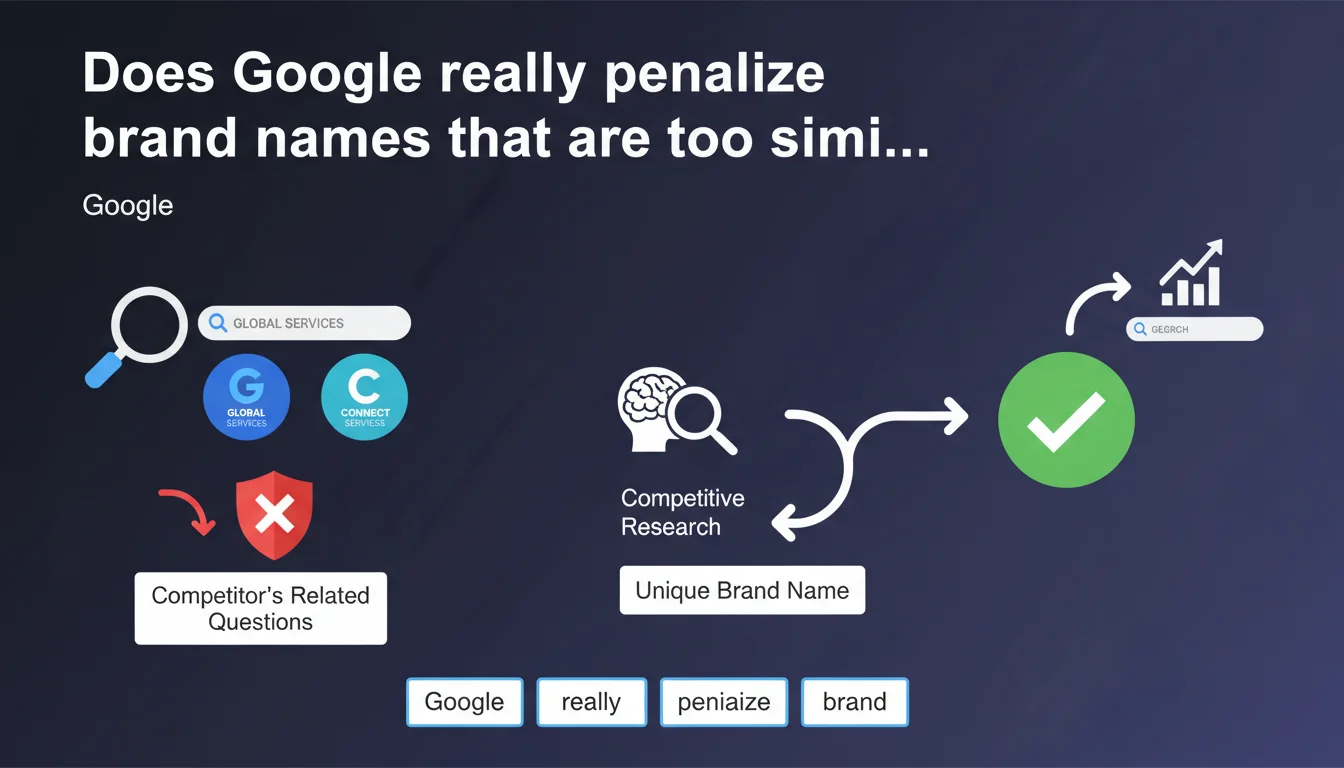
Google recommends avoiding company or service names too close to existing competitors to prevent being buried in their related questions or other SERP blocks. This directive aims to limit semantic confusion in search results, but raises the question: how far does Google go in intervening in branding choices for purely algorithmic reasons?
What you need to understand
Can Google really penalize a brand name that is too generic?
The statement is clear: choosing a name too close to an established player exposes you to visibility problems in the SERP. Concretely, your site risks appearing in a dominant competitor's related questions or carousels, diluting your own identity.
The search engine works through semantic associations: if two entities share a similar name, Google prioritizes the one with the most authority, mentions, and E-E-A-T signals. Result? You become an involuntary satellite of a stronger brand.
What technical mechanisms explain this confusion in search results?
Google relies on its Knowledge Graph to differentiate entities. If your name resembles an entity already indexed with thousands of signals (backlinks, press mentions, branded queries), the algorithm struggles to distinguish you.
The PAA (People Also Ask) and rich snippets aggregate content related to a search intent. With an ambiguous name, you risk being absorbed into a competitor's semantic ecosystem — and may never be able to extract yourself from it.
- Knowledge Graph: Google merges or confuses entities with similar names if differentiation signals are weak
- Branded queries: A similar name dilutes search volume on your own brand
- SERP blocks: PAA, carousels, featured snippets favor the dominant entity in case of ambiguity
- Competitive research: Google suggests monitoring before even launching — an admission that the algorithm doesn't self-correct these conflicts
Does this guideline also apply to product names and sub-brands?
Yes. A service or product name that's too generic faces the same fate. If you launch a feature called "Pro Dashboard" while a major competitor already has "ProDash", expect Google to mix the two in search results.
The recommendation also applies to subdomains, pillar pages, or entities structured via Schema.org. An Organization or Product markup with a name identical to an established entity won't be enough to force differentiation if other signals are missing.
SEO Expert opinion
Is this guideline realistic for saturated industries?
Google is asking companies here to do competitive research before they even exist. It's rational in theory, but unrealistic in certain sectors.
In fintech, B2B SaaS, or niche e-commerce, available names are becoming scarce. All "Verb + Noun" or "Adjective + Core Term" combinations are already taken. Result? Either you invent an absurd neologism, or you accept having to fight for existence despite the naming proximity. [To verify]: Google provides no tolerance threshold for similarity — 70% resemblance? 90%? No metric.
Do field observations confirm this dilution risk?
Yes, massively. We observe cases where recent brands with a name close to a leader see their branded queries cannibalized. Users typing "NewBrand reviews" land on PAA filled with content about "OldBrand".
Worse: some sites end up in a competitor's related entities in the Knowledge Panel. Google treats them as variants or sub-brands, even though they have no corporate relationship. It's a nightmare for organic branding.
What nuances should be added to this guideline?
Google doesn't say that any naming similarity is fatal. It talks about "names similar to other existing players" — which implies a notion of sector or context. Two companies with the same name in opposing verticals (e.g., "Nova" in insurance vs. "Nova" in cosmetics) may not necessarily pose a problem.
The real danger concerns players in the same semantic ecosystem. If you launch "CloudSync" while a competitor offers "CloudSynch" in the same SaaS sector, you're done for. But a "CloudSync" travel agency? Less risk — although Google could still mix them if queries are ambiguous.
Practical impact and recommendations
What should you concretely do before naming a brand or product?
Start with a multi-angle Google search: exact query in quotes, query without quotes, image search, Google News, Google Shopping if relevant. Check if a competitor already occupies the SERP with that name.
Then test variations: singular/plural, with/without hyphen, with/without capital letter. Google often treats these variations as identical. If "SuperApp" is taken, "Super-App" or "SuperApps" won't save you.
Also consult the Knowledge Graph via an entity search (e.g., "SuperApp company" or "SuperApp business"). If a Knowledge Panel already exists, it's a strong signal that the entity is established — you'll always be in a position of weakness.
- Exact Google search in quotes of the intended name
- Analysis of PAA and related entities in existing Knowledge Panels
- Verification of spelling and linguistic variations
- Testing simulated branded queries ("[name] reviews", "[name] price", "[name] alternative")
- Trademark registry consultation (USPTO, INPI) to cross legal and SEO concerns
- Schema.org audit: verify that no competing entity already uses this sameAs or name
How do you limit damage if the name is already in place?
If you've already launched with a problematic name, the priority is to differentiate the entity across all Google signals. This involves ultra-precise Schema.org markup (Organization + sameAs to social networks, Wikidata if possible), press mentions with the full and distinctive name, and a backlink strategy anchored to the exact name.
Also work on branded long-tail queries to establish your own semantic ecosystem. If Google sees 10,000 people searching "[YourName] + [unique feature]", it will eventually create a distinct entity. But it takes time — expect 6 to 12 months minimum.
Finally, use Google tools (Google My Business, Google Merchant Center, YouTube if applicable) to anchor the entity with verified profiles. The more cohesive signals Google sees pointing to a distinct entity, the more it differentiates.
What mistakes should you absolutely avoid in managing naming and SEO?
Never attempt to intentionally "squat" a name similar to a competitor hoping to capture their traffic. Google detects patterns of intentional confusion and may apply manual actions (rare, but observed in extreme trademark abuse cases).
Also avoid changing your name too often. Every rebrand breaks accumulated signals — backlinks, mentions, branded queries. If you pivot, implement flawless 301 redirects and a massive communication plan to transfer authority.
Managing naming SEO requires rigorous upstream competitive monitoring and a downstream semantic differentiation strategy. These mechanisms involve complex technical audits (Schema.org, Knowledge Graph, backlinks) and coordination between branding, legal, and SEO teams. If your team lacks resources or expertise in these areas, support from a specialized SEO agency can accelerate the process and prevent costly errors to fix later.
❓ Frequently Asked Questions
Google peut-il fusionner deux entités distinctes dans son Knowledge Graph à cause d'un nom similaire ?
Un nom de domaine différent suffit-il à éviter la confusion si le nom de marque est proche ?
Faut-il déposer une marque à l'INPI pour éviter les problèmes SEO liés aux noms similaires ?
Les balises Schema.org sameAs et alternateName peuvent-elles forcer Google à distinguer deux entités homonymes ?
Combien de temps faut-il pour que Google crée une entité distincte si on corrige le tir après un mauvais naming ?
🎥 From the same video 17
Other SEO insights extracted from this same Google Search Central video · published on 27/03/2025
🎥 Watch the full video on YouTube →
💬 Comments (0)
Be the first to comment.