
Official statement
Other statements from this video 29 ▾
- □ Un fichier robots.txt volumineux pénalise-t-il vraiment votre SEO ?
- □ Soumettre son sitemap dans robots.txt ou Search Console : y a-t-il vraiment une différence ?
- □ Les balises H1-H6 ont-elles encore un impact réel sur le classement Google ?
- □ Faut-il vraiment respecter une hiérarchie stricte des balises Hn pour le SEO ?
- □ Combien de temps faut-il réellement pour qu'une migration de domaine soit prise en compte par Google ?
- □ Une migration de site peut-elle vraiment booster votre SEO ou tout faire planter ?
- □ Googlebot crawle-t-il vraiment depuis un seul endroit pour indexer vos contenus géolocalisés ?
- □ Le noindex sur pages géolocalisées peut-il faire disparaître tout votre site des résultats Google ?
- □ Faut-il vraiment abandonner les redirections géolocalisées pour une simple bannière ?
- □ Faut-il créer des pages de destination pour chaque ville ou se limiter aux régions ?
- □ Faut-il rediriger les utilisateurs mobiles vers votre application mobile ?
- □ Faut-il vraiment traduire mot pour mot ses pages pour que le hreflang fonctionne ?
- □ Fichier Disavow : pourquoi la directive domaine permet-elle de contourner la limite de 2MB ?
- □ Faut-il vraiment utiliser le fichier Disavow uniquement pour les liens achetés ?
- □ Faut-il mettre en noindex ses pages de résultats de recherche interne pour bloquer les backlinks spam ?
- □ Le HTML sémantique booste-t-il vraiment votre référencement naturel ?
- □ AMP est-il encore un critère de ranking dans Google Search ?
- □ Supprimer AMP boost-t-il le crawl de vos pages classiques ?
- □ Faut-il tester la suppression de son fichier Disavow de manière incrémentale ?
- □ Pourquoi les panels de connaissance s'affichent-ils différemment selon les appareils ?
- □ Le système de synonymes de Google fonctionne-t-il vraiment sans intervention humaine ?
- □ Faut-il vraiment créer une page distincte par localisation pour le schema Local Business ?
- □ Faut-il vraiment marquer TOUT son contenu en données structurées ?
- □ Faut-il vraiment afficher toutes les questions du schema FAQ sur la page ?
- □ Le contenu masqué dans les accordéons peut-il vraiment apparaître dans les featured snippets ?
- □ Pourquoi Google ne veut-il pas indexer l'intégralité de votre site web ?
- □ Faut-il supprimer des pages pour améliorer l'indexation de son site ?
- □ Le volume de recherche des ancres influence-t-il vraiment la valeur d'un lien interne ?
- □ Faut-il vraiment ajouter du contenu unique sur vos pages produit en e-commerce ?
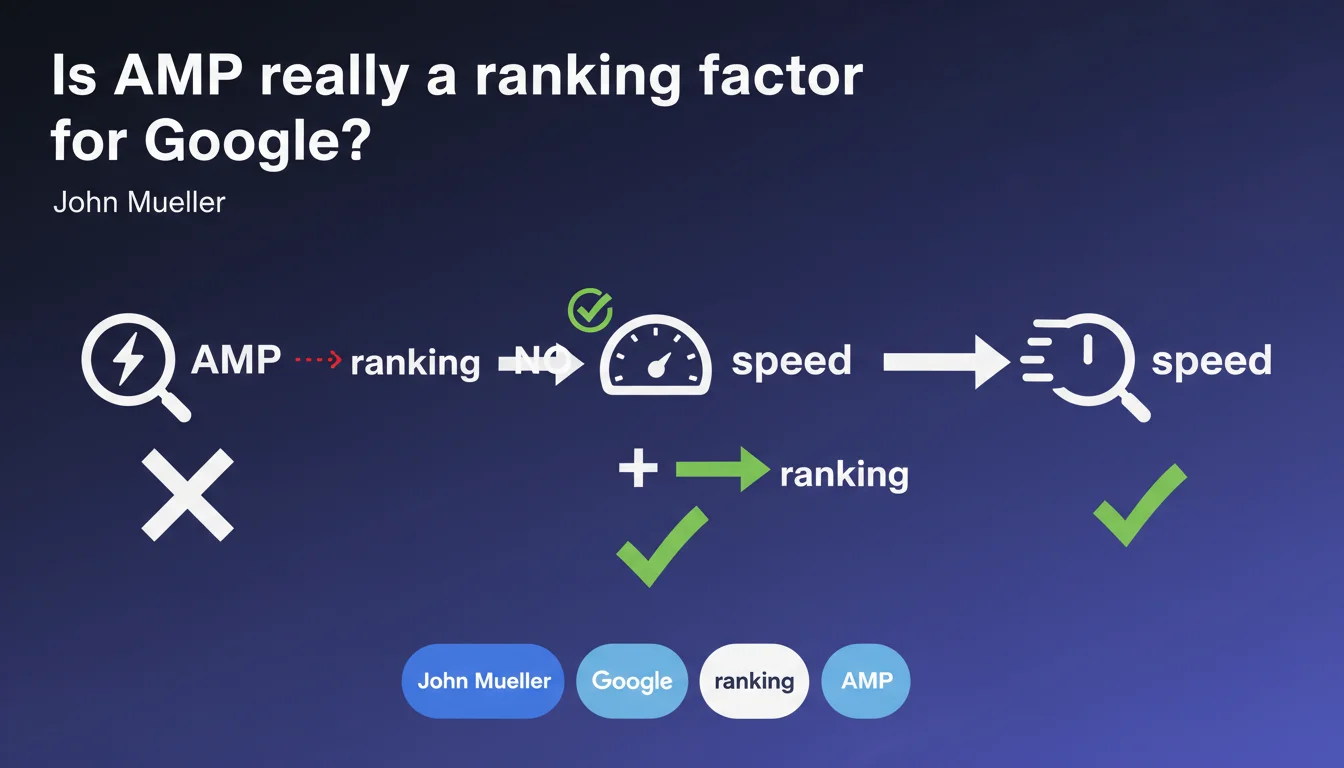
AMP is not a ranking factor according to Google. Migrating to AMP won't change your search positions. However, since AMP pages are often fast, it's the speed that matters, not the technology itself.
What you need to understand
Why does Google claim that AMP doesn't influence rankings?
John Mueller is crystal clear: AMP has never been a ranking signal. This statement puts an end to a persistent misconception in the SEO industry. Many believed that adopting AMP would guarantee a boost in the SERPs.
The confusion came from the fact that AMP was initially required to appear in the mobile news carousel — which created the illusion of an SEO advantage. Google has since abandoned this requirement.
So what's the actual relationship between AMP and performance in search results?
The nuance lies here: AMP pages are structurally optimized for speed. They typically load faster thanks to strict technical constraints (limited JavaScript, inline CSS, cached resources).
Now, page loading speed is indeed a ranking factor, particularly through Core Web Vitals. So there's an indirect advantage, not a privilege granted to the AMP technology itself.
Should you continue using AMP in 2025 and beyond?
The question now presents itself differently. If your only goal is SEO, AMP has no particular merit. A well-optimized standard HTML page will achieve the same results.
On the other hand, if you already have a functional AMP infrastructure and your pages are fast because of it, there's no point in tearing everything down. The real criterion remains performance as measured by Google.
- AMP is not a ranking signal — no direct advantage in the algorithm
- The speed of AMP pages explains their apparent performance
- Core Web Vitals are the real issue for rankings
- No need for AMP if your standard HTML pages are already fast
- The mobile news carousel no longer requires AMP since 2021
SEO Expert opinion
Is this statement consistent with what we observe in the field?
Absolutely. A/B tests conducted by several agencies show that a well-optimized standard HTML page performs as well as an equivalent AMP version. No significant difference in organic positions.
What blurred the picture for years was a deceptive correlation: sites that adopted AMP often did broader performance work. It was then difficult to distinguish the AMP effect from the pure speed effect.
What nuances should be added to this official message?
Google is intentionally simplifying. In certain contexts — media, news — AMP remains relevant for UX or ecosystem reasons, not for SEO. Cached AMP pages load nearly instantly from mobile SERPs.
But let's be honest: this UX advantage is eroding. With the general improvement of mobile web and technologies like prefetching, the gap is narrowing. AMP is losing its reason for being.
[To verify] : some still observe slightly higher click-through rates for AMP pages in mobile SERPs, probably linked to the lightning bolt icon — but that's not ranking, it's CTR. Google doesn't document this point.
In what cases might this rule not be sufficient?
If your site has massive technical debt and the dev team can't optimize Core Web Vitals, AMP can serve as a temporary workaround. You force performance through technical constraints.
But it's a band-aid. In the long run, it's better to clean up the source code, optimize JavaScript, and work on fundamentals. AMP then becomes unnecessary.
Practical impact and recommendations
Should you migrate your site to AMP to improve your SEO?
No. If your motivation is purely SEO, don't go down the AMP route. Instead, focus on optimizing the Core Web Vitals of your standard HTML pages.
The resources you would have invested in an AMP migration will be much better spent improving LCP, reducing CLS, and optimizing FID/INP. That's where performance-related ranking is decided.
If I'm already using AMP, should I get rid of everything?
Not necessarily. If your AMP pages are performing well and maintenance is under control, there's no urgent need to tear everything down. The lack of SEO advantage doesn't mean a disadvantage.
However, honestly evaluate the cost/benefit ratio. If you're maintaining two versions of each page without a clear strategic reason, you're probably wasting resources.
What concrete actions can you take to optimize speed without AMP?
Measure first. Use PageSpeed Insights and Chrome UX Report to identify your real bottlenecks. Don't start optimizing blindly.
Then tackle the quick wins: image compression (WebP), lazy loading, reducing render-blocking JavaScript, effective caching. These levers often yield 70% of gains for 30% of effort.
- Measure your current Core Web Vitals via PageSpeed Insights and Search Console
- Prioritize image optimization (WebP format, compression, lazy loading)
- Eliminate unnecessary JavaScript and defer loading of non-critical content
- Enable Gzip/Brotli compression on your server
- Implement a CDN if your audience is geographically dispersed
- Test your pages on actual mobile connections (not just WiFi)
- Monitor your metrics over time, not just a single snapshot
- If you use AMP, evaluate the real maintenance cost vs UX benefits
Speed optimization without AMP relies on solid technical fundamentals. For complex sites or teams lacking internal expertise, these projects can quickly become time-consuming and require specialized skills.
Engaging a specialized SEO agency often allows you to accelerate these optimizations with an external perspective and proven methodology, especially when it comes to balancing performance with specific business constraints.
❓ Frequently Asked Questions
AMP améliore-t-il le taux de clic dans les SERP mobiles ?
Les pages AMP sont-elles encore requises pour le carrousel d'actualités ?
Peut-on perdre des positions en supprimant AMP d'un site ?
AMP compte-t-il pour les Core Web Vitals ?
Y a-t-il encore un intérêt à utiliser AMP en dehors du SEO ?
🎥 From the same video 29
Other SEO insights extracted from this same Google Search Central video · published on 14/01/2022
🎥 Watch the full video on YouTube →
💬 Comments (0)
Be the first to comment.