
Official statement
Other statements from this video 13 ▾
- 3:25 Why don't valid rich results guarantee visibility in Job Search?
- 5:14 Does the employmentType field in JobPosting structured data really impact query matching?
- 10:28 Is it really necessary to have strictly identical content between mobile and desktop for Mobile-First Indexing?
- 10:28 Does hiding mobile content with CSS really sabotage your Mobile-First indexing?
- 19:07 Is it true that hidden content in accordions and tabs is indexed by Google?
- 19:07 Why is Google so silent about massive indexing problems?
- 19:07 Google Office Hours: Why might your SEO question never get answered?
- 24:24 Why does the number of URLs in Search Console's Web Vitals vary each month?
- 25:24 Why are your Page Experience metrics fluctuating when you haven't changed anything?
- 31:07 Are geo-targeted redirects using cookies considered cloaking by Google?
- 31:07 Should you really ditch geolocation redirects in favor of hreflang?
- 31:07 Do IP redirections really block the indexing of your multilingual content?
- 48:33 Could A/B testing actually risk cloaking in Google's eyes?
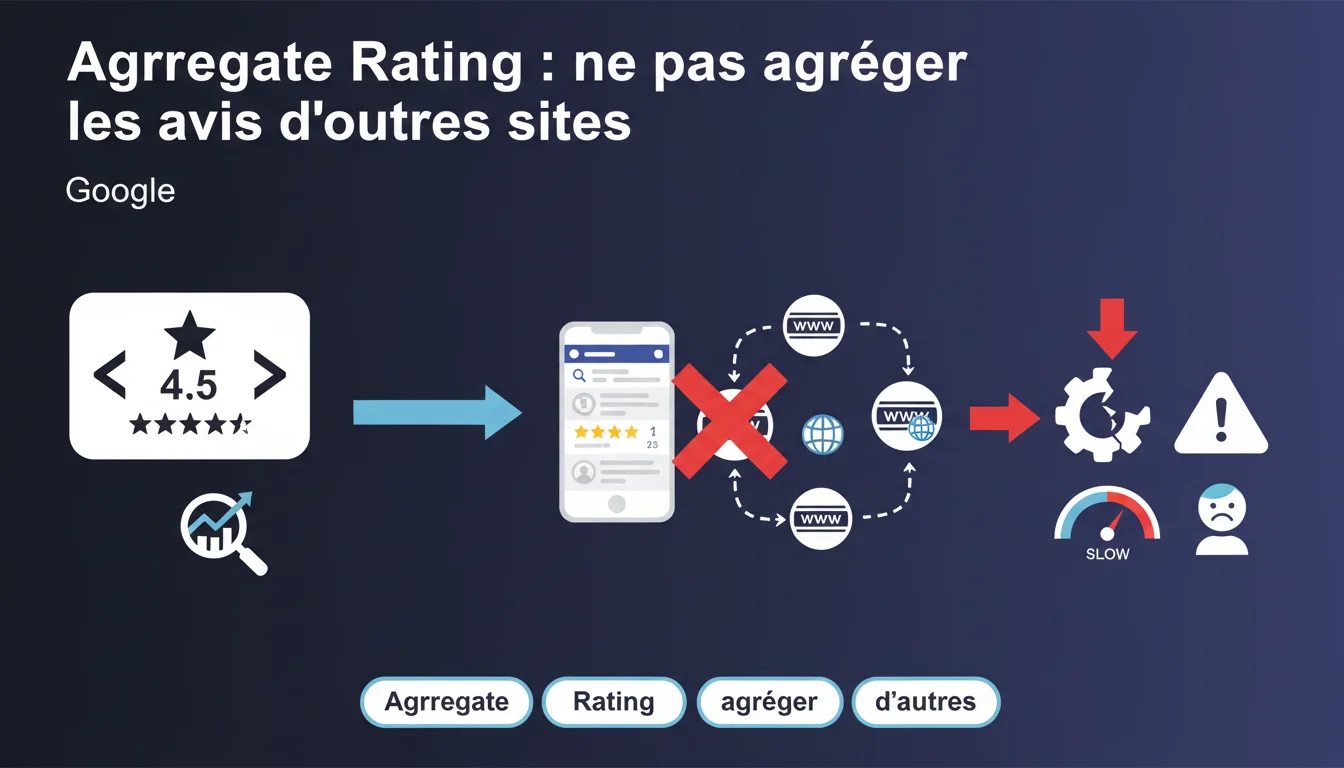
Google explicitly prohibits including reviews from other sites or third-party platforms in your Aggregate Rating structured data. This practice violates the guidelines and exposes you to manual or algorithmic penalties. Only reviews collected directly on your own site or service are allowed.
What you need to understand
What exactly does "aggregating reviews from other sites" mean?
This prohibition targets the practice of sucking or copying reviews published on third-party platforms (Google Reviews, Trustpilot, Verified Reviews, etc.) to integrate them into your own structured data. In practical terms: if you are an e-commerce merchant and you retrieve ratings left on Amazon or Google My Business to display on your site with AggregateRating markup, you are violating the rules.
Google wants structured data to only reflect reviews collected in-house, meaning on your platform, your internal rating system. The goal: to prevent search results from being polluted by misleading, duplicated, or manipulated stars.
Why is Google tightening its stance on this issue?
There are two major reasons. The first: manipulation of rich snippets. Some sites aggregate thousands of reviews from reputable platforms to artificially display 4.8/5 stars in the SERPs, even though they have never collected a single customer feedback directly. This skews competition and degrades user experience.
The second reason, more technical: Google does not want to index the same reviews multiple times. If each aggregator republishes the same content with structured markup, the engine ends up with duplicated content on a large scale. This complicates its deduplication work and harms relevance.
What exceptions does Google allow?
There are almost none for regular sites. However, third-party review platforms themselves (Trustpilot, Yelp, TripAdvisor) can legitimately markup their own content — as they are the ones who collect and host the original reviews.
If you are a reseller, distributor, or affiliate, you cannot appropriate the ratings from the manufacturer or marketplace. Even if these reviews concern a product you sell, they do not come from your own collection system.
- Only reviews collected on your own site/service can be marked up as AggregateRating
- Sucking reviews from third-party platforms (Google, Trustpilot, Amazon, etc.) violates the guidelines
- Review platforms themselves can markup their own content without restriction
- No tolerance for aggregators, resellers, or affiliates who republish external ratings
- Possible penalties: loss of rich snippets, manual action, or even partial deindexation
SEO Expert opinion
Is this prohibition really enforced in practice?
Let's be honest: we still see a lot of sites marking up aggregated reviews without suffering visible penalties. The reason? Google detects this violation primarily during manual actions, triggered by reports or targeted audits. Large-scale algorithmic enforcement remains patchy.
That said, several waves of penalties have hit price comparison sites and e-commerce sites in recent years. The result: immediate loss of stars in the SERPs, drop in CTR, negative impact on organic traffic. The risk is indeed real, even if it is not systematic.
What nuances should be added to this rule?
Google does not provide any precise definition of what constitutes a "review collected in-house." If you use a third-party widget (e.g., Verified Reviews, Trusted Shops) to collect reviews on your own transactions, are you compliant? [To be verified] — Google has never clearly stated its position on this borderline case.
Similarly, what about multi-vendor marketplaces? If you are Amazon or Cdiscount and a third-party seller uses your rating system, can they markup those reviews on their own external store? Again, total gray area. Logic would suggest no, but no official documentation clarifies it.
If you are a review platform itself (Trustpilot, Yelp, etc.), you can markup your own content without restriction — it's even recommended. The same goes for recognized specialized aggregators by Google as legitimate sources (e.g., Rotten Tomatoes for movies).
However, if you republish these reviews on a third-party site, even with source attribution, you fall under the prohibition. Citing the source does not exempt you — it is the aggregation itself that poses the problem.In what cases does this rule not apply?
Practical impact and recommendations
What should you do to remain compliant?
First step: audit your existing structured data. Inspect all your AggregateRating and Review markups to ensure that the reviews originate from your own collection system. If you have aggregated content from other platforms, immediately remove the corresponding markup.
Next, establish a system for collecting in-house reviews. This could be through a custom module, a WordPress plugin, or a third-party solution like Verified Reviews — provided the reviews are collected for you and not republished from elsewhere.
What mistakes should be absolutely avoided?
The classic mistake: displaying Google My Business reviews on your site with structured markup. Even if these reviews concern your business, they are hosted on Google, not on your own site. You cannot markup them. Display them visually if you want, but without Schema.org markup.
Another pitfall: the improperly configured Trustpilot or Verified Reviews widgets. Some automatically inject JSON-LD with the platform's ratings. If you haven't verified that these reviews are collected through your own account (and not aggregated), you are potentially out of compliance.
How can I check if my site is compliant?
Use Google's Rich Results Test to inspect your pages. Verify that each marked review corresponds to content actually published on your site, by your users, through your system. If not, remove the markup.
Then, check Search Console, under the "Enhancements" section. Google sometimes reports structured data issues there, although this detection is not exhaustive. When in doubt, adopt a conservative stance: it's better not to markup than to risk a penalty.
- Audit all existing AggregateRating and Review markups
- Immediately remove any markup related to external reviews (Google, Trustpilot, Amazon, etc.)
- Implement a system for collecting in-house reviews (internal module or dedicated third-party solution)
- Verify the configuration of third-party widgets to ensure they only markup your own reviews
- Regularly test with Rich Results Test and monitor Search Console
- In case of an auto-injecting widget (Trustpilot, etc.), disable automatic JSON-LD if necessary
- Document the origin of each marked review to justify in case of a manual audit
❓ Frequently Asked Questions
Puis-je baliser les avis Google My Business de mon établissement sur mon site ?
Si j'utilise Trustpilot pour collecter mes avis, puis-je les baliser ?
Quel est le risque si je balis des avis externes ?
Les marketplaces peuvent-elles baliser les avis de leurs vendeurs tiers ?
Comment savoir si mes avis sont conformes ?
🎥 From the same video 13
Other SEO insights extracted from this same Google Search Central video · published on 21/12/2021
🎥 Watch the full video on YouTube →
💬 Comments (0)
Be the first to comment.