
Official statement
Other statements from this video 13 ▾
- 3:25 Pourquoi des rich results valides ne garantissent-ils pas l'affichage dans Job Search ?
- 5:14 Le champ employmentType dans les données structurées JobPosting influence-t-il le matching des requêtes ?
- 7:19 Peut-on agréger les avis d'autres sites dans ses données structurées Rating ?
- 10:28 Faut-il vraiment avoir un contenu strictement identique entre mobile et desktop pour le Mobile-First Indexing ?
- 10:28 Pourquoi masquer du contenu mobile en CSS sabote-t-il votre indexation Mobile-First ?
- 19:07 Le contenu masqué dans des accordéons et des onglets est-il vraiment indexé par Google ?
- 19:07 Pourquoi Google reste-t-il muet face aux problèmes d'indexation massifs ?
- 19:07 Google Office Hours : pourquoi votre question SEO ne recevra-t-elle peut-être jamais de réponse ?
- 24:24 Pourquoi le nombre d'URLs dans Web Vitals de Search Console varie-t-il chaque mois ?
- 25:24 Pourquoi vos métriques Page Experience fluctuent-elles alors que vous n'avez rien changé ?
- 31:07 Faut-il vraiment abandonner les redirections géolocalisées au profit du hreflang ?
- 31:07 Les redirections IP bloquent-elles vraiment l'indexation de vos contenus multilingues ?
- 48:33 Les tests A/B posent-ils un risque de cloaking aux yeux de Google ?
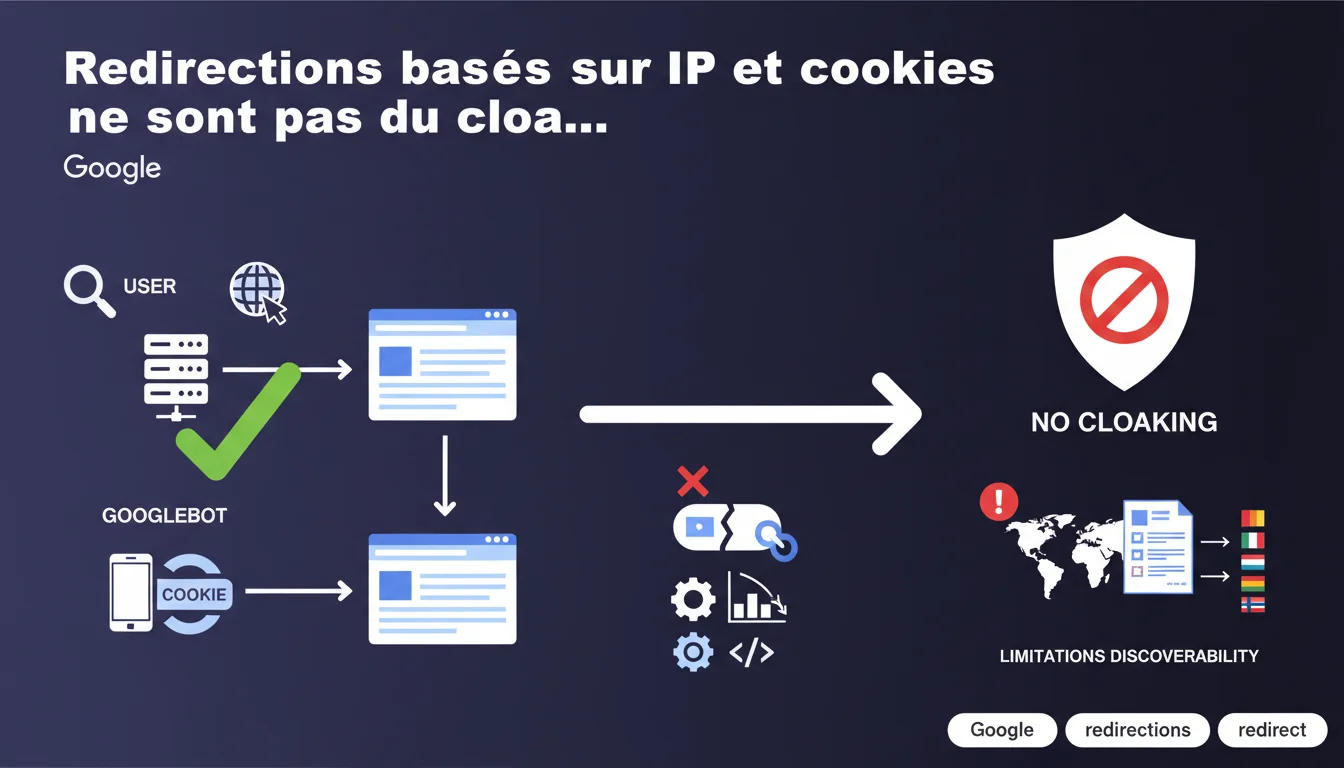
Google confirms that redirecting users based on their geolocation via cookies is not cloaking, provided Googlebot accesses the same content as visitors. The key issue: this practice can seriously limit the discoverability and indexing of your alternative language versions.
What you need to understand
Why is there a distinction between geolocation and cloaking?<\/h3>
Cloaking involves deliberately serving different content<\/strong> to Googlebot and users with the intent of manipulating search results. Google tolerates geo-targeted redirects because their intention is not to deceive the engine, but to enhance user experience by adapting content to their language or region.<\/p> The crucial nuance: as long as Googlebot can access the same content as an average user without restrictions, there is no deception. The bot must be able to see all versions of your site exactly as your visitors do.<\/p> Google points out a major collateral effect<\/strong>: if you consistently redirect based on geolocation, Googlebot — which primarily crawls from the United States — risks only discovering one language version of your site. Your French, German, or Japanese versions remain invisible.<\/p> This limitation directly affects your ability to rank in multiple countries or languages<\/strong>. Google cannot index what it cannot see, no matter how well your hreflang tags are implemented.<\/p> An IP-based redirect detects the visitor's geographic location via their network address. A cookie redirect stores a user preference (language, region) and redirects on subsequent visits.<\/p> In both cases, Google applies the same rule: no cloaking if Googlebot accesses the same content. But the issue of discoverability of alternative versions<\/strong> persists with both methods.<\/p>What does this change for indexing in practical terms?<\/h3>
What is the difference between IP redirect and cookie redirect?<\/h3>
SEO Expert opinion
Is this statement consistent with observed practices in the field?<\/h3>
Yes, this position from Google is consistent with years of observation<\/strong>. International e-commerce sites that redirect by IP without blocking Googlebot generally do not suffer manual penalties for cloaking. The real problem lies elsewhere: in incomplete indexing.<\/p> I have seen dozens of multilingual sites losing rankings across entire markets because Google had never crawled their local versions. The bot lands on .com/en, gets redirected, and never discovers .com/fr or .com/de. [To be verified]<\/strong>: Google claims that its crawlers can "sometimes" crawl from other locations, but no public data specifies the frequency or conditions.<\/p> Google says “no cloaking,” but does not say “no problem.” This distinction is crucial. A technically compliant site can be structurally invisible<\/strong> to part of its target audience.<\/p> Another critical nuance: the wording “Googlebot sees the same content” is ambiguous. If Googlebot from Mountain View accesses your US version and a French user on the same URL accesses the FR version after redirection, technically there is a difference. Google seems to tolerate this difference as long as it is not based on user-agent<\/em>.<\/p> This tolerance collapses if you use geolocation to hide spam<\/strong>, duplicate content across domains, or manipulate search results. Google does not forgive dishonest intents, even under the guise of UX improvement.<\/p> Similarly, if your redirect actively prevents Googlebot from accessing certain versions (for example, by blocking US IPs on your .fr pages), you fall into formal prohibition. Total transparency is the only way out.<\/p>What nuances should be added to this statement?<\/h3>
In what cases does this rule not apply?<\/h3>
Practical impact and recommendations
What concrete steps should be taken to avoid indexing problems?<\/h3>
The most robust solution: never redirect automatically<\/strong>. Offer a language/region banner or suggestion, but let the user — and Googlebot — freely access all URLs. This has been Google's recommended method for years.<\/p> If you absolutely must redirect, ensure that each language version has distinct and accessible canonical URLs<\/strong> without redirection. Create language-specific sitemaps, submit them in Search Console with appropriate geographic targeting. Googlebot should be able to crawl /fr/, /de/, /es/ directly without passing through an IP filter.<\/p> Test your URLs using the URL Inspection Tool<\/strong> in Search Console. Check that Googlebot can access each language version without being redirected. If you see a consistent 301/302 redirect, this is a warning sign.<\/p> Analyze your coverage reports<\/strong> by Search Console property (ideally one per language version). If certain versions display zero indexed pages or unreasonably low volumes, your redirect system is likely blocking discovery.<\/p>How can I check if my site is compliant and well indexed?<\/h3>
❓ Frequently Asked Questions
Puis-je rediriger automatiquement mes visiteurs français vers /fr/ sans risquer une pénalité ?
Les balises hreflang suffisent-elles si j'utilise des redirections par IP ?
Googlebot crawle-t-il depuis plusieurs pays pour tester mes redirections ?
Est-ce que détecter la langue du navigateur (Accept-Language) est considéré comme du cloaking ?
Quelle est la meilleure alternative aux redirections automatiques pour un site multilingue ?
🎥 From the same video 13
Other SEO insights extracted from this same Google Search Central video · published on 21/12/2021
🎥 Watch the full video on YouTube →Related statements
Get real-time analysis of the latest Google SEO declarations
Be the first to know every time a new official Google statement drops — with full expert analysis.
💬 Comments (0)
Be the first to comment.