
Official statement
Other statements from this video 13 ▾
- 3:25 Pourquoi des rich results valides ne garantissent-ils pas l'affichage dans Job Search ?
- 5:14 Le champ employmentType dans les données structurées JobPosting influence-t-il le matching des requêtes ?
- 7:19 Peut-on agréger les avis d'autres sites dans ses données structurées Rating ?
- 10:28 Faut-il vraiment avoir un contenu strictement identique entre mobile et desktop pour le Mobile-First Indexing ?
- 10:28 Pourquoi masquer du contenu mobile en CSS sabote-t-il votre indexation Mobile-First ?
- 19:07 Le contenu masqué dans des accordéons et des onglets est-il vraiment indexé par Google ?
- 19:07 Pourquoi Google reste-t-il muet face aux problèmes d'indexation massifs ?
- 19:07 Google Office Hours : pourquoi votre question SEO ne recevra-t-elle peut-être jamais de réponse ?
- 24:24 Pourquoi le nombre d'URLs dans Web Vitals de Search Console varie-t-il chaque mois ?
- 25:24 Pourquoi vos métriques Page Experience fluctuent-elles alors que vous n'avez rien changé ?
- 31:07 Les redirections géolocalisées par cookies sont-elles considérées comme du cloaking par Google ?
- 31:07 Faut-il vraiment abandonner les redirections géolocalisées au profit du hreflang ?
- 31:07 Les redirections IP bloquent-elles vraiment l'indexation de vos contenus multilingues ?
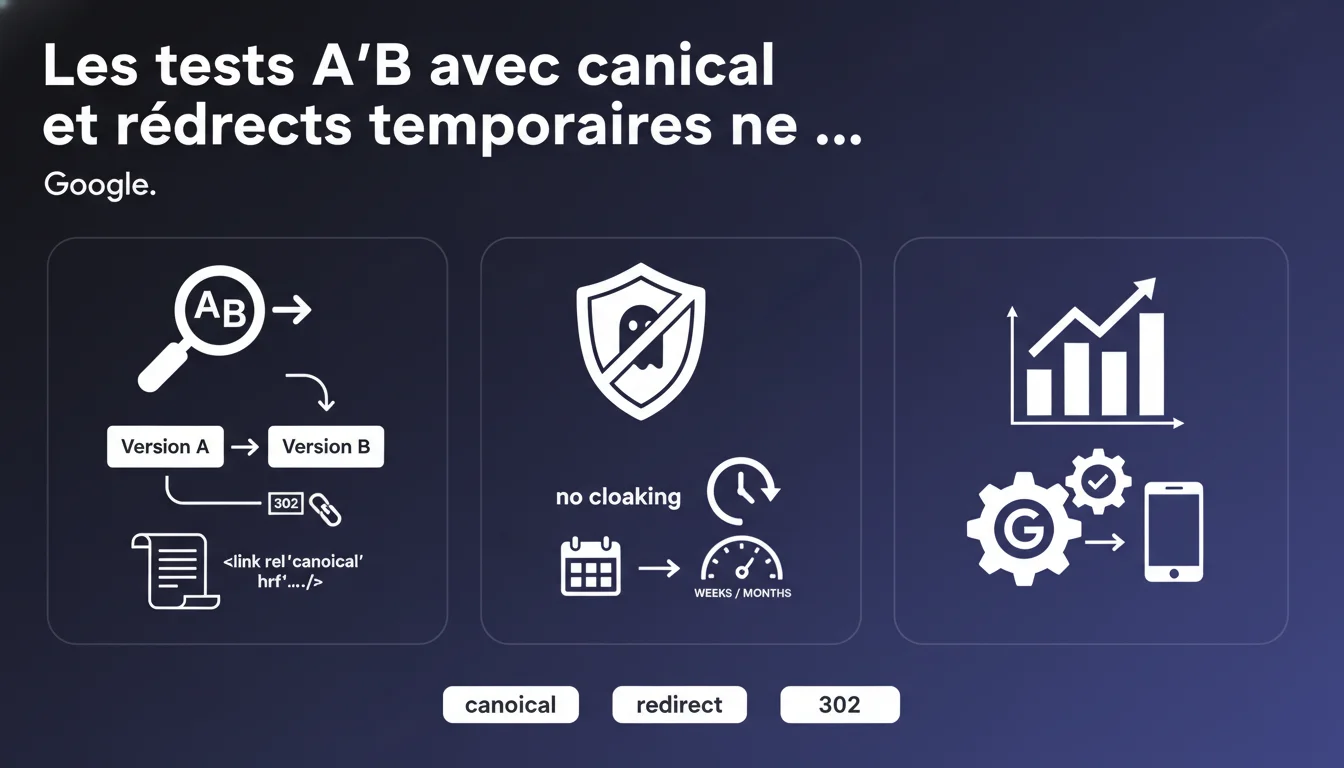
Google confirms that A/B tests adhering to the official guidelines (canonical to the original, 302 redirects) are not considered cloaking, even over several months. The key condition: serve consistent content to both users and the bot without any intentional ranking manipulation.
What you need to understand
Why is Google making this clarification now?
A/B testing has always been a gray area for many SEOs. The idea of serving different versions of the same page based on the user immediately evokes cloaking — a blackhat practice that involves showing one content to Google and another to visitors.
This official statement aims to clear up the ambiguity: as long as you follow the technical recommendations (canonical, temporary redirects), you are not engaging in manipulation. Google clearly distinguishes legitimate UX optimization from deliberate deception.
What exactly are these official recommendations?
For an A/B test to be compliant, you must:
- Use a canonical tag pointing to the original URL on all variants
- Implement 302 redirects (temporary) if you redirect part of the traffic
- Serve the same content to Googlebot as to users — no special bot version
- Not prolong tests indefinitely: a few weeks to a few months, not years
Does the duration of the test really matter?
Google specifies that several weeks or months are not problematic. But be careful: a test dragging on for a year starts to look like a disguised permanent implementation.
If your variant B remains in place six months after the test ends, Google might consider you are serving different content permanently — and at that point, there is a risk of penalty. The blurry limit remains intentional on Google's part.
SEO Expert opinion
Is this position consistent with observed field practices?
Yes and no. In practice, I've seen sites run A/B tests for six to eight months without any visible penalties. But I've also noted situations where Google ignored the canonicals and indexed the variants — creating unwanted duplicate content.
The real trap? Google says "as long as the guidelines are followed," but does not precisely quantify what "several months" means. Four months, OK. Ten months? [To be verified] — no one has an official quantified answer.
What nuances should be added to this statement?
Google refers to classic A/B tests: you're testing a title, a CTA, a layout. What isn't covered here are tests that substantially alter the semantic content of the page — for instance, completely changing the editorial angle or targeted keywords.
If your variant B targets "running shoes" while the original targets "sport sneakers," you are changing the intent. Even with canonical and 302, you are navigating murky waters. Google might interpret this as an attempt to manipulate SERPs for different queries.
In what cases does this rule not apply?
If you intentionally serve different content to Googlebot — for example, an ultra-optimized version for the bot and a streamlined version for humans — that's pure cloaking. It doesn't matter if you call it a "test."
Similarly, if you use 301 redirects (permanent) instead of 302, you indicate to Google that the change is permanent. The canonical becomes obsolete, and you risk having the variant replace the original in the index. It's no longer a test; it's a botched migration.
Practical impact and recommendations
What actionable steps can you take to secure your A/B tests?
Before launching a test, ask yourself: am I changing the search intent of the page? If yes, you are stepping outside Google's "safe" framework. Purely UX tests (colors, layouts, CTAs) pose no issues.
Technically, ensure that your testing tool (Optimizely, VWO, Google Optimize, etc.) correctly injects the right canonical tags and does not block Googlebot. Some poorly configured JavaScript tools may prevent the bot from seeing the original content — and in that case, you are in inadvertent violation.
What mistakes should be avoided at all costs?
- Never leave a test running without a defined end date — set a deadline (3 months max recommended)
- Do not redirect Googlebot to a specific version — it must see the same distribution as users
- Do not use 301 redirects for an A/B test — always use 302
- Do not test major keyword changes or editorial angles — maintain stable intent
- Do not multiply indexable variants — one original plus variants with canonical is sufficient
How can you verify that your implementation is compliant?
Use the Search Console to inspect the URL of your variants. Google should recognize the canonical and indicate "Alternative page with correct canonical tag." If you see "Indexed, though blocked by robots.txt" or "Detected, currently not indexed" for a variant, investigate further.
Also test with a Googlebot user-agent (via a tool like Screaming Frog in bot mode) to ensure that the bot's render matches what humans see. No hidden content, no simplified version for the crawler.
In summary: A/B testing is allowed and does not constitute cloaking if you adhere to technical best practices. However, the boundary between a legitimate test and manipulation remains blurry — caution dictates limiting duration, not altering search intent, and monitoring indexing closely.
These configurations can quickly become complex, especially on high-traffic sites or with heavy technical stacks. If you are not absolutely certain about your implementation, having your tests audited by a specialized SEO agency can prevent costly mistakes — and above all, allow you to fully leverage optimization potential without risking a penalty.
❓ Frequently Asked Questions
Puis-je faire un test A/B permanent si je garde les canonical et redirects 302 ?
Est-ce que tester deux titres H1 différents pose un risque de cloaking ?
Mon outil de test A/B JavaScript bloque-t-il Googlebot ?
Combien de temps maximum peut durer un test A/B selon Google ?
Dois-je déclarer mes tests A/B à Google d'une manière ou d'une autre ?
🎥 From the same video 13
Other SEO insights extracted from this same Google Search Central video · published on 21/12/2021
🎥 Watch the full video on YouTube →
💬 Comments (0)
Be the first to comment.