
Official statement
Other statements from this video 13 ▾
- 3:25 Pourquoi des rich results valides ne garantissent-ils pas l'affichage dans Job Search ?
- 7:19 Peut-on agréger les avis d'autres sites dans ses données structurées Rating ?
- 10:28 Faut-il vraiment avoir un contenu strictement identique entre mobile et desktop pour le Mobile-First Indexing ?
- 10:28 Pourquoi masquer du contenu mobile en CSS sabote-t-il votre indexation Mobile-First ?
- 19:07 Le contenu masqué dans des accordéons et des onglets est-il vraiment indexé par Google ?
- 19:07 Pourquoi Google reste-t-il muet face aux problèmes d'indexation massifs ?
- 19:07 Google Office Hours : pourquoi votre question SEO ne recevra-t-elle peut-être jamais de réponse ?
- 24:24 Pourquoi le nombre d'URLs dans Web Vitals de Search Console varie-t-il chaque mois ?
- 25:24 Pourquoi vos métriques Page Experience fluctuent-elles alors que vous n'avez rien changé ?
- 31:07 Les redirections géolocalisées par cookies sont-elles considérées comme du cloaking par Google ?
- 31:07 Faut-il vraiment abandonner les redirections géolocalisées au profit du hreflang ?
- 31:07 Les redirections IP bloquent-elles vraiment l'indexation de vos contenus multilingues ?
- 48:33 Les tests A/B posent-ils un risque de cloaking aux yeux de Google ?
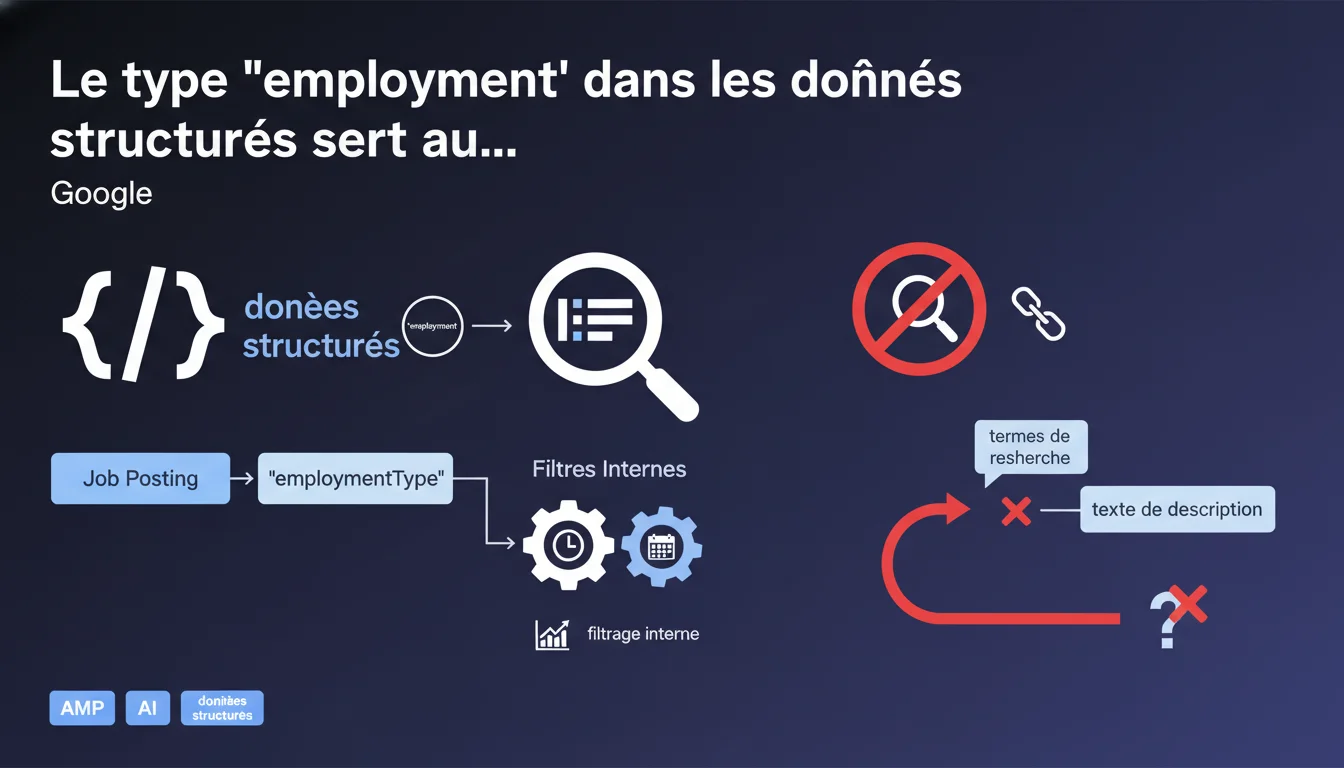
Google confirms that the 'employmentType' field in JobPosting structured data is used solely for internal filters (full-time, part-time, etc.). It does not play a role in the semantic matching between user queries and job description content. This distinction has direct implications on how you structure your job listings.
What you need to understand
What is the real role of the employmentType field? <\/h3>\n\n
The employmentType<\/strong> field in the JobPosting schema functions as a meta-filter<\/strong>. Google uses it to feed filtering options in the job search interface: a user can check 'Full-time' or 'Freelance', and the engine will use this property to display or hide results.<\/p>\n\n This field is not considered in the textual matching algorithm<\/strong>. If someone types 'full-time Python developer job', Google will not match 'full-time' with the employmentType field value — it will seek this expression in the title, description, or other free text areas.<\/p>\n\n Because it clarifies where to place your semantic signals<\/strong>. If you stuff the employmentType field with lexical variants ('full-time', 'temps plein', 'CDI'), it is pointless. This field expects standardized values from the Schema.org vocabulary: FULL_TIME, PART_TIME, CONTRACTOR, etc.<\/p>\n\n The matching occurs elsewhere — in the textual description<\/strong>, job title, qualifications. That’s where you should focus your semantic and lexical optimization efforts.<\/p>\n\n This statement invites you to clearly separate<\/strong> filtering metadata (employmentType, datePosted, validThrough) from semantic content (description, title, responsibilities). The former serves navigation and filtering in the interface; the latter feeds the matching algorithm.<\/p>\n\n Specifically? If you manage a job site with thousands of listings, you can automate the filling of the employmentType field with simple rules (contract type = CDI → FULL_TIME) and focus your editorial resources on the quality and semantic richness of the descriptions.<\/p>Why is this distinction important for SEO practitioners? <\/h3>\n\n
\n
What are the implications for the architecture of your structured data? <\/h3>\n\n
SEO Expert opinion
Is this statement consistent with practices observed in the field? <\/h3>\n\n
Yes, and it’s even reassuring. It has long been observed that Google handles enumerated fields<\/strong> (like employmentType) differently from text fields<\/strong> (like description). The former serve for internal taxonomy, while the latter are for NLP and ranking.<\/p>\n\n On sites I've audited, adding lexical variants in employmentType ('temps plein', 'full time', 'à temps complet') never improved organic traffic on queries containing those terms. In contrast, enriching the description with relevant industry vocabulary consistently had a positive impact.<\/p>\n\n Google says that the field 'does not serve to match search terms.' But be careful: that does not mean it is optional<\/strong>. If you do not fill out employmentType, your listing will never appear in the 'Full-time' or 'Freelance' filters, drastically reducing visibility for users who are actively filtering.<\/p>\n\n Another nuance: Google does not clarify whether this field indirectly influences CTR or conversion rates. [To be verified]<\/strong> A well-categorized ad could have better engagement, which would send positive signals to the algorithm. This isn’t direct matching, but a potential side effect.<\/p>\n\n If Google strengthens the integration of its filters with NLP — for example, by automatically detecting that a search for 'part-time job' should activate the PART_TIME filter — we could imagine a form of indirect matching<\/strong>. But for now, there is no signal pointing in that direction.<\/p>\n\n The statement is clear and unambiguous. As long as Google maintains a clear separation between structured filters and textual matching, this rule will remain stable.<\/p>What nuances should be made to this statement? <\/h3>\n\n
In what cases could this rule evolve? <\/h3>\n\n
Practical impact and recommendations
What should you concretely do with the employmentType field? <\/h3>\n\n
Fill it systematically<\/strong> with a normalized Schema.org value. This is non-negotiable if you want your listings to appear in Google’s job search filters.<\/p>\n\n Avoid fanciful values or free text strings. If you use 'full-time' instead of 'FULL_TIME', Google won’t be able to utilize it correctly. Adhere to the vocabulary defined in the Schema.org JobPosting specification.<\/p>\n\n The classic mistake: believing that stuffing this field<\/strong> with synonyms or translations will improve SEO. No. This field is a checkbox in an internal taxonomy, not a vector for semantic matching.<\/p>\n\n Another pitfall: neglecting text fields (description, responsibilities, qualifications) in favor of over-structuring. It’s the opposite that should be done. Structured data organizes the information; free text makes it discoverable and relevant<\/strong> for long-tail queries.<\/p>\n\n Use the Rich Results Test<\/strong> from Google to validate that your structured data is correctly formatted. Check that the employmentType field only contains normalized values, without free text or lexical variations.<\/p>\n\n Then, conduct a job search on Google with filters enabled ('Full-time', 'Freelance', etc.) and verify that your listings appear in the correct segments. If they do not, it is likely that the employmentType field is incorrectly filled.<\/p>\n\n The employmentType field serves exclusively for Google’s internal filters. Fill it with normalized Schema.org values, and focus your semantic optimization efforts on the text fields (description, title, qualifications). If managing structured data at scale seems complex — especially to synchronize normalized values with your internal database while optimizing textual content for semantic matching — hiring a specialized SEO agency can save you valuable time and avoid costly visibility errors.<\/p><\/div>\n
What mistakes to avoid when implementing JobPosting structured data? <\/h3>\n\n
\n
How to verify that your implementation is compliant? <\/h3>\n\n
❓ Frequently Asked Questions
Puis-je utiliser plusieurs valeurs dans le champ employmentType pour une même annonce ?
Que se passe-t-il si je ne remplis pas le champ employmentType ?
Est-ce que le champ employmentType influence le ranking des annonces dans les résultats organiques ?
Dois-je répéter les informations de type d'emploi dans la description textuelle ?
Les plateformes d'emploi tierces (Indeed, LinkedIn) utilisent-elles employmentType de la même manière ?
🎥 From the same video 13
Other SEO insights extracted from this same Google Search Central video · published on 21/12/2021
🎥 Watch the full video on YouTube →Related statements
Get real-time analysis of the latest Google SEO declarations
Be the first to know every time a new official Google statement drops — with full expert analysis.
💬 Comments (0)
Be the first to comment.