
Official statement
Other statements from this video 14 ▾
- □ Does a 403 error on mobile really block your entire site from being indexed by Google?
- □ Do 404 errors and 301 redirects really hurt your SEO rankings?
- □ Does the canonical tag really prevent your pages from being indexed?
- □ Is Google really seeing your prices in US dollars by default?
- □ Why does Google treat hreflang and canonical tags as two completely separate mechanisms?
- □ Does the disavow tool really delete toxic backlinks from Google's index?
- □ How can you create unique content for identical products without falling into duplicate content traps?
- □ Should you really verify each subdomain separately in Search Console?
- □ Do you really need to worry about a high volume of 404 errors on your site?
- □ Do Google's quality raters really affect your site's search rankings?
- □ How long does Google actually remember old URLs after a site migration?
- □ Is mobile-first indexing really the standard for every website on the web?
- □ Is the .ai domain really being treated as a gTLD by Google?
- □ Does cutting your indexed pages really boost SEO, or is it just a myth?
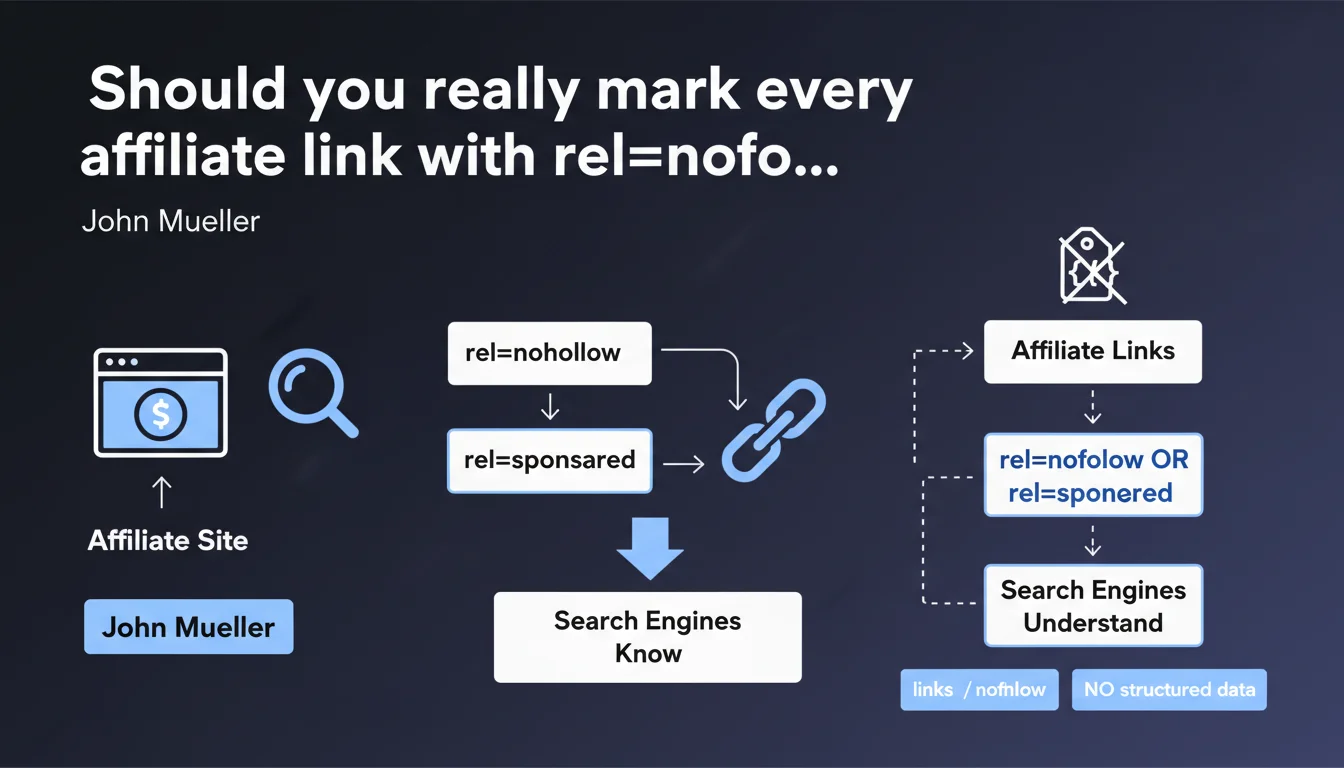
Google confirms that affiliate sites are acceptable, but requires that each affiliate link be marked with rel=nofollow or rel=sponsored. No specific structured data exists to signal that an entire site practices affiliate marketing — only individual links matter.
What you need to understand
Why does Google require marking affiliate links?
Google wants to distinguish natural editorial links from links that generate compensation. An affiliate link potentially transfers PageRank to a site from which you profit financially — which distorts the meritocratic principle of ranking.
The rel=nofollow or rel=sponsored attribute signals to search engines that this link should not influence the ranking of the target page. It's a requirement to stay compliant with Google Webmaster Guidelines, which explicitly prohibit manipulative link schemes.
What's the difference between rel=nofollow and rel=sponsored?
Technically, both prevent PageRank transfer. rel=sponsored is more precise — it explicitly indicates a commercial relationship. Google can thus better understand the nature of the link and refine its algorithms.
In practice, using rel=nofollow remains acceptable for affiliate links. But adopting rel=sponsored demonstrates greater transparency and anticipates the evolution of Google's criteria.
Is there a way to signal that an entire site is affiliate-based?
No. Google provides no structured data to globally declare that a site practices affiliate marketing. Each link must be treated individually — there's no way around this rule with a site-wide signal.
- Affiliate links must carry rel=nofollow or rel=sponsored
- rel=sponsored is more explicit and recommended for commercial relationships
- No global affiliate site declaration is recognized by Google
- Failure to mark links exposes you to manual penalties for link manipulation
SEO Expert opinion
Does this rule really apply to all affiliate links?
In theory, yes. In practice? Many sites don't systematically mark their Amazon or other affiliate program links. Some fly under the radar, others get caught during a manual review.
Risk increases with site visibility and the proportion of affiliate links. A personal blog with 3 Amazon links per article risks less than a massive comparison site generating 100% of its revenue via affiliate marketing. Google mainly targets large-scale schemes.
Does Mueller deliberately remain vague about Google's tolerance?
Frankly, yes. He doesn't specify what actually happens if a site forgets to mark a few links. Immediate penalty? Progressive algorithmic devaluation? Simple risk during a manual audit? [To verify]
Field experience shows that Google doesn't apply this rule in a binary fashion. Some poorly marked affiliate sites maintain excellent positions for years. Others get demoted brutally after manual action. Consistency is lacking.
Is marking enough to protect an affiliate site from penalties?
No. Marking your links with rel=sponsored doesn't exempt you from producing content with genuine added value. Google regularly penalizes affiliate sites that technically follow the attribute rules but offer poor or duplicate content.
Affiliate marketing remains acceptable in Google's eyes if and only if the site provides genuine expertise, original tests, in-depth comparisons. A simple Amazon link aggregator without original analysis remains vulnerable, marked links or not.
Practical impact and recommendations
What should you do concretely on an existing affiliate site?
First reflex: audit all outbound links to identify those generating commission. A simple CTRL+F for "amazon.com", "awin1.com", "tradedoubler" in the HTML code isn't enough — some links go through redirects or JavaScript.
Next, systematically verify that each affiliate link carries rel="sponsored" or rel="nofollow". If your CMS automatically generates affiliate links (via a WordPress plugin for example), configure automatic marking in the settings.
- Crawl the site with Screaming Frog in "external links" mode to list all outbound links
- Filter known affiliate domains (Amazon, Awin, Commission Junction, etc.)
- Verify the presence of rel="sponsored" or rel="nofollow" on each link
- Manually correct or script fix non-compliant links
- Update templates and plugins to automate future marking
- Document the process to prove good faith in case of manual review
What errors must you absolutely avoid?
Don't confuse rel="noopener" or rel="noreferrer" with rel="nofollow". The former concern security and privacy, not SEO. Google completely ignores them when determining whether a link should transfer PageRank.
Another pitfall: using rel="ugc" on affiliate links. This attribute signals user-generated content (comments, forums). It doesn't apply to commercial links — systematically prefer rel="sponsored".
How do you verify that a site remains compliant over time?
Set up automated monthly monitoring: crawl the site, extract outbound links, verify rel attributes. Alert the technical team if unmarked links appear.
Integrate an SEO checklist into the editorial workflow: before publishing an article with affiliate links, mandatory validation of marking. Many errors come from writers who manually insert links without knowing the technical rules.
❓ Frequently Asked Questions
Peut-on cumuler rel=sponsored et rel=nofollow sur un même lien ?
Les liens d'affiliation en JavaScript doivent-ils aussi être marqués ?
Un site peut-il être pénalisé pour des liens d'affiliation non marqués ajoutés par des contributeurs externes ?
Faut-il aussi marquer les liens vers des comparateurs ou agrégateurs qui ne sont pas directement affiliés ?
Le marquage des liens d'affiliation impacte-t-il le taux de conversion ?
🎥 From the same video 14
Other SEO insights extracted from this same Google Search Central video · published on 11/07/2023
🎥 Watch the full video on YouTube →
💬 Comments (0)
Be the first to comment.