
Official statement
Other statements from this video 17 ▾
- 1:24 Why is Google republishing guides on robots.txt and meta robots right now?
- 7:02 Does GoogleBot really crawl URLs that your site never created?
- 7:27 Why do Search Console and Google Analytics show different numbers?
- 7:27 Does GoogleBot really crawl URLs your site never created?
- 8:07 Why does Search Console show completely different data than Google Analytics?
- 8:51 How long does it actually take Google to detect and process a noindex tag fix?
- 9:49 Why does Google take so long to recognize the removal of a noindex tag?
- 11:11 Does special character encoding in source code really harm your SEO rankings?
- 11:11 Does special character encoding in your source code actually hurt your SEO rankings?
- 11:47 What's the safest way to prevent Google from crawling your PDFs without accidentally getting them indexed?
- 11:51 Should you really block PDFs with robots.txt or use noindex instead?
- 14:14 How long does Google really take to display your new site name in search results?
- 14:14 How can you force Google to display your site's correct name in the SERPs?
- 14:59 Does Google really penalize brand names that are too similar to competitors in search results?
- 15:14 Could similar brand names harm your SEO performance and search visibility?
- 20:13 Does Google penalize a site that's 100% HTTPS with no HTTP version?
- 20:30 Does running an HTTPS-only website actually hurt your SEO rankings?
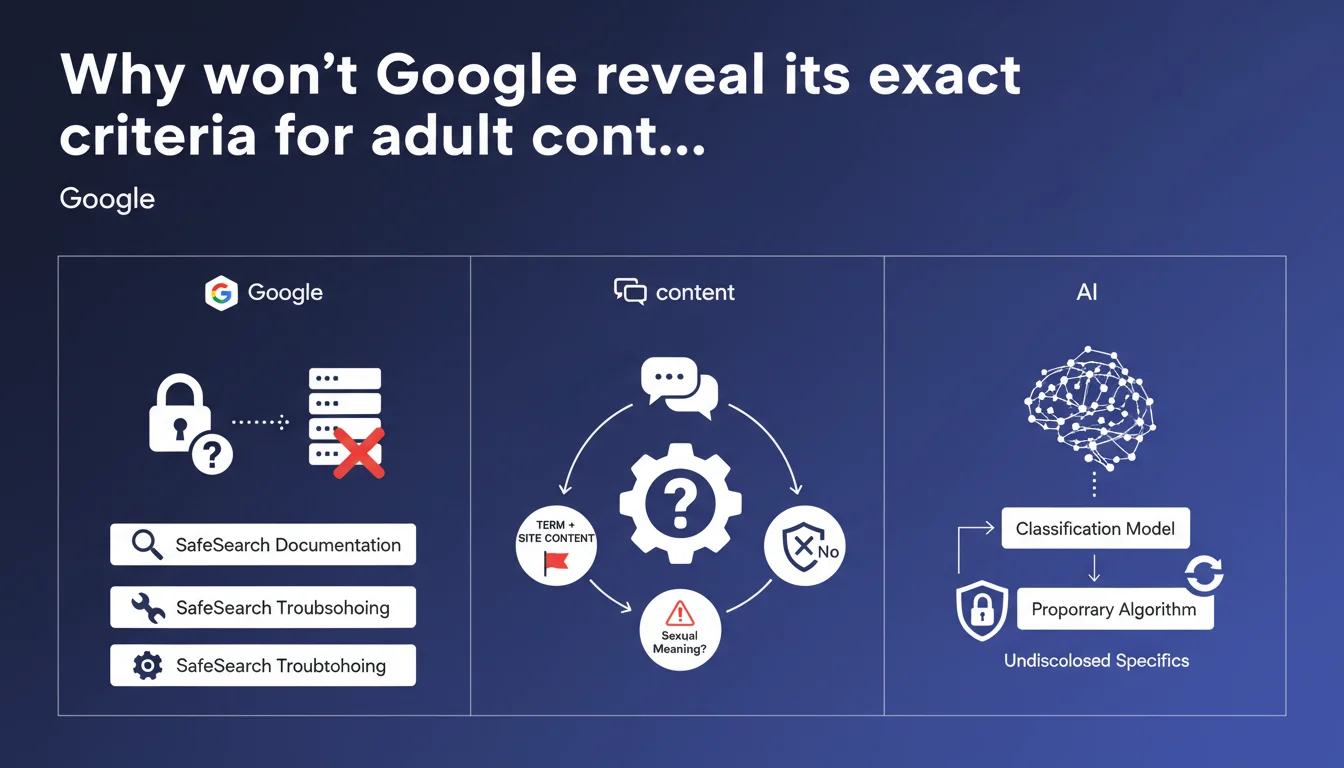
Google won't provide precise criteria beyond existing SafeSearch documentation. The real challenge: detecting potential sexual double meanings in term combinations across your site. Intentional vagueness that makes compliance difficult.
What you need to understand
What exactly is Google saying in this statement?
Google explicitly refuses to provide additional details about the criteria that trigger content being classified as "adult". The existing SafeSearch documentation — deliberately vague — is the only official reference.
The critical point: Google recommends verifying that no term can have a sexual meaning when combined with other elements on the site. It's not the isolated word that matters, but the overall semantic context.
Why does this lack of transparency create problems?
The absence of precise criteria places publishers in a permanent gray zone. It's impossible to confidently validate that content won't be filtered by SafeSearch or demoted in standard SERPs.
This opacity generates two risks: legitimate sites can be penalized by unintentional lexical combinations, while borderline content exploits system loopholes. SEO professionals have no reliable way to test before publication.
What Google documentation is available?
Official resources are limited to the SafeSearch help page and troubleshooting guidelines. These documents mention general concepts — sexually explicit content, nudity, vulgar language — without numerical thresholds or detailed examples.
- No list of trigger keywords
- No density or frequency thresholds
- No official preview tool for classification ranking
- No clear appeal procedure if misclassified
- Semantic context takes priority over isolated terms
SEO Expert opinion
Is this position consistent with field observations?
Yes and no. We do observe that term combinations play a key role. A medical site using correct anatomical vocabulary generally won't be filtered, while a lifestyle blog using the same terms in ambiguous context will be.
But — and here's where it breaks down — the system makes glaring errors. Sexual education sites, women's health blogs, even standard lingerie shops find themselves arbitrarily filtered. Google's "semantic context" sometimes seems interpreted with excessive caution.
Why does Google maintain this intentional ambiguity?
Two likely reasons. First, to avoid gaming the system: publishing precise criteria would allow adult sites to bypass filters by staying just under thresholds. It's a cat-and-mouse game.
Second — and less admittedly — it allows Google to change rules without notice or justification. A machine learning model can be retrained overnight, changing classifications without anyone being able to technically contest it.
[To verify] Google claims "combinations" of terms are analyzed, but no public data explains what weight is given to different signals: title, URL, text content, images, outbound links, backlink profile.
In what cases does this rule create absurd situations?
Sectors with unintended double semantics are most affected. Concrete example: an e-commerce site selling "roosters" (poultry) can be filtered if other page elements — user comments, related terms, images — create ambiguity.
Same problem for medical sectors, artistic content (academic nudity), or discussions about sexual violence. Legitimate context isn't always enough to avoid the filter. And without clear criteria, it's impossible to know which text modification would allow you to exit adult classification.
Practical impact and recommendations
How can you check if your site is affected by this classification?
First step: test with SafeSearch enabled. Run targeted queries on your main pages in private browsing mode, SafeSearch set to "strict". If your content disappears, you're likely classified as adult.
Second test: analyze Search Console to detect sudden traffic drops on specific queries, especially those including double-meaning terms. An unexplained drop without explicit manual penalty can signal silent reclassification.
What mistakes should you absolutely avoid in your content?
Never mix neutral terms with ambiguous lexical fields. Example: a medical article on reproductive health using casual tone or slang expressions risks filtering.
Avoid URLs containing problematic word combinations. A URL like "/products-for-adults/" will be scrutinized differently than "/professional-training/", even if the content is identical.
Be vigilant about user-generated content: comments, forums, reviews. A single unmoderated explicit comment can be enough to flip an entire page into adult filter status.
What should you do if your site is misclassified?
Use the SafeSearch troubleshooting form (available in Google documentation). But let's be honest: processing times are long and responses rarely detailed.
In the meantime, aggressively clean any potentially ambiguous content. Rephrase titles, change word combinations, add explicit context (mentions of "medical article", "educational content", etc.). Some publishers have seen results by adding precise schema.org tags (MedicalWebPage, EducationalOrganization).
- Systematically test new pages with SafeSearch enabled
- Audit URLs to detect at-risk word combinations
- Actively moderate user-generated content
- Document editorial context via schema.org
- Monitor traffic fluctuations on sensitive queries
- Avoid casual vocabulary in potentially ambiguous content
- Maintain consistent professional tone across the entire site
❓ Frequently Asked Questions
Existe-t-il une liste officielle des mots-clés déclenchant la classification adulte ?
Un site médical ou éducatif peut-il être filtré par SafeSearch ?
Comment savoir si mon site est classé comme contenu adulte ?
La classification adulte impacte-t-elle le référencement naturel hors SafeSearch ?
Peut-on contester une mauvaise classification adulte ?
🎥 From the same video 17
Other SEO insights extracted from this same Google Search Central video · published on 27/03/2025
🎥 Watch the full video on YouTube →
💬 Comments (0)
Be the first to comment.