
Official statement
Other statements from this video 12 ▾
- □ Is keyword stuffing really penalized by Google?
- □ Does Google really consider all hidden text as spam, or is it more nuanced than that?
- □ Is randomly generated content really considered spam by Google's standards?
- □ Have backlinks really become obsolete for SEO success?
- □ Does valid HTML really matter for ranking higher on Google?
- □ Why does Google insist so much on real <a href> tags?
- □ Should you really abandon CSS images in favor of HTML img tags for better SEO?
- □ Does Google really require HTTPS to index your website?
- □ Is your website still using plugins to display content? Here's why Google says you need to stop immediately
- □ Does Google really trigger scroll or click events to crawl your hidden content?
- □ Is image alt text really still essential when Google has computer vision to understand images?
- □ Are Google's SEO guidelines really reliable over time?
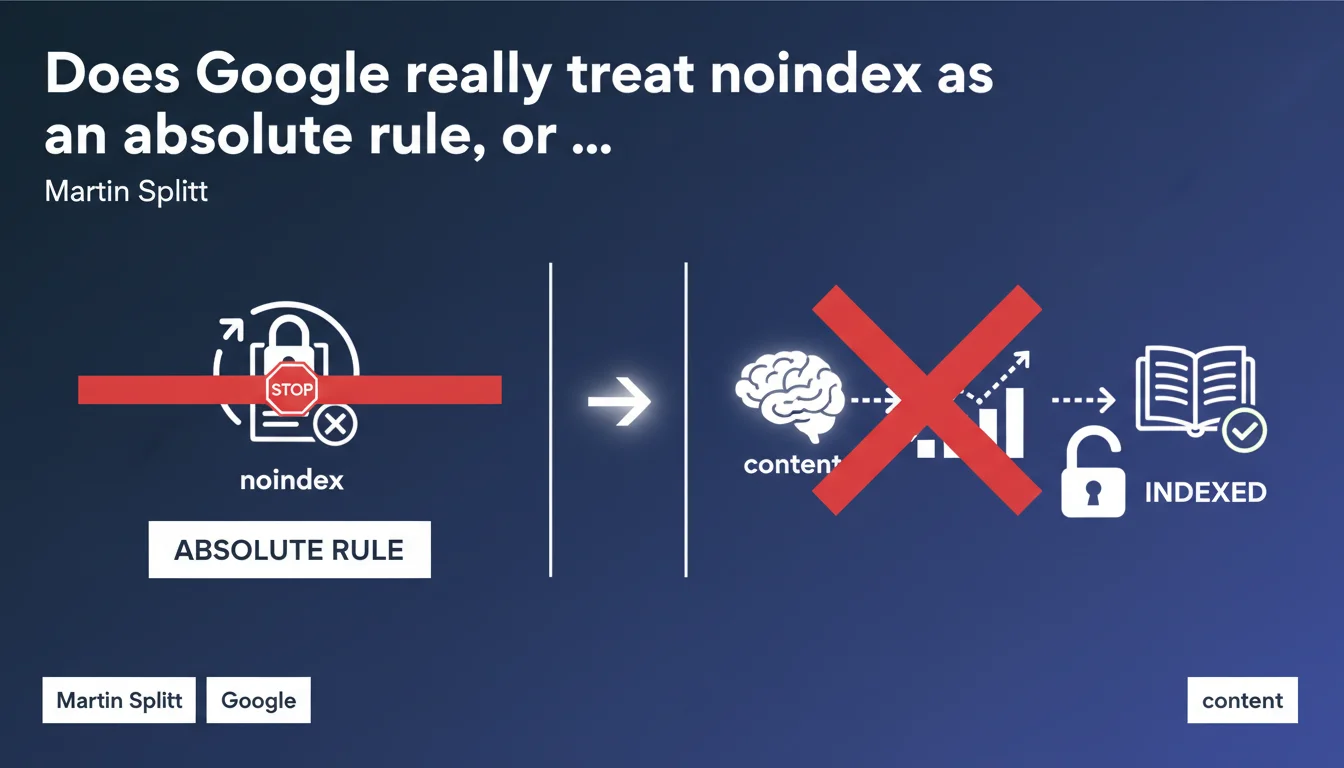
Google strictly respects the noindex tag without exception: a page with this directive will never be indexed, even if its content seems relevant or useful. This is a non-negotiable technical instruction, not a simple recommendation that the algorithm could bypass depending on context.
What you need to understand
Why does Google insist so much on the strict nature of noindex?
Martin Splitt's statement puts an end to a persistent belief: Google makes no exceptions to the noindex directive. Some SEOs thought that pages with exceptionally useful content could still be indexed — that's false.
This rule is part of a user control logic. Noindex is an explicit instruction from the webmaster, not a weak signal that the algorithm can ignore if it suits it. Google treats this tag as a technical imperative in the same way as robots.txt that blocks crawling.
What's the difference between noindex and other indexation directives?
Unlike canonical or URL parameters that Google can sometimes interpret differently, noindex is not subject to negotiation. It's binary: present or absent.
Other signals like duplicate content or low quality can influence indexation, but remain algorithmic recommendations. Noindex is a direct command that bypasses the entire evaluation process.
In which cases does this rule change the game for practitioners?
For SEOs managing seasonal or temporary content with conditional noindex, this confirmation removes any gray area. There's no "maybe Google will index it anyway if it's really good."
Strategies for soft launches or A/B testing with noindex need to be rethought: a noindexed page is invisible, period. No algorithmic miracle will come to index it despite the directive.
- Noindex is an absolute technical instruction, not a recommendation
- Google makes no exceptions even for content deemed useful or high quality
- This directive bypasses any algorithmic evaluation of content
- No difference in treatment depending on site type or domain authority
- Noindex should be used carefully as it completely removes a page from the index
SEO Expert opinion
Is this statement consistent with real-world observations?
Yes, completely. In practice, we never observe cases where a page with correctly implemented noindex appears in search results. Zero documented exceptions.
What sometimes differs is the detection timeframe. Google may take several weeks to detect a noindex that has been added, especially on pages that are rarely crawled. But once detected, it's implacable — the page disappears.
What implementation errors create confusion?
The main pitfall: a noindex in a JavaScript file loaded asynchronously. If Googlebot cannot execute the JS or if the noindex arrives after the initial HTML rendering, the directive could be technically ignored.
Another source of confusion: noindex in an X-Robots-Tag HTTP header versus the meta tag. Both work, but the HTTP header takes priority if both are contradictory. And some SEOs forget to check both locations during audits.
Redirects also add complexity. A page A with noindex that redirects to B doesn't prevent B from being indexed — obvious in theory, but a source of errors in practice.
Should you always trust official statements?
This one is among the most reliable because it concerns a simple, observable technical mechanism. No opaque algorithm, no mysterious weighting — just a binary instruction.
However, Google sometimes remains vague about edge cases. What happens if a noindex disappears and then reappears quickly? How long does a page remain cached after noindex removal? These nuances are never detailed publicly. [To verify] in your own tests if you manage complex implementations.
Practical impact and recommendations
What should you verify immediately on your site?
Start with a comprehensive audit of noindex tags via your preferred crawler — Screaming Frog, Oncrawl, or even Search Console if the volume is manageable. Identify any strategically important pages accidentally noindexed.
Also check X-Robots-Tag HTTP headers, often forgotten because they're invisible in HTML source code. A server directive can block indexation without anyone noticing for months.
Control paginated pages, filters, and facets: these areas are often noindexed by default in e-commerce CMS platforms. Make sure this configuration still matches your current strategy.
What errors should you absolutely avoid?
Never combine noindex and disallow in robots.txt for the same URL. This is the classic error that prevents Google from seeing the noindex directive, leaving the page in the index with an empty description.
Avoid conditional noindex based on fragile parameters (cookies, geolocation, device). If the condition changes between two crawls, Google may see noindex one time and nothing the next — a source of erratic behavior.
Don't rely solely on JavaScript to deploy a noindex. Put it in the initial HTML or via HTTP header to ensure Googlebot catches it on the first pass, before even executing the JS.
How do you adjust your indexation strategy?
Rethink pages in noindex "just to be safe". If a page adds nothing to SEO but could be useful through other channels, noindex is drastic — maybe just a lack of internal links would suffice.
For temporary or seasonal content, prefer reversible mechanisms: removal from the sitemap, reduction of internal linking, or even 410 Gone if it's truly obsolete. Noindex is definitive as long as it remains in place.
Document your indexation choices in a centralized dashboard. When a page is intentionally noindexed, note why and who made the decision. This avoids "Why is this category no longer in Google?" six months later.
- Audit all noindex tags (meta + X-Robots-Tag HTTP)
- Eliminate any noindex + disallow robots.txt conflicts
- Verify that strategic pages are indexable
- Test implementation on both server and JavaScript side
- Document each noindex decision in a centralized registry
- Review "historical" noindex directives that may no longer have a reason to exist
- Set up alerts if important pages switch to noindex
❓ Frequently Asked Questions
Le noindex empêche-t-il aussi le crawl de la page ?
Peut-on noindexer une page tout en la gardant dans le sitemap XML ?
Combien de temps faut-il pour qu'une page noindexée disparaisse de l'index ?
Si je retire le noindex, la page sera-t-elle réindexée automatiquement ?
Le noindex affecte-t-il le PageRank transmis par les liens internes ?
🎥 From the same video 12
Other SEO insights extracted from this same Google Search Central video · published on 03/02/2022
🎥 Watch the full video on YouTube →
💬 Comments (0)
Be the first to comment.