
Official statement
Other statements from this video 12 ▾
- □ Does Google really consider all hidden text as spam, or is it more nuanced than that?
- □ Is randomly generated content really considered spam by Google's standards?
- □ Have backlinks really become obsolete for SEO success?
- □ Does valid HTML really matter for ranking higher on Google?
- □ Why does Google insist so much on real <a href> tags?
- □ Should you really abandon CSS images in favor of HTML img tags for better SEO?
- □ Does Google really treat noindex as an absolute rule, or does it bend the rules for exceptional content?
- □ Does Google really require HTTPS to index your website?
- □ Is your website still using plugins to display content? Here's why Google says you need to stop immediately
- □ Does Google really trigger scroll or click events to crawl your hidden content?
- □ Is image alt text really still essential when Google has computer vision to understand images?
- □ Are Google's SEO guidelines really reliable over time?
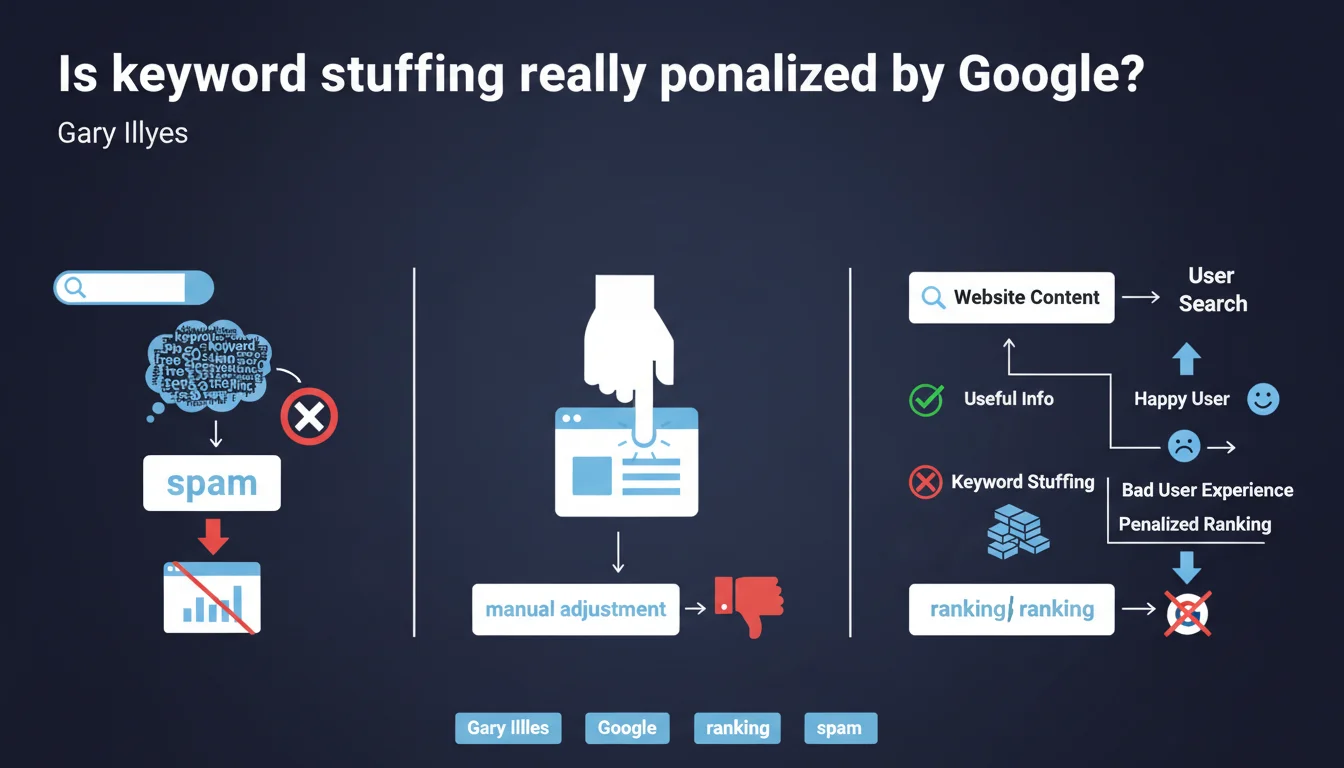
Google identifies keyword stuffing as spam and can manually adjust the rankings of sites that use it. The technique provides no value to users and exposes sites to manual actions. Relying on excessive repetition remains a losing strategy.
What you need to understand
What exactly does Google consider keyword stuffing?
The term keyword stuffing refers to the artificial and excessive repetition of a keyword in content, tags, or metadata. The historical objective was to manipulate algorithms by increasing keyword density, a practice that worked in the 2000s.
Today, Google detects these patterns through its natural language processing algorithms and through manual evaluations. Where's the line? When repetition harms readability and the text appears written for robots rather than humans.
Why is this statement coming now?
Keyword stuffing has never completely disappeared — some practitioners still believe an optimal density exists. Gary Illyes is reminding us here that this approach falls under spam, not optimization.
Google continues to refine its automatic detection systems, but retains the capacity to intervene manually in flagrant cases. This statement serves as a warning: penalties exist and can be applied without notice.
What's the difference between this and legitimate optimization?
Repeating a keyword is not inherently problematic. What matters is intent and user outcome. A technical article may naturally use a specific term many times without it being spam.
The red line? When repetition only serves forced placement, when sentences become awkward, when text loses clarity. Google analyzes the broader semantic context, not just raw frequency.
- Keyword stuffing creates artificial and poorly readable text
- Google can manually penalize sites that abuse it
- Legitimate optimization prioritizes semantic context and user value
- Modern algorithms detect over-optimization through natural language processing
- No "ideal" keyword density exists — only relevance matters
SEO Expert opinion
Is this position consistent with what we observe in the field?
Overall, yes. Sites that abuse keyword stuffing end up stagnating or declining, especially since the Helpful Content updates. Algorithms clearly favor semantic richness and lexical variety.
But — and here's where it gets tricky — some ultra-competitive sectors still show over-optimized pages ranking first. These cases are often temporary anomalies, or niches where quality competition is weak. [To verify]: the exact definition of this over-optimization threshold remains unclear.
What's the boundary between natural repetition and manipulation?
Google never gives precise figures — and that's intentional. No magic percentage, no formula to apply. Evaluation relies on qualitative criteria: text fluidity, diversity of phrasing, contextual relevance.
A writer who masters their subject will naturally use synonyms, reformulations, variations. Content stuffed with keywords often betrays mechanized writing or a lack of subject understanding. Quality Raters are trained to spot these patterns.
Are manual penalties really common for this reason?
No, manual actions for pure keyword stuffing are rare today. Most cases are handled algorithmically: the site stagnates, doesn't climb, or gradually loses ground.
Manual interventions target massive and recurring abuse, often coupled with other spam techniques. An isolated site with a few over-optimized pages likely won't trigger manual action, but will suffer mediocre performance. It's a silent penalty.
Practical impact and recommendations
How to identify keyword stuffing on your own site?
Read your pages aloud. If certain sentences sound strange, if a keyword returns awkwardly, if the text seems written for a robot, you have a problem. Human analysis remains the best detector.
Supplement with tools: check the lexical variety of your content, analyze the semantic field covered. A 1000-word text that contains only 10 different terms is suspicious. Use N-gram extractors to spot excessive repetitions.
What corrective actions to apply concretely?
Rewrite over-optimized passages by prioritizing synonyms, natural cooccurrences, varied phrasing. Don't sacrifice clarity to force placement — if the keyword doesn't integrate naturally, rephrase.
Diversify your semantic strategy: work on named entities, associated concepts, related questions. Google understands context — leverage this capability rather than hammering an isolated keyword.
How to avoid falling back into this trap?
Train your writers in the principles of modern semantic SEO. Well-optimized text doesn't look optimized. It informs, structures, answers user questions without forcing keyword presence.
Implement qualitative review processes before publishing. Content that delivers value will rank better than content stuffed with hollow keywords. Always prioritize user experience.
- Audit current pages to spot excessive repetitions
- Rewrite over-optimized passages with natural phrasing
- Vary vocabulary: synonyms, cooccurrences, reformulations
- Broaden semantic field: entities, associated concepts, related questions
- Train writers in modern semantic SEO principles
- Establish systematic qualitative review before publication
- Abandon tools that calculate an "ideal" keyword density
- Prioritize user value and reading fluidity
❓ Frequently Asked Questions
Existe-t-il une densité de mots-clés idéale recommandée par Google ?
Le keyword stuffing peut-il entraîner une désindexation complète ?
Comment différencier une répétition légitime d'un bourrage abusif ?
Les balises meta et les attributs alt sont-ils aussi concernés ?
Peut-on utiliser des outils pour détecter automatiquement le keyword stuffing ?
🎥 From the same video 12
Other SEO insights extracted from this same Google Search Central video · published on 03/02/2022
🎥 Watch the full video on YouTube →
💬 Comments (0)
Be the first to comment.