
Official statement
Other statements from this video 12 ▾
- □ Is keyword stuffing really penalized by Google?
- □ Does Google really consider all hidden text as spam, or is it more nuanced than that?
- □ Is randomly generated content really considered spam by Google's standards?
- □ Have backlinks really become obsolete for SEO success?
- □ Does valid HTML really matter for ranking higher on Google?
- □ Why does Google insist so much on real <a href> tags?
- □ Should you really abandon CSS images in favor of HTML img tags for better SEO?
- □ Does Google really treat noindex as an absolute rule, or does it bend the rules for exceptional content?
- □ Does Google really require HTTPS to index your website?
- □ Is your website still using plugins to display content? Here's why Google says you need to stop immediately
- □ Does Google really trigger scroll or click events to crawl your hidden content?
- □ Is image alt text really still essential when Google has computer vision to understand images?
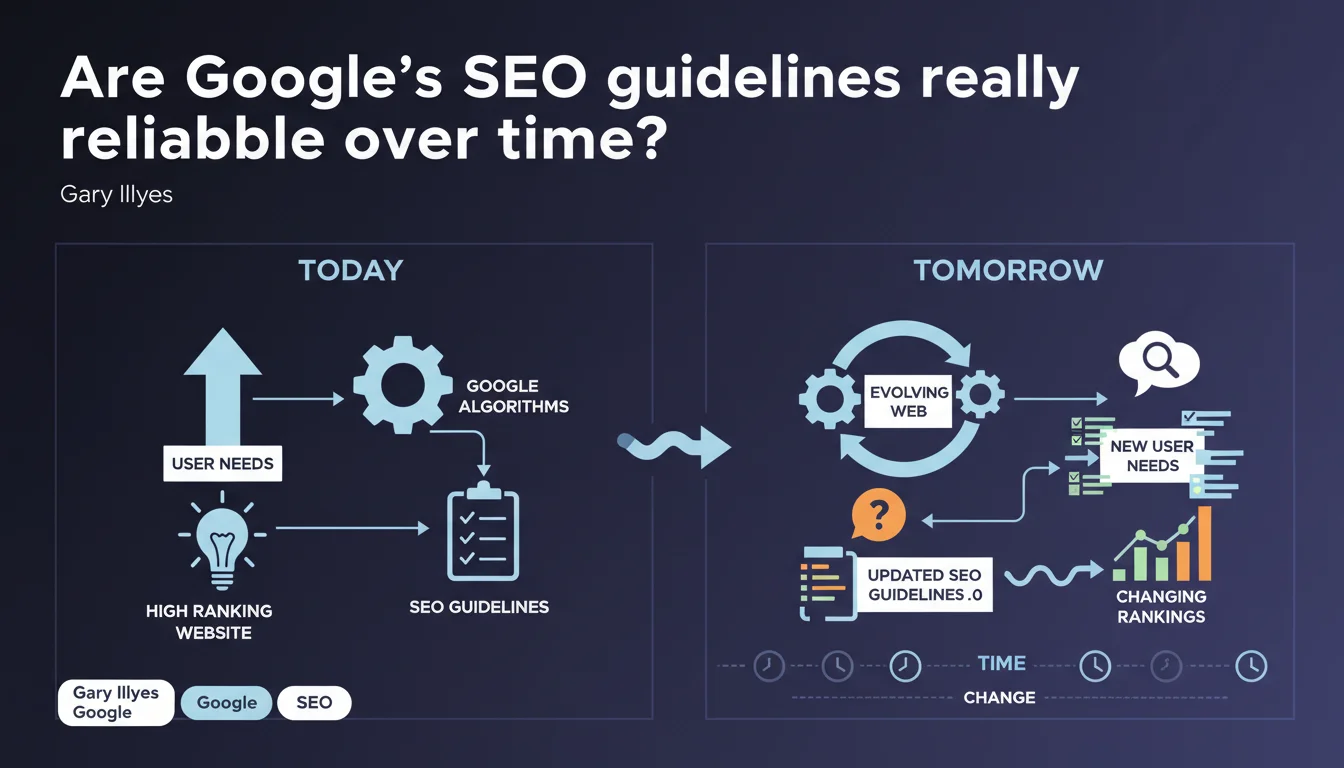
Google claims that its SEO guidelines are not set in stone and constantly evolve with the web. What is recommended today may become obsolete tomorrow. Practitioners must therefore accept permanent instability in their optimization strategies.
What you need to understand
Why does Google insist on the evolving nature of its guidelines?
Google seeks to protect itself legally and strategically. By asserting that nothing is carved in stone, the search engine reserves the right to change its rules overnight without having to justify its reversals.
This position also serves a technical objective. The web evolves, technologies change, user behaviors transform. Google must adapt its ranking criteria to maintain the relevance of its results — and this adaptation cannot follow a predictable timeline.
Concretely, what can change in the guidelines?
Everything. From the treatment of meta tags to recommendations on internal link structure. Tolerance toward certain practices can evolve: what was considered acceptable (or even recommended) can shift into the gray zone, or even be explicitly discouraged.
Core Web Vitals are a perfect example — metrics that didn't exist a few years ago and have become official ranking signals. Conversely, some historical recommendations (like the importance of exact keywords in anchors) have been progressively nuanced.
Does this instability make the guidelines useless?
No, but it requires permanent critical reading. The guidelines remain the official reference — simply, you must consider them as a snapshot of a given moment, not as an eternal truth.
The main risk: clinging to outdated practices thinking they remain valid "because Google said so." Monitoring becomes an absolute imperative.
- Google guidelines are a mobile reference framework, not a fixed dogma
- What is recommended today can become counterproductive tomorrow without warning
- SEO monitoring is not optional — it becomes a strategic necessity
- You must distinguish fundamental principles (relevance, quality) from specific technical recommendations
- The history of past changes helps anticipate future evolutions
SEO Expert opinion
Is this statement consistent with observed practices?
Absolutely. Gary Illyes is simply formalizing what every experienced practitioner has observed for years: the goalposts move constantly. The problem is that Google rarely communicates these changes proactively.
Once-encouraged practices (like press releases with optimized links) have become suspect. Elements considered secondary (mobile page speed) have become major ranking factors. And all of this without a clear roadmap, without announced transition — just algorithmic adjustments that SEOs discover in their analytics.
What nuances should be applied to this statement?
Not all elements of the guidelines evolve at the same pace. Some fundamental principles remain stable: creating content relevant to users, having clean technical architecture, avoiding gross manipulations. These pillars don't move.
What changes are rather the modalities of application and specific technical criteria. The philosophy remains coherent — it's the execution that mutates. [To verify]: Google does not systematically document the history of its guideline changes, making it difficult to precisely trace these evolutions.
In what cases does this rule not apply?
Anti-spam principles remain remarkably stable. Buying links to manipulate PageRank was forbidden 15 years ago, it still is. Cloaking, massive keyword stuffing, private blog networks — all these practices remain consistently sanctioned.
Formal prohibitions evolve little. It's rather the gray zones and technical recommendations that fluctuate. If you focus on the essentials — quality, relevance, user experience — you're less exposed to turbulence.
Practical impact and recommendations
What should you do concretely in the face of this instability?
Adopt a resilient SEO strategy rather than one optimized for a single moment in time. This means favoring fundamentals (logical architecture, substantive content, smooth user experience) over technical micro-optimizations that risk becoming obsolete quickly.
Document your strategic choices and their justifications. If you followed a Google recommendation at a given time, keep a record of that recommendation and its date. This will allow you to periodically reassess your practices without starting from scratch each time.
Establish structured monitoring — not just reading official announcements, but also observing SERP evolutions, testing, measuring. Guideline changes often manifest in results before being officially documented.
What mistakes should you absolutely avoid?
Don't freeze your SEO processes thinking "we've always done it this way." Routines that worked two years ago may be counterproductive today. Regular questioning is not optional.
Avoid blindly following each new Google recommendation without evaluating it. Some directives are generic and may not apply to your specific context. Others are temporary overcorrections that will be nuanced later.
Don't neglect the historical dimension. Understanding why a recommendation changed helps anticipate next evolutions. If Google has hardened its position on sponsored links, it's because abuse was massive — this logic will apply to other practices.
How do you build a durable SEO strategy despite this volatility?
Focus on what Google will never change: the desire to serve the most relevant results to users. If your site truly answers search intent, it will withstand algorithmic variations better.
Diversify your levers. Don't depend on a single technique or content type. A balanced mix between technical SEO, content, and authority protects you better than over-optimization on a single axis.
Test, measure, adjust — but on long cycles. Short-term fluctuations aren't always significant. Wait until you have confirmed trends before making major changes.
- Document each Google recommendation you follow with its date and source
- Establish a monthly watch of official guideline evolutions
- Audit your SEO practices quarterly to identify potential obsolescence
- Favor fundamental principles rather than pointed technical optimizations
- Test new recommendations on a restricted scope before generalizing
- Maintain internal documentation explaining strategic choices and their context
- Observe SERP evolutions in your sector to anticipate changes
❓ Frequently Asked Questions
À quelle fréquence Google modifie-t-il réellement ses guidelines ?
Les anciennes recommandations de Google restent-elles applicables si elles n'ont pas été explicitement retirées ?
Comment savoir si une recommandation SEO est encore d'actualité ?
Google prévient-il toujours avant de changer ses directives ?
Faut-il systématiquement appliquer les nouvelles recommandations de Google dès leur publication ?
🎥 From the same video 12
Other SEO insights extracted from this same Google Search Central video · published on 03/02/2022
🎥 Watch the full video on YouTube →
💬 Comments (0)
Be the first to comment.