
Official statement
Other statements from this video 12 ▾
- □ Is keyword stuffing really penalized by Google?
- □ Is randomly generated content really considered spam by Google's standards?
- □ Have backlinks really become obsolete for SEO success?
- □ Does valid HTML really matter for ranking higher on Google?
- □ Why does Google insist so much on real <a href> tags?
- □ Should you really abandon CSS images in favor of HTML img tags for better SEO?
- □ Does Google really treat noindex as an absolute rule, or does it bend the rules for exceptional content?
- □ Does Google really require HTTPS to index your website?
- □ Is your website still using plugins to display content? Here's why Google says you need to stop immediately
- □ Does Google really trigger scroll or click events to crawl your hidden content?
- □ Is image alt text really still essential when Google has computer vision to understand images?
- □ Are Google's SEO guidelines really reliable over time?
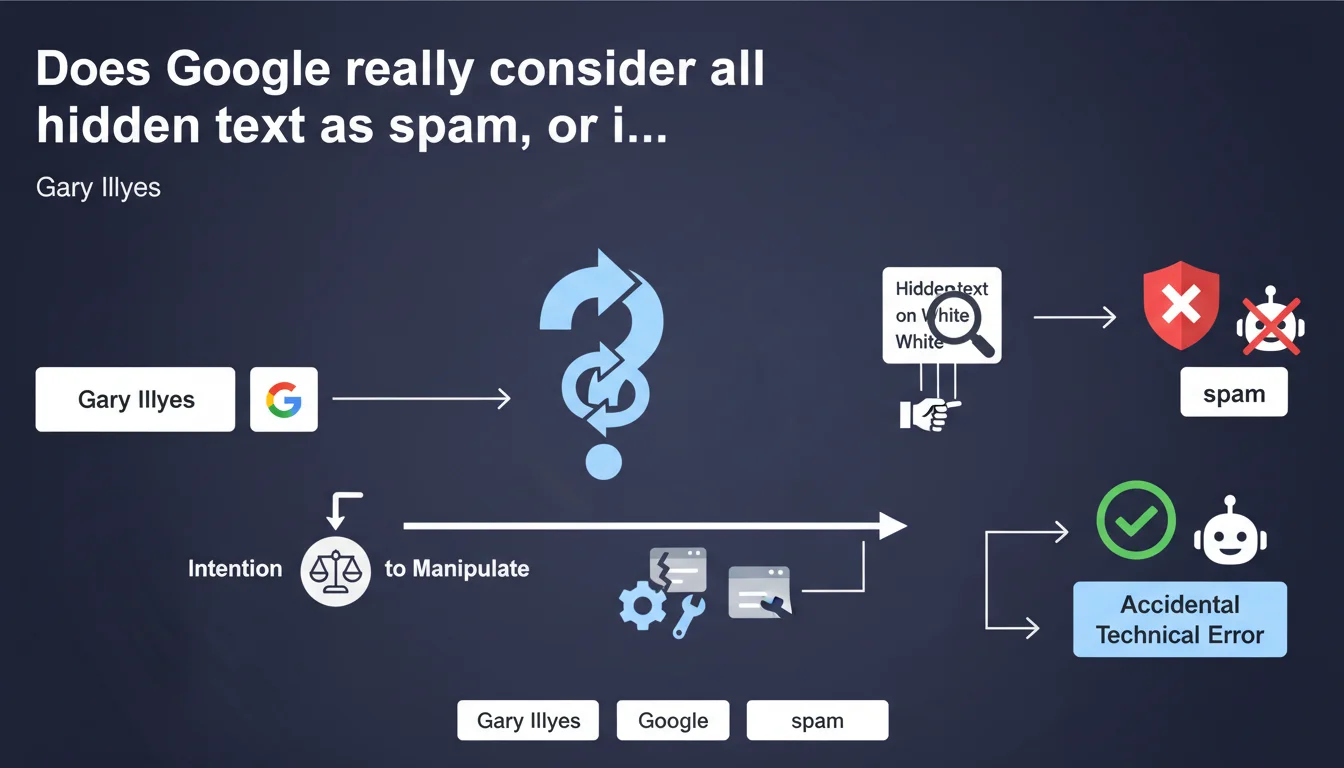
Google considers hidden text (white on white, etc.) as spam only if the intention is to manipulate search results. An accidental technical error will not be penalized — it's the intention that matters, not the visual result. The question remains: how does Google determine this so-called "intention"?
What you need to understand
Why does Google make this distinction between intention and accident?
The nuance is crucial. Hidden text has long been a classic black hat technique: stuffing a page with invisible keywords to artificially inflate its relevance. But as the web evolved, with complex CSS and JavaScript frameworks, elements could end up hidden without malicious intent.
Google recognizes this reality. The algorithm now seeks to distinguish between intentional manipulation (white text on white background to deceive) and technical error (CSS bug, element hidden by mistake). Let's be honest: this distinction also opens a comfortable gray area for Google — it's hard to prove intent.
What types of hidden text are specifically targeted?
Classic examples: white text on white background, text in font size 0, text positioned off-screen via CSS (position: absolute; left: -9999px), text behind images. Anything that makes content invisible to users but readable by Googlebot.
And that's where it gets tricky. What about accordions closed by default? Content in inactive tabs? Unopened modals? Technically hidden, but not necessarily spam. Google must interpret the context — and that remains unclear.
How does Google determine the intention to manipulate?
That's the weak point of this statement. Google doesn't detail the intent signals it analyzes. Probably a mix of factors: consistency of hidden content with the rest of the page, relevance to users, keyword repetition, site history.
But without precise criteria, we're left with approximation. A site can be penalized even without malicious intent if the algorithm misinterprets the context. Conversely, some borderline sites slip under the radar.
- Intent trumps technique: a CSS error is not penalized if it's accidental
- White text on white remains spam if the goal is to manipulate ranking
- Gray areas persist: accordions, tabs, modals — Google must interpret context
- No exhaustive list of intent signals provided by Google
SEO Expert opinion
Is this statement consistent with real-world observations?
Broadly yes, but with notable inconsistencies. In practice, we observe that Google tolerates certain hidden content (accordions, tabs) and penalizes others (off-screen text stuffed with keywords). The intent vs. accident distinction works… when it's obvious.
The problem? Edge cases. I've seen sites penalized for perfectly legitimate accordion content — likely because the algorithm detected keyword over-optimization in the masked sections. [To verify]: Google claims not to penalize technical errors, but the signals it uses to differentiate intent from accident remain opaque.
What nuances should be added to this position?
First nuance: intent is subjective. What Google considers manipulation can be perceived by the webmaster as legitimate optimization. Example: hiding secondary content to improve mobile UX while keeping the text indexable. UX intent or SEO intent? Both?
Second nuance: this statement doesn't cover dynamic content loaded in JavaScript. Technically "hidden" from initial crawl, it doesn't fit the classic hidden text definition. Google handles it differently, with rendering — but that remains a blind spot in this statement.
In what cases doesn't this rule apply strictly?
Accordion, tab, or modal content to improve UX are not considered spam — as long as they serve the user. Google has confirmed this multiple times. But be careful: if these hidden elements contain abnormal keyword density, the algorithm may interpret it as manipulation.
Another case: off-screen text for accessibility (screen readers). Legitimate… unless repurposed to stuff SEO content. Again, everything relies on Google's interpretation of intent.
Practical impact and recommendations
What should you do concretely to avoid problems?
First, audit all hidden content on your site. Identify what's hidden by default: accordions, tabs, off-screen elements. For each element, ask yourself: am I hiding this to improve UX or to manipulate SEO?
Next, verify consistency. If hidden content contains strategic keywords absent from the rest of the page, it can raise a red flag. Thematic consistency between visible and hidden content is your best protection.
What mistakes must you absolutely avoid?
Never play with classic black hat techniques: white text on white, font size 0, off-screen positioning to stuff keywords. Even if you think "it will pass," the risk isn't worth it. Google has 20 years of experience detecting these patterns.
Also avoid over-optimization of hidden content. If your accordions contain 3 times more keywords than your main content, you're creating a suspicious imbalance. Keep distribution natural.
How do you verify that your site is compliant?
Use the URL Inspection tool in Search Console to see how Google renders your page. Compare the user version with the Googlebot version. If content appears in Google's render but is invisible to users without interaction, investigate.
Also do a manual test: disable CSS and JavaScript. Any content that appears then but was invisible before deserves examination. Is it justified by UX? Or is it a disguised SEO optimization attempt?
- Identify all content hidden by default (accordions, tabs, modals)
- Verify thematic consistency between visible and hidden content
- Eliminate any classic hidden text techniques (white on white, off-screen, etc.)
- Test rendering with Search Console's URL Inspection tool
- Disable CSS/JS to reveal invisible content and assess its legitimacy
- Document the UX choices that justify hidden content
❓ Frequently Asked Questions
Les contenus en accordéon fermés par défaut sont-ils considérés comme du texte caché ?
Comment Google différencie-t-il une erreur technique d'une intention de spam ?
Le texte masqué pour l'accessibilité (lecteurs d'écran) est-il autorisé ?
Un bug CSS qui masque accidentellement du contenu peut-il entraîner une pénalité ?
Les contenus chargés dynamiquement en JavaScript sont-ils concernés par cette règle ?
🎥 From the same video 12
Other SEO insights extracted from this same Google Search Central video · published on 03/02/2022
🎥 Watch the full video on YouTube →
💬 Comments (0)
Be the first to comment.