
Official statement
Other statements from this video 12 ▾
- □ Is keyword stuffing really penalized by Google?
- □ Does Google really consider all hidden text as spam, or is it more nuanced than that?
- □ Have backlinks really become obsolete for SEO success?
- □ Does valid HTML really matter for ranking higher on Google?
- □ Why does Google insist so much on real <a href> tags?
- □ Should you really abandon CSS images in favor of HTML img tags for better SEO?
- □ Does Google really treat noindex as an absolute rule, or does it bend the rules for exceptional content?
- □ Does Google really require HTTPS to index your website?
- □ Is your website still using plugins to display content? Here's why Google says you need to stop immediately
- □ Does Google really trigger scroll or click events to crawl your hidden content?
- □ Is image alt text really still essential when Google has computer vision to understand images?
- □ Are Google's SEO guidelines really reliable over time?
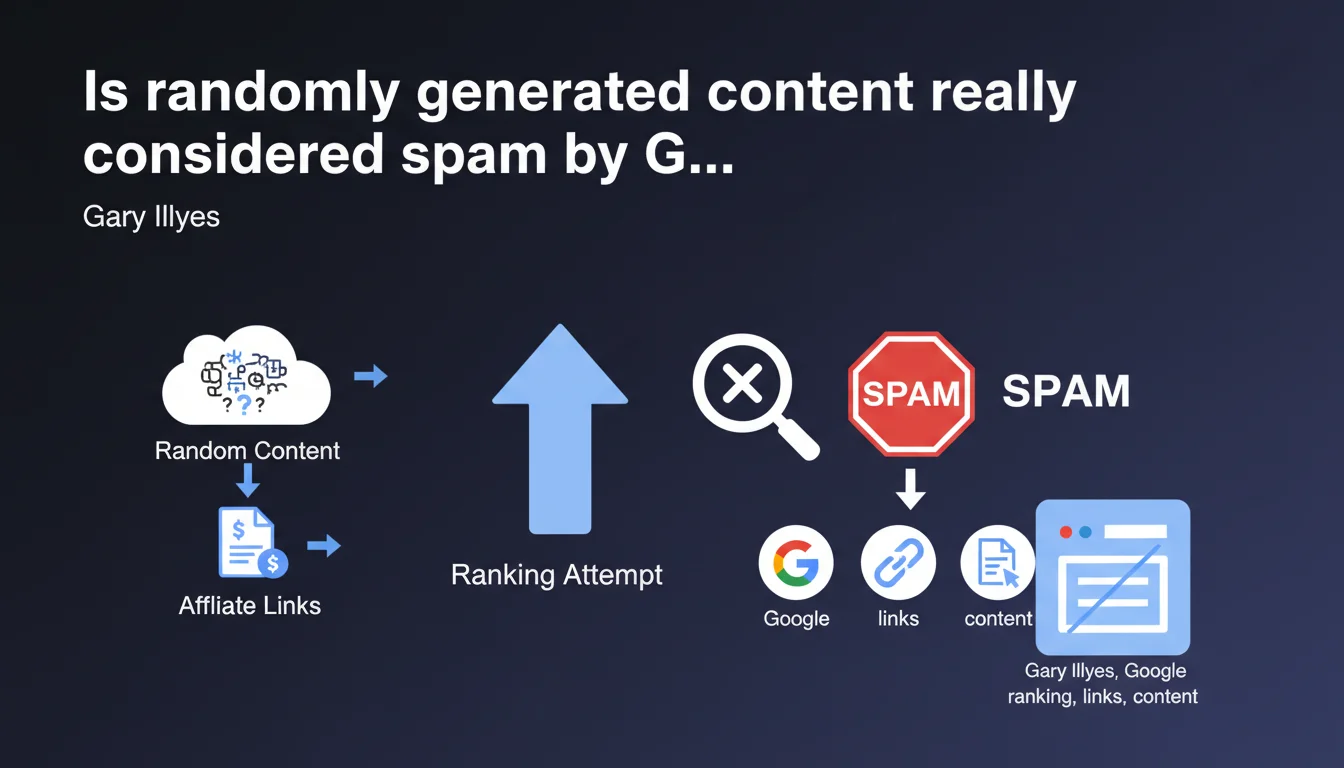
Google explicitly classifies gibberish content (incoherent nonsense) as spam, especially when used to rank and monetize through affiliate links. The line is clear: if content makes no sense to a human reader, it violates the guidelines — regardless of the technique used to generate it.
What you need to understand
What exactly does Google mean by "gibberish"?
The term gibberish refers to text composed of random words or incoherent sentences, lacking logical structure or informational value. We're talking about content where syntax might seem correct at first glance, but where overall meaning is absent.
Concretely? Pages stuffed with keywords assembled without logic, sentences generated by concatenating unrelated expressions, or spinning pushed to extremes that produces incomprehensible text. The common denominator: no human reader could extract useful information from it.
Why does Google specifically target affiliate links in this statement?
The mention of affiliate links is not incidental. It reveals the intent behind the spam: generating organic traffic to meaningless pages to earn commissions through clicks to third-party merchants.
These pages often exploit low-competition long-tail searches. The goal isn't to serve the user, but to maximize traffic volume at minimal editorial cost. Google is pointing here to a business model based on manipulation, not value creation.
Is this position new or does it continue existing policy?
Nothing revolutionary here. Gibberish has been in spam policies for years. What Gary Illyes is doing is publicly reminding an obvious truth that some players seem to forget — or work around.
The nuance lies in the emphasis on affiliate pages. With the rise of AI-generated content, Google reaffirms that production technique matters little: only the result counts. If it's gibberish, it's spam.
- Gibberish = incoherent content with no value for users
- Targeting affiliate links reveals the manipulative intent behind these pages
- This statement continues existing spam policy
- The origin of content (AI, spinning, etc.) is secondary to the final result
SEO Expert opinion
Does this statement really provide operational precision?
Let's be honest: no. Gary Illyes restates an established principle without defining measurable criteria. What distinguishes "gibberish" content from mediocre but coherent content? The boundary remains fuzzy.
Google specifies neither detection threshold nor evaluation method. AI-generated text can be perfectly structured but superficial — is that gibberish? [To verify] in the field, because exact algorithmic signals remain opaque.
Do we observe strict enforcement of this rule in the SERPs?
Field observation reveals inconsistencies. Affiliate pages with poor content still rank on certain low-competition niches. Gibberish detection appears more effective on obviously automated content than on "clean" spinning.
The delay between publication and penalty varies tremendously — from days to months. Some sites escape filters by diversifying linguistic patterns, proving detection isn't infallible. The question remains: how far can you push mediocrity before demotion?
Does AI-generated content automatically fall into this category?
No. Google has repeated this: AI itself isn't forbidden. The problem arises when AI produces content without added value, repetitive or incoherent.
Text generated by GPT-4 with good prompting, reviewed and enriched by a human, doesn't fit the gibberish definition. Conversely, content generated in bulk without oversight, stuffed with redundancy and approximations, comes dangerously close. The red line: can the user extract a useful answer from it?
Practical impact and recommendations
How do you identify if my content risks being classified as gibberish?
First reflex: the read-aloud test. If a paragraph sounds odd, redundant, or empty of meaning when read aloud, that's an alarm signal. A human should understand it without effort.
Second indicator: information density. If an 800-word page delivers only one concrete piece of information buried in filler, it borders on functional gibberish — technically readable, but without substance.
What mistakes should you absolutely avoid on affiliate pages?
Never sacrifice editorial coherence to place keywords. Stuffing synonymous variants detected by scraping suggest is a practice to ban. Google recognizes these patterns.
Also avoid doorway pages: minimal content created only to intercept a query and redirect to an affiliate link. If the page exists only for the outbound click, it's vulnerable.
- Have each page reviewed by someone outside the project — if they don't understand it, neither will Google
- Verify semantic coherence: each paragraph should have a logical connection to the previous one
- Measure the information-to-volume ratio: a 1000-word page should contain at least 5-7 distinct informational points
- Audit affiliate pages with a readability tool (Flesch-Kincaid, etc.) — a low score = risk
- Compare your content against the top three organic results: if it adds nothing more, it's in danger
- Avoid mass content generators without strict human oversight
The essential point: coherent, informative and useful content to the user will never be classified as gibberish, regardless of production method. The question isn't "how did I create it?" but "what value does it provide?".
These checks require combined editorial and technical expertise. For high-volume sites or complex affiliate catalogs, support from a specialized SEO agency allows thorough auditing of each page type and strategy adjustment before ranking problems appear.
❓ Frequently Asked Questions
Un contenu mal traduit peut-il être considéré comme gibberish ?
Le spinning de contenu est-il systématiquement classé comme spam ?
Les pages générées automatiquement pour du e-commerce sont-elles concernées ?
Google pénalise-t-il tout le site ou seulement les pages gibberish ?
Peut-on ranker avec du contenu généré par IA sans risque ?
🎥 From the same video 12
Other SEO insights extracted from this same Google Search Central video · published on 03/02/2022
🎥 Watch the full video on YouTube →
💬 Comments (0)
Be the first to comment.