
Official statement
What you need to understand
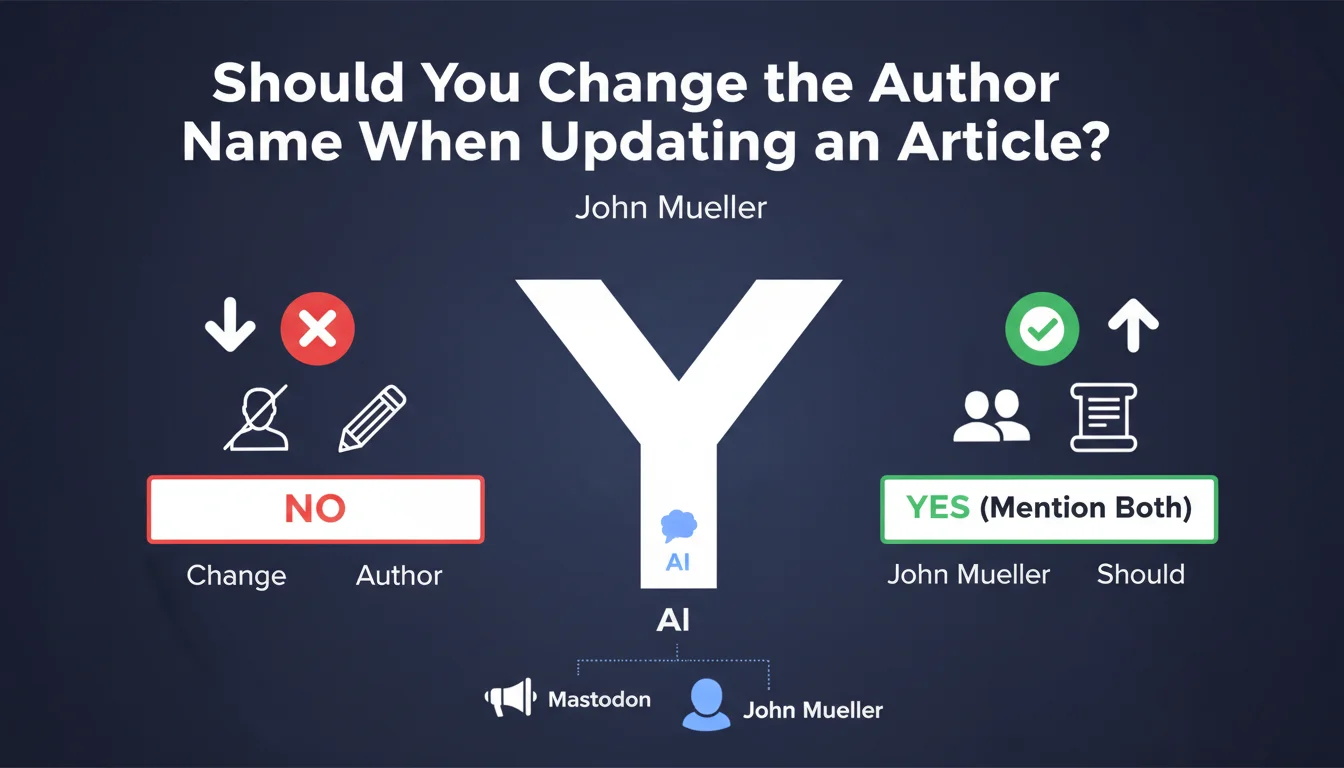
Google recommends maintaining consistency in content attribution on your web pages. The principle is simple: each article must have a clearly identified author who does not change arbitrarily.
When content undergoes substantial modifications by a new person, Google suggests adopting a transparent approach. This means indicating both the original author and the contributor who made the significant update.
This recommendation fits within the logic of E-E-A-T (Experience, Expertise, Authoritativeness, Trustworthiness). Google seeks to understand who produces the content to assess its credibility and reliability.
- Never change the author name randomly or arbitrarily
- Maintain attribution to the original author even after several years
- Explicitly mention both authors in case of major content overhaul
- Ensure traceability of creation and significant modifications
- Prioritize transparency to strengthen user and Google trust
SEO Expert opinion
This position is perfectly consistent with field observations. Sites that maintain clear and stable attribution of their content tend to perform better, particularly in YMYL (Your Money Your Life) sectors where author expertise matters tremendously.
However, there is a significant gray area: minor updates. Correcting a few sentences, updating a date, or adding a paragraph doesn't necessarily justify adding a second author. The dividing line is around modifications that substantially change the message, angle, or expertise deployed in the article.
A rarely discussed point concerns collective content or brand articles. In these cases, attribution to the company itself may prove more relevant than regular changes of individual authors.
Practical impact and recommendations
- Audit your current attributions: verify that the displayed authors actually correspond to the real creators and that there have been no arbitrary changes in your history
- Define a clear editorial policy: establish precise rules on when and how to add a co-author during updates (modification threshold, types of changes concerned)
- Implement a dual attribution system: configure your templates to display "Written by [Author A] - Updated by [Author B]" when relevant
- Optimize your structured data: correctly use schema.org author and contributor tags to distinguish the main author from secondary contributors
- Check your CMS settings: disable any option that would automatically change the author during a simple edit
- Create robust author pages: each mentioned author must have a dedicated page with their biography, qualifications, and other contributions
- Document major updates: add a visible "Modification History" section for significant overhauls with dates and contributors
- Train your editorial teams: raise awareness among writers and editors about the importance of consistent attribution for SEO
Rigorous management of content attribution involves technical modifications in your templates, a revision of your editorial processes, and a fine understanding of E-E-A-T signals. Faced with the complexity of these optimizations that simultaneously touch technical, semantic, and organizational aspects, support from a specialized SEO agency can prove valuable in developing a custom attribution strategy adapted to your content ecosystem.
💬 Comments (0)
Be the first to comment.