
Official statement
What you need to understand
Why did Google's founders believe their search engine was immune to spam?
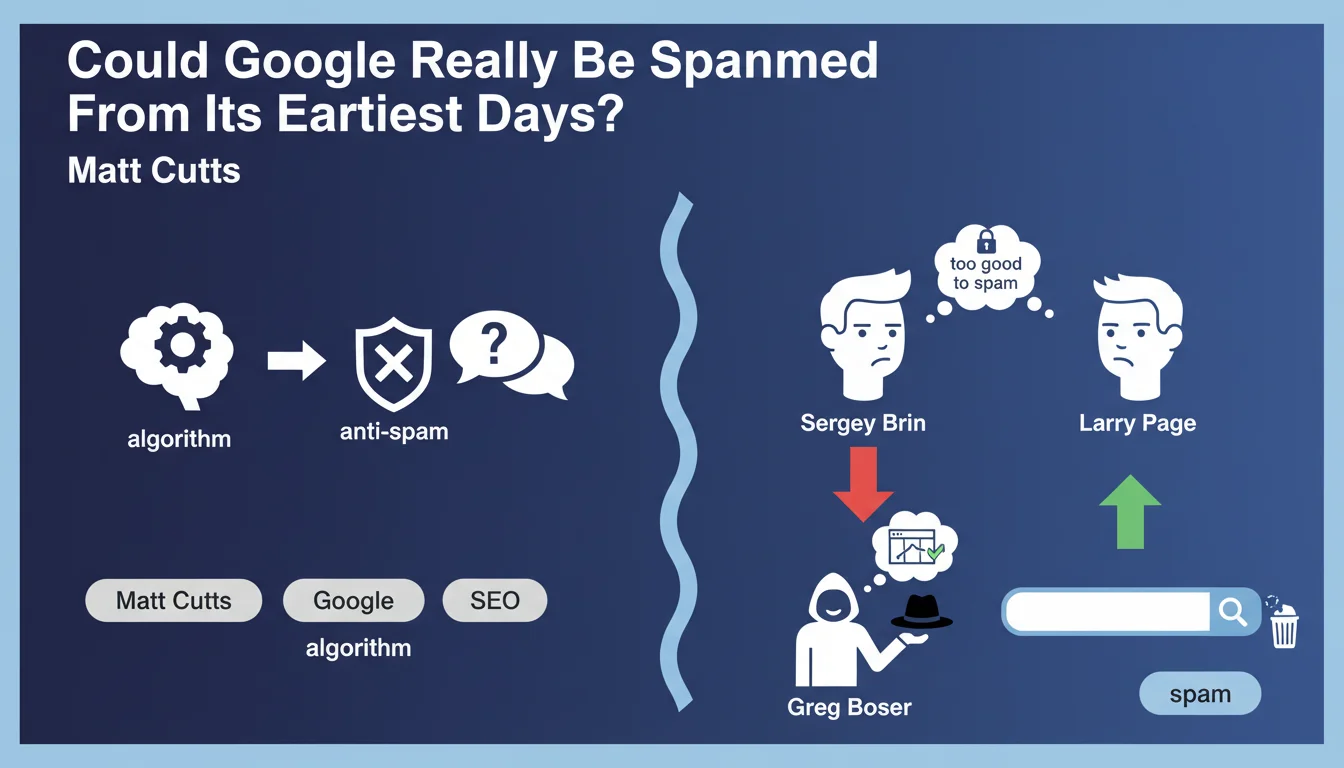
In Google's early days, Sergey Brin and Larry Page were convinced that their algorithm was so sophisticated it couldn't be manipulated. This confidence was based on the innovation of PageRank, which evaluated page quality according to incoming links rather than simply keywords.
Matt Cutts, hired as head of the webspam team, had to prove otherwise. He concretely demonstrated that manipulation techniques could fool the algorithm, forcing Google to develop detection and penalty systems that are now at the heart of SEO.
What does this anecdote reveal about the evolution of SEO?
This story illustrates a major turning point: the transition from a naive search engine to a complex surveillance ecosystem. Google's early years saw the emergence of black hat SEO, with techniques like keyword stuffing, link farms, and cloaking.
The founders' initial stubbornness explains why Google subsequently developed an almost military approach against spam. Every major update (Panda, Penguin, etc.) is a direct response to these early manipulations that the leadership team hadn't anticipated.
- Historical lesson: No algorithm is invulnerable to manipulation
- Necessary evolution: Google had to invest massively in anti-spam
- Current reality: The fight against spam represents a major portion of Google's resources
- Lasting impact: This experience shaped Google's policy of limited transparency about its algorithm
How does this confession influence our current understanding of Google?
Recognizing this initial vulnerability helps us understand Google's current paranoia regarding manipulations. The search engine now maintains deliberate opacity about its ranking criteria precisely to avoid systematic exploitation.
This story also contextualizes the central role of Matt Cutts in SEO history. For years, he was the interface between Google and SEO professionals, establishing the foundations of best practices we still follow today.
SEO Expert opinion
Is this statement consistent with practices observed in the field?
Absolutely. With 15 years of SEO experience, I can confirm that this anecdote perfectly explains the current dynamic between Google and SEO practitioners. The search engine remains in a state of permanent alert against any manipulation attempt.
Sergey Brin's initial arrogance has given way to systematic mistrust. Every new SEO technique, even white hat, is scrutinized to detect potential abuse. This vigilance explains why Google sometimes penalizes legitimate sites out of excessive caution.
Matt Cutts' victory in this debate shaped Google's punitive philosophy. Rather than simply ignoring manipulations, the algorithm applies severe penalties that can destroy a site's traffic in a matter of hours.
What nuances should be added to this historical perspective?
We must acknowledge that spam techniques of that era were much cruder than today. Keyword stuffing, doorway pages, or obvious link networks are now easily detectable. Modern spam is far more sophisticated.
Furthermore, the current algorithm integrates hundreds of criteria and machine learning that indeed make it more difficult to manipulate durably. Brin's original confidence wasn't completely unfounded, just 20 years premature.
What lesson should SEO practitioners take from this anecdote?
The main lesson is that the balance between optimization and manipulation remains at the heart of the profession. Google has never trusted SEOs since this awakening, which explains the strict guidelines and frequent algorithmic updates.
Understanding this historical mistrust helps anticipate Google's reactions to new practices. Every SEO innovation will be examined from the angle of abuse potential, even if it brings real value to users.
Practical impact and recommendations
What should you do concretely following this revelation?
Adopt a defensive approach in your SEO strategy. Since Google assumes that any optimization could be spam, ensure that every action is justifiable by user experience.
Document your SEO practices and maintain complete transparency. In case of penalty, you must be able to demonstrate that your optimizations aimed at site improvement, not algorithm manipulation.
Diversify your traffic sources to avoid depending solely on Google. This strategic resilience protects you against unpredictable algorithmic changes born from this historical paranoia.
What mistakes should you absolutely avoid in this context?
Never attempt grey hat or black hat techniques, even if they seem to work short-term. History shows that Google invests massively to detect and penalize these practices, with a time lag that's constantly shrinking.
Avoid over-optimizations that can trigger algorithmic alerts. Too-perfect link anchor text, excessively high keyword density, or artificial link patterns are bright red signals for anti-spam systems.
Don't blindly follow SEO advice found online without verifying its legitimacy. Many practices presented as effective are actually risky techniques inherited from the pre-Cutts era.
- Regularly audit your link profile to identify toxic backlinks
- Always prioritize quality content oriented toward users rather than search engines
- Use Search Console to monitor alerts and manual actions
- Maintain a natural publishing rhythm without suspicious activity spikes
- Vary your link anchors organically and contextually
- Invest in user experience (speed, mobile, Core Web Vitals)
- Create natural links through content merit, not through purchase or exchange
- Stay informed about algorithmic updates and adapt your strategy
How do you build a sustainable SEO strategy facing this reality?
Focus on creating a solid content ecosystem that naturally attracts links and visits. This long-term approach better withstands algorithmic evolutions than aggressive optimization tactics.
Invest in measurable quality signals: topical authority, user engagement, content freshness, and demonstrated expertise (E-E-A-T). These criteria are difficult to manipulate and aligned with Google's objectives.
💬 Comments (0)
Be the first to comment.