
Official statement
Other statements from this video 12 ▾
- □ Le keyword stuffing est-il vraiment pénalisé par Google ?
- □ Le texte caché est-il toujours considéré comme du spam par Google ?
- □ Le contenu généré aléatoirement fait-il vraiment partie des pratiques spam selon Google ?
- □ Le HTML valide est-il vraiment nécessaire pour bien se classer dans Google ?
- □ Pourquoi Google insiste-t-il autant sur les vraies balises <a href> ?
- □ Faut-il vraiment abandonner les images CSS au profit des balises <img> pour le SEO ?
- □ Le noindex est-il vraiment une règle absolue ou Google prend-il des libertés ?
- □ HTTPS est-il vraiment obligatoire pour être indexé par Google ?
- □ Pourquoi Google recommande-t-il d'abandonner les plugins pour afficher du contenu web ?
- □ Pourquoi Google ne déclenche-t-il pas les événements de scroll ou de clic pour crawler votre contenu ?
- □ L'alt text des images reste-t-il vraiment indispensable face à la vision par ordinateur de Google ?
- □ Les directives SEO de Google sont-elles vraiment fiables sur la durée ?
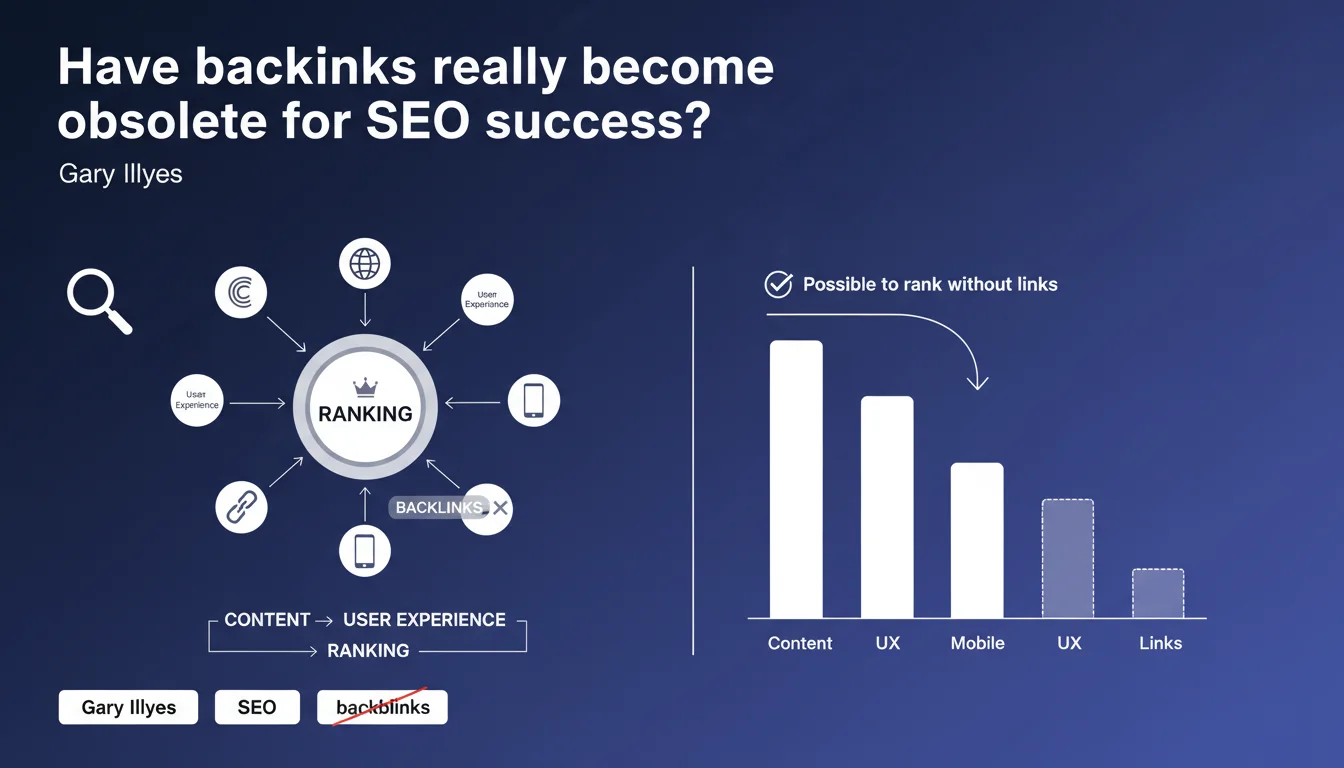
Gary Illyes claims it's possible to rank without links and that backlinks are no longer a major ranking factor in Google's algorithm. This statement disrupts 20 years of SEO doctrine that placed links at the heart of every positioning strategy. In practical terms, Google would now prioritize other signals to evaluate content relevance and authority.
What you need to understand
What does "links are no longer a major factor" really mean?
Gary Illyes is not saying that links have become completely useless. He is asserting that they no longer constitute a decisive element in the modern ranking algorithm. In other words: yes, backlinks still matter, but their relative weight has diminished compared to other signals.
This nuance is critical. Google has always operated on a system of hundreds of ranking factors that interact with each other. What Illyes implies is that other dimensions — content quality, user experience, behavioral data, semantic entities — have taken the upper hand.
How is it possible to rank without any links at all?
The statement explicitly affirms that a site can rank without backlinks. This primarily concerns niche queries, content addressing ultra-specific intent, or pages benefiting from already-established domain authority.
Google then relies on other criteria: content freshness, semantic alignment with search intent, engagement signals, technical site structure. In certain low-competition niches, these factors are indeed sufficient to achieve a ranking.
What are the other factors that have taken over?
Several major algorithm evolutions explain this shift. BERT and MUM enable Google to understand natural language and contextual nuances without relying solely on links. Core Web Vitals measure actual technical experience.
Semantic entity analysis via the Knowledge Graph gives Google deep topical understanding, independent of inbound links. Behavioral data — click-through rates, session duration, pogo-sticking — provide direct user satisfaction signals.
- Links remain a factor among others but no longer dominate the algorithm
- It is technically possible to rank without backlinks, especially in low-competition areas
- Google now prioritizes semantic understanding, user experience, and contextual relevance
- This statement challenges the historical SEO obsession with link building
- Behavioral signals and entity analysis are gaining in importance
SEO Expert opinion
Is this statement consistent with what we observe in practice?
Let's be honest: partially. In ultra-competitive sectors (finance, health, insurance), it's impossible to rank in the top 3 without a solid link profile. Sites that dominate these SERPs all have massive, quality backlinks. Empirical observation contradicts the idea that you can systematically do without links.
However, on specific long tails or low-competition niches, we do see pages rank with virtually no link profile. The determining factor? Content that exactly answers the intent with flawless technical structure.
[To verify]: Google doesn't specify at what competition threshold links become decisive again. This gray area is problematic for calibrating a strategy.
Why is Google downplaying link importance now?
Several hypotheses. First, massive manipulation of link building over 20 years may have prompted Google to diversify its signals to avoid being too dependent on an easily exploitable factor. PBNs, link exchanges, mass purchases have polluted this signal.
Second, Google has invested heavily in natural language processing (NLP) and can now evaluate content quality intrinsically, without relying solely on the "votes" that external links represent. This is a logical evolution of the technology.
But beware — and this is where it gets tricky: downplaying links publicly also allows Google to discourage aggressive link-building practices while continuing to use them internally. A form of strategic communication, not necessarily an accurate reflection of the algorithm.
In what cases does this rule absolutely not apply?
On money keywords with ultra-high competition, this statement is virtually obsolete. Try ranking for "car insurance" or "mortgage loan" without links — you'll be waiting a long time. Market reality still imposes backlinks as the primary weapon.
Same for new domains without history or authority. A site starting from scratch will need external signals to emerge, even if its content is excellent. Google needs third-party trust signals, especially in the absence of behavioral data.
Practical impact and recommendations
Should you abandon link building in your SEO strategy?
No. Let's clarify: you should rebalance your effort. If you were spending 70% of your time on link building and 30% on content and technical optimization, reverse the proportion. Links still matter, but they're no longer sufficient on their own.
Concretely, prioritize quality, contextual backlinks from thematically relevant sites, rather than quantitative accumulation. A link from an authoritative site in your sector is now worth far more than 20 mediocre generalist links.
What levers should move up in priority?
First axis: intrinsic content quality. Not content for search engines, but content that precisely answers user intent, with depth, clear structure, original data. Google can now measure this.
Second axis: technical optimization and UX. Core Web Vitals, loading time, mobile-first, clear architecture. These signals carry weight when Google evaluates the actual visitor experience. A slow site with good links loses to a fast site without links.
Third axis: strategic internal linking. If external links carry less weight, distributing authority internally via a well-constructed semantic silo becomes even more critical for guiding Google to your key pages.
How to verify your strategy is aligned with this evolution?
Audit your current effort distribution. If 80% of your resources go to link acquisition and your content stagnates, you're vulnerable. Rebalance toward a more holistic approach.
Test pages without active link building on long-tail queries in your sector. Publish ultra-targeted, technically flawless content, and measure if they rank naturally. This is a good barometer of your other signals' strength.
Analyze your direct competitors: are they beating you solely through links, or do they also have richer content, better UX, superior topical authority? The answer will tell you where to invest.
- Don't eliminate link building, but reduce its share of your time/resource budget
- Focus on quality, thematic, contextual backlinks
- Invest heavily in content quality and answering user intent
- Optimize technical experience: Core Web Vitals, mobile-first, loading speed
- Strengthen internal linking to compensate for reduced importance of external links
- Test pages without active link building to measure your other signals' strength
- Audit competitors to identify true performance levers
❓ Frequently Asked Questions
Les backlinks sont-ils complètement inutiles maintenant ?
Peut-on vraiment ranker sans aucun lien entrant ?
Quels facteurs ont pris le relais des liens dans l'algorithme ?
Faut-il arrêter complètement les campagnes de netlinking ?
Cette déclaration change-t-elle la donne pour les nouveaux sites ?
🎥 From the same video 12
Other SEO insights extracted from this same Google Search Central video · published on 03/02/2022
🎥 Watch the full video on YouTube →
💬 Comments (0)
Be the first to comment.