
Official statement
Other statements from this video 12 ▾
- □ Le keyword stuffing est-il vraiment pénalisé par Google ?
- □ Le texte caché est-il toujours considéré comme du spam par Google ?
- □ Le contenu généré aléatoirement fait-il vraiment partie des pratiques spam selon Google ?
- □ Les backlinks sont-ils devenus inutiles pour le référencement naturel ?
- □ Le HTML valide est-il vraiment nécessaire pour bien se classer dans Google ?
- □ Pourquoi Google insiste-t-il autant sur les vraies balises <a href> ?
- □ Faut-il vraiment abandonner les images CSS au profit des balises <img> pour le SEO ?
- □ Le noindex est-il vraiment une règle absolue ou Google prend-il des libertés ?
- □ HTTPS est-il vraiment obligatoire pour être indexé par Google ?
- □ Pourquoi Google recommande-t-il d'abandonner les plugins pour afficher du contenu web ?
- □ Pourquoi Google ne déclenche-t-il pas les événements de scroll ou de clic pour crawler votre contenu ?
- □ Les directives SEO de Google sont-elles vraiment fiables sur la durée ?
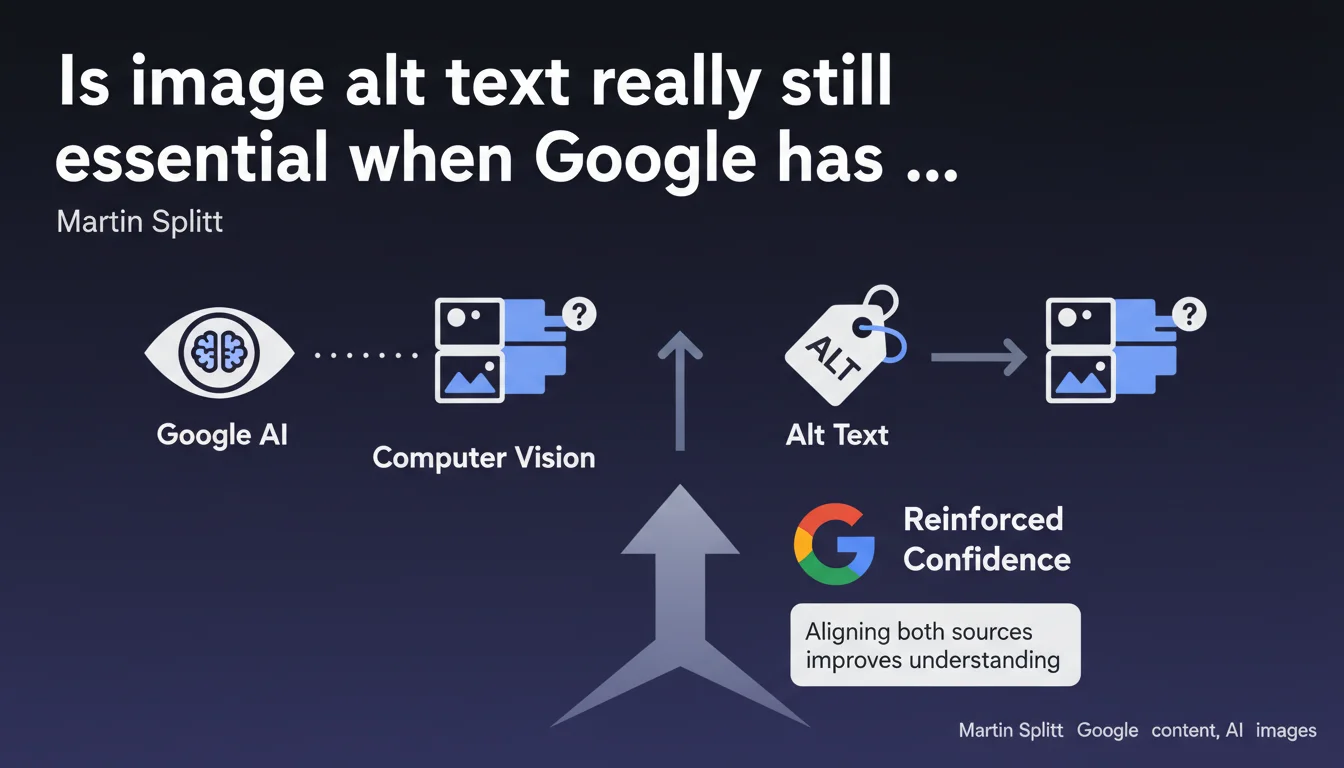
Google now combines computer vision and alt attributes to analyze your images. Alt text isn't being replaced by AI — it serves as a confirmation signal that reinforces Google's trust when it aligns with what the algorithm detects visually. In other words: relevant alt text doubles your credibility.
What you need to understand
Why does Google continue to value alt text when it can already "see" images?
Google has developed computer vision capabilities that can identify objects, faces, embedded text, and even the general context of a photo. Technically, the algorithm could get by without your alt.
But — and this is where it gets interesting — Google uses alt as a confirmation signal. When what you declare in the alt attribute matches what the AI detects, trust increases. When there's a discrepancy or no alt at all, Google has to make a judgment call on its own, without external validation.
Concretely, how does this "trust" actually manifest?
The alignment between AI vision and alt text allows Google to index the image with greater confidence in Google Images, better understand page context, and potentially display enriched results.
Conversely, deceptive alt text or keyword-stuffed alt full of off-topic terms creates cognitive dissonance for the algorithm. Google detects a cat, you declare "commercial law attorney Paris" — trust plummets.
Does this change how we should write alt text?
Yes and no. The golden rule remains factual and precise description. But now you know Google is verifying your claims.
Gone are the days when you could stuff alt text with unrelated keywords. Computer vision plays the role of lie detector.
- Alt text isn't obsolete — it becomes a mutual trust signal between your site and Google
- AI vision analyzes independently, but values human confirmation through the alt attribute
- Relevant alt = double validation = better indexing in Google Images
- Deceptive or spam-filled alt triggers a discrepancy alert
- Missing alt means losing an opportunity to strengthen your visual content's credibility
SEO Expert opinion
Does this announcement really change the game for SEO practitioners?
Honestly? Not that much. Competent SEOs were already writing factual alt text years ago. What's changing is the technical justification: we now know Google actively cross-references these sources.
Where it gets interesting is for sites that neglected alt text thinking "Google can see the image anyway." Splitt confirms that's not true — missing alt means losing a reinforcement signal. It's not a blocker, but it's wasted potential.
What blind spots remain in this announcement?
Martin Splitt stays vague on several critical points. [To verify]: at what threshold of divergence does Google penalize a site? Is "acceptable but imprecise" alt treated as an error or simply ignored?
Another gap: what about complex images (charts, infographics, technical diagrams) that AI still struggles to decode? In these cases, does alt remain the dominant signal, or does Google simply abandon detailed indexing?
Should we change our alt text writing strategy right now?
If you were already doing solid work: nothing changes. Keep describing factually, without keyword stuffing, thinking accessibility first.
If you were stuffing your alt text with out-of-context keywords: now's the time to stop. Google can now objectively measure the gap between what you declare and what it sees. The risk of losing credibility increases.
Practical impact and recommendations
What should you do concretely on an existing site?
First step: audit existing alt text. Identify images without alt, those with generic alt ("image1.jpg"), and especially those with alt overloaded with unrelated keywords.
Second step: write or rewrite alt text following the visual alignment rule. Describe what's actually visible, not what you want Google to understand.
What errors should you absolutely avoid?
Don't fall into the opposite trap: alt that's too minimal also loses value. "Photo" or "product image" adds nothing — neither for Google nor for screen readers.
Also avoid duplicating the same alt across multiple different images. Google's computer vision detects that these are distinct visuals — identical alt text creates structural inconsistency.
How can you verify that your site complies with this double-validation logic?
Use an SEO crawler (Screaming Frog, OnCrawl, Botify) to extract all your images and their alt attributes. Cross-check with manual verification on a sample.
For e-commerce or editorial sites with thousands of images, partially automate writing through dynamic templates, but keep human validation on strategic images (flagship products, featured visuals).
- Audit images without alt or with generic/duplicate alt
- Rewrite alt by factually describing what's visible
- Remove any keyword stuffing unrelated to the image
- Favor alt text of 10-15 words max, precise and natural
- Check alt/visual alignment on strategic images (products, banners, infographics)
- Automate with caution: templates OK, but human validation needed
- Regularly monitor newly published images (CMS, user uploads)
❓ Frequently Asked Questions
Google peut-il indexer correctement une image sans attribut alt ?
Un alt bourré de mots-clés non liés à l'image peut-il pénaliser mon site ?
Faut-il réécrire tous mes alt existants immédiatement ?
La vision par ordinateur fonctionne-t-elle aussi bien sur des graphiques ou schémas techniques ?
Quelle longueur idéale pour un attribut alt ?
🎥 From the same video 12
Other SEO insights extracted from this same Google Search Central video · published on 03/02/2022
🎥 Watch the full video on YouTube →
💬 Comments (0)
Be the first to comment.