
Official statement
What you need to understand
What technical issue does this statement raise?
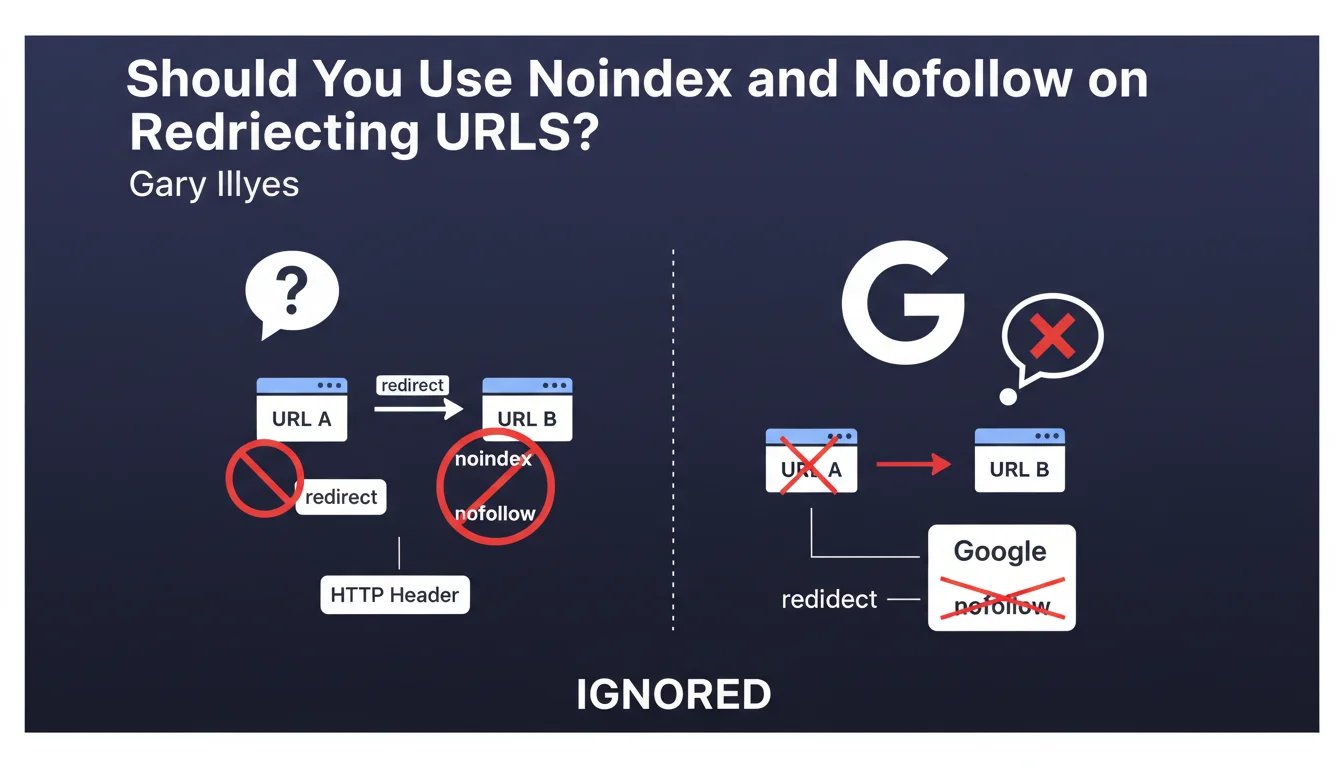
The question concerns a situation where a URL that performs an HTTP redirection (301 or 302) also contains noindex or nofollow directives in the HTTP headers. This is a potential conflict between two contradictory instructions given to Googlebot.
On one hand, the redirection indicates "follow this new URL". On the other, the noindex/nofollow directives request "don't index and don't follow the links". Google must therefore choose which instruction to prioritize.
What exactly does Google say about this topic?
According to Gary Illyes, Google would tend to ignore the noindex/nofollow directives when a redirection is present. The redirection would therefore be treated as the priority instruction.
However, the response remains intentionally vague, as the behavior could vary depending on the site. This ambiguity suggests that Google probably applies contextual logic rather than an absolute rule.
Why does this technical situation rarely occur?
In practice, it's uncommon to combine redirection and noindex/nofollow directives, because these instructions have opposite objectives. A redirection aims to transfer users and PageRank, while noindex/nofollow aim to block indexation.
- Redirections serve to preserve SEO during URL changes
- Noindex/nofollow directives prevent indexation and link following
- Combining both creates a contradictory instruction for search engines
- Google generally prioritizes the redirection over other directives
- Behavior may vary depending on the context and site
SEO Expert opinion
Is this statement consistent with real-world observations?
This position from Google is perfectly logical from a technical standpoint. When a crawler encounters an HTTP redirection, it naturally follows this instruction and loads the new URL. The headers of the starting URL therefore become obsolete.
In my audits, I've indeed observed that Google follows redirections almost systematically, even in the presence of other directives. The HTTP status code (301, 302, etc.) takes precedence over other header instructions.
What important nuances should be brought to this rule?
The ambiguity of Gary Illyes' response reveals that Google doesn't apply a binary rule. The engine probably analyzes the overall site context and the intent behind this configuration.
If Google detects a suspicious pattern (for example, massive redirections to noindex pages), it could apply anti-spam logic. Conversely, an isolated and accidental configuration will be treated differently.
In what exceptional cases could this configuration be intentional?
There are rare legitimate scenarios where this combination might appear. For example, during a progressive site migration where you want to redirect temporarily but avoid double indexation.
You can also imagine cases of complex geolocation where a URL redirects according to geographic area while wanting to avoid indexation of the distribution URL. But these situations remain marginal and often reveal a sub-optimal architecture.
Practical impact and recommendations
What should you do concretely on your site?
The first action is to audit your site to identify any combination of redirections and noindex/nofollow directives. This configuration is generally the result of an error or contradictory settings between different systems.
Use your log analysis tools and a technical crawler to detect these cases. Check particularly URLs from migrations, A/B tests, or geolocation systems.
What critical errors must you absolutely avoid?
Never intentionally configure a URL with redirection AND noindex/nofollow, thinking you're finely controlling Google's behavior. The result will be unpredictable and uncontrolled.
Also avoid leaving obsolete configurations lingering after a migration. Systematically clean up directives that are no longer relevant once redirections are in place.
How can you verify and correct your current configuration?
Perform a complete crawl of your site with a tool like Screaming Frog or OnCrawl by activating HTTP header analysis. Filter URLs that simultaneously present a redirection code (3xx) and noindex or nofollow directives.
For each detected case, clarify the intent: either you want to redirect (then remove the blocking directives), or you want to block indexation (then remove the redirection and return a 200 code with noindex).
- Crawl your site to identify URLs with redirection + noindex/nofollow
- Analyze server logs to understand how Googlebot treats these URLs
- Remove noindex/nofollow directives on all redirecting URLs
- Document your configuration choices to avoid future regressions
- Test the behavior in Google Search Console after correction
- Set up automatic monitoring to detect these configurations
- Train your technical teams on redirection best practices
💬 Comments (0)
Be the first to comment.