
Official statement
Other statements from this video 15 ▾
- □ Does hreflang really boost your ranking in a targeted country?
- □ Should you really reduce the number of pages to optimize your international SEO?
- □ Does Google really use only main content to identify language on multilingual pages?
- □ Does Google really ignore your page titles when the language doesn't match your content?
- □ Does Google really use domain authority to rank websites?
- □ Is your content trapped behind buttons that Googlebot refuses to click?
- □ Are JavaScript interstitials really safe for your SEO?
- □ Can a technical bug during a Core Update really cause your site to crash in rankings?
- □ Can technical problems really trigger a ranking drop during a Core Update?
- □ Does Google penalize you for translating content between languages?
- □ Can poor machine translations really sabotage your international SEO strategy?
- □ Can Googlebot actually access your .htaccess file?
- □ Does Google really give its own platforms an unfair advantage in search results?
- □ Does the meta description really impact your Google rankings?
- □ Should you really choose your structured data based on the rich results you're targeting in the SERPs?
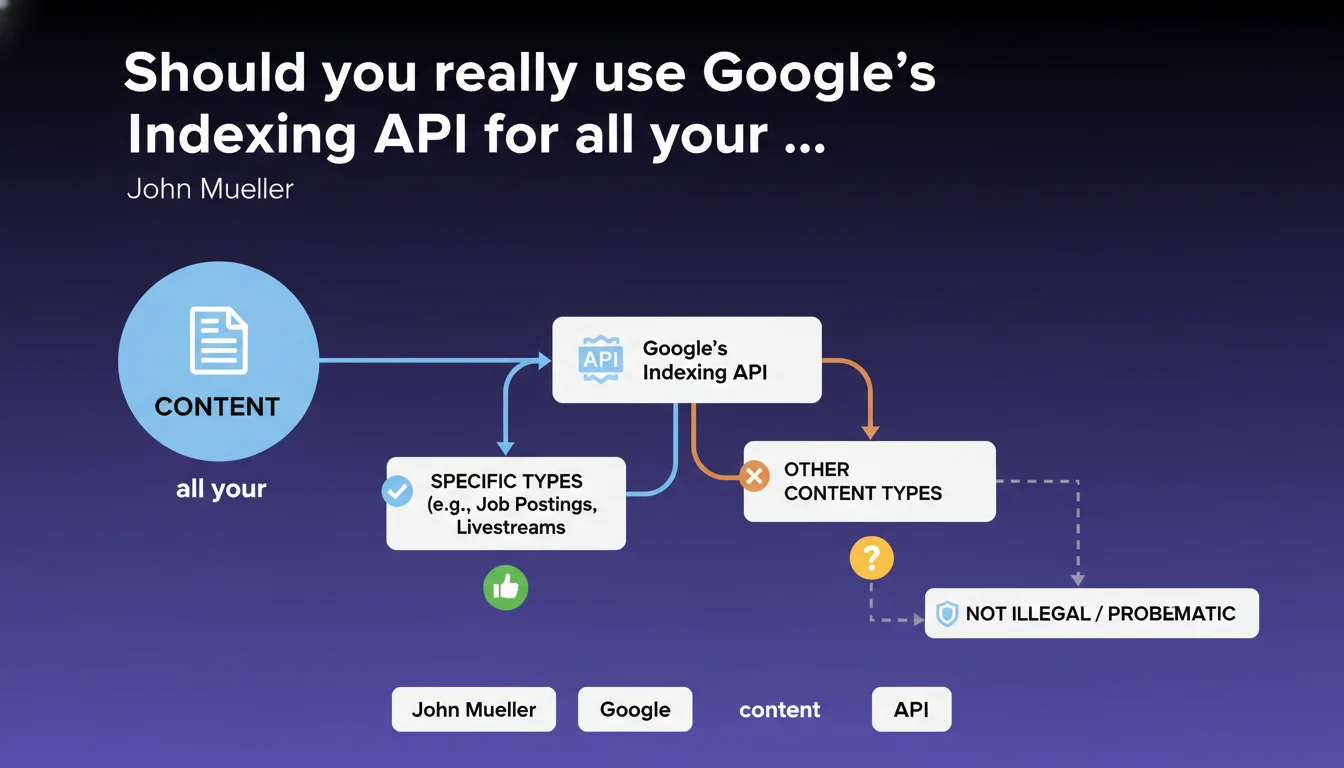
Google's Indexing API is relevant only for very specific types of content. Using it for other content types brings no tangible benefit, even though it doesn't cause technical problems. Mueller confirms it's a niche tool, not a universal indexing lever.
What you need to understand
Why does Google impose restrictions on the Indexing API?
The Indexing API was designed to accelerate indexing of time-sensitive content: job postings and streaming videos primarily. These types of content require near-immediate indexing because their relevance evaporates within hours or days.
Google has never positioned it as a generic tool. Unlike Search Console which passively signals URLs, the API actively pushes indexing requests — which mobilizes resources on Google's side.
What happens if you use it for other content types?
According to Mueller, nothing dramatic. No penalty, no technical blocks. Simply, no measurable effect on indexing speed.
URLs submitted via the API outside intended use cases join the normal crawl queue. You lose development time for a result identical to an XML sitemap submission.
What are the officially validated use cases?
Google documents two main cases: JobPosting (job offers) and BroadcastEvent (live video events). These content types benefit from priority treatment via the API.
For everything else — blog articles, product sheets, category pages — classical mechanisms (sitemaps, internal linking, natural crawl) remain the standard.
- The Indexing API targets only short-lived content
- Using it outside its intended purpose generates neither benefit nor penalty
- Standard content must go through traditional channels
- JobPosting and BroadcastEvent are the two officially validated types
SEO Expert opinion
Is this restriction consistent with real-world observations?
Yes, absolutely. Tests conducted on e-commerce or editorial sites show zero indexing delay difference between API and classical sitemap for standard content.
Some SEO tools have attempted to bypass the limitation by declaring pages as JobPosting when they were actually articles. Result: indexing without acceleration, and risk of deindexing for structured data spam if Google detects the abuse.
Why so much confusion around this tool?
Because the name "Indexing API" makes people believe it improves indexing in general. It's a perception bias perpetuated by poorly informed articles and SaaS tools that oversell the feature.
Google could have named it "JobPosting/BroadcastEvent API" to avoid any ambiguity. The semantic blur creates unrealistic expectations among less experienced practitioners.
In what cases could this rule evolve?
[To be verified] — Google could expand the use cases if API request volume remains manageable. But nothing indicates a move in that direction.
The trend is rather toward tightening of criteria. Google has historically closed API access (Authorship, rel=author) when usage deviated from the initial intent. Anticipating an opening would be naive.
Practical impact and recommendations
What should you concretely do with the Indexing API?
If you manage a recruitment site or video streaming platform, implement the API without hesitation. It's the only case where it delivers real measurable value.
For all other types of sites: ignore it. Focus on levers that actually work — optimized XML sitemaps, crawl budget, strategic internal linking.
What mistakes must you absolutely avoid?
Never declare a false content type to try to speed up indexing. Google detects these manipulations via structured data validators and can apply manual actions.
Don't pay for a tool that promises "instant indexing via Google's API". It's either technical ignorance or misleading marketing.
How do you verify that your indexing strategy is optimal?
Audit your server logs to identify Googlebot crawl patterns. If certain important sections are under-crawled, the problem is structural (architecture, pagination, JS rendering), not related to lack of API.
Use the Search Console Coverage report to spot "Discovered – currently not indexed" URLs. These pages won't be indexed faster via the API — they lack internal popularity or perceived value.
- Implement the API only if you publish JobPosting or BroadcastEvent content
- Abandon the idea of using the API to accelerate general indexing
- Prioritize segmented XML sitemaps by update frequency
- Strengthen internal linking to strategy pages with low crawl frequency
- Avoid tools that oversell the API's capabilities
- Monitor logs to understand Googlebot's actual behavior
❓ Frequently Asked Questions
L'API d'indexation accélère-t-elle l'indexation de mes articles de blog ?
Puis-je être pénalisé si j'utilise l'API pour des contenus non éligibles ?
Quels types de contenus bénéficient réellement de l'API ?
Les outils SEO qui proposent l'API d'indexation tous contenus sont-ils fiables ?
Faut-il désactiver l'API si je l'ai déjà implémentée sur un site éditorial ?
🎥 From the same video 15
Other SEO insights extracted from this same Google Search Central video · published on 29/04/2022
🎥 Watch the full video on YouTube →
💬 Comments (0)
Be the first to comment.