
Official statement
Other statements from this video 9 ▾
- □ Does Search Console Really Only Track Data Before Users Click Through to Your Site?
- □ Why do Search Console clicks and Analytics sessions never match up?
- □ Does Google really process Search Console data the same way for every single website?
- □ Why do Search Console and Google Analytics show conflicting data?
- □ Why does Search Console report more traffic than Analytics for your non-HTML content?
- □ Why do your traffic data differ between Search Console and Analytics?
- □ Why do Search Console and Google Analytics show different traffic numbers?
- □ Should you worry about discrepancies between Search Console and Google Analytics?
- □ Should you really cross Search Console and Google Analytics data to optimize your SEO strategy?
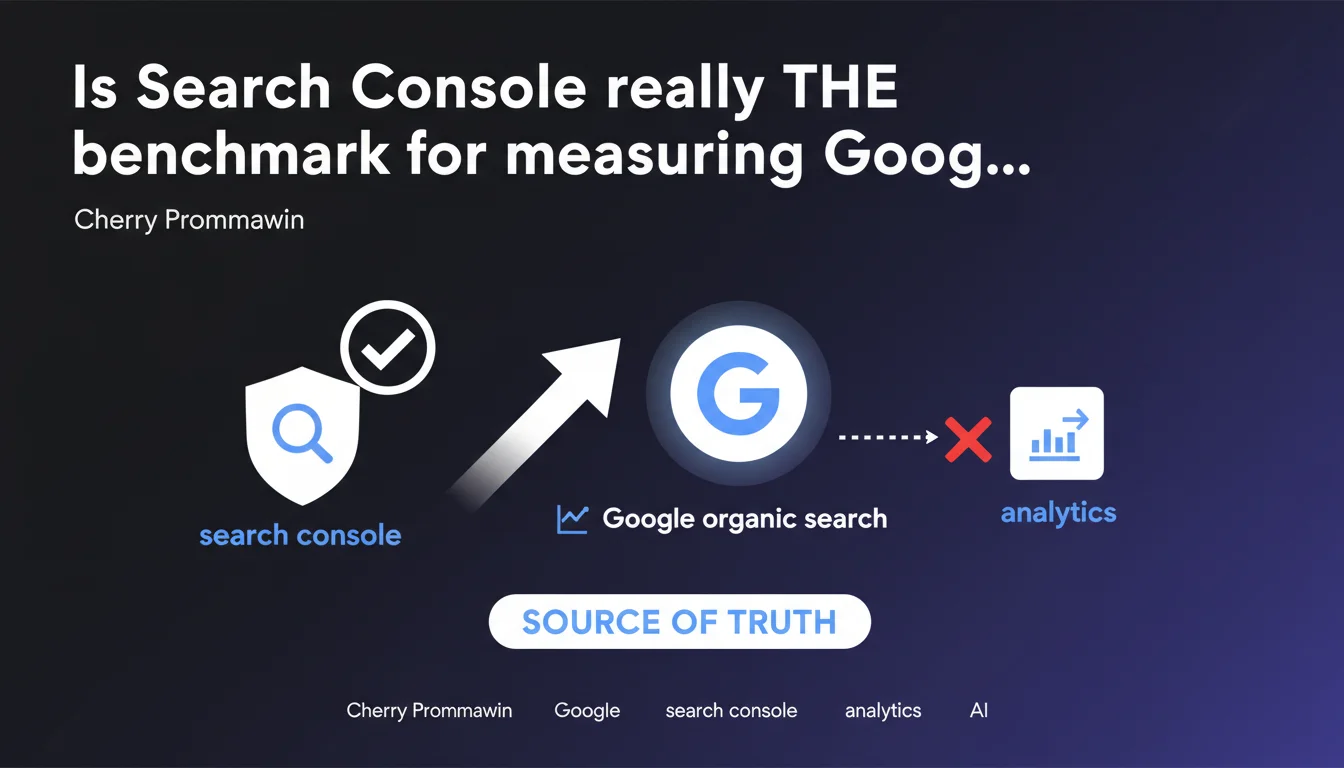
Google confirms that Search Console remains the official source for measuring organic search performance, even though Analytics also provides traffic data. This distinction is not trivial: the two tools don't measure exactly the same thing, and it's Search Console that reflects Google's view of your visibility.
What you need to understand
Why is there a distinction between Search Console and Google Analytics?
The two tools collect their data in fundamentally different ways. Search Console records impressions and clicks directly from Google search results, even before the user arrives on your site.
Google Analytics, on the other hand, triggers its tracking once the visitor has loaded your page — which means it can miss sessions if JavaScript doesn't load, if the user blocks cookies, or if the page never fully loads.
What are the limitations of each tool?
Search Console is capped at 1000 rows in its export reports, retains only 16 months of history, and aggregates certain "rare" queries under privacy thresholds. You never get the complete raw data.
Analytics, for its part, can underestimate actual organic traffic due to script blockers, privacy-focused browsers, or simply a poor tracking implementation. The gaps between the two platforms are therefore structural, not accidental.
- Search Console measures what Google sees: impressions, clicks, average position on its SERPs
- Google Analytics measures what your site receives: sessions, duration, conversions once the visitor arrives
- The two don't count the same events, hence systematically different figures
- "Anonymized" queries in Search Console can represent up to 10-15% of actual impressions
In what context is Google making this statement?
This position comes as more and more SEO professionals point out inconsistencies between tools. Cherry Prommawin clarifies: if you want to measure your SEO performance in Google's eyes, it's Search Console that has authority.
Concretely, this means that during an audit or client reporting, Search Console data should take precedence in evaluating organic visibility — even if it seems counterintuitive compared to Analytics.
SEO Expert opinion
Is this hierarchy between tools really new?
No — and that's precisely what's interesting. Google is simply reaffirming a principle that practitioners have known for years. But this official clarification puts an end to recurring debates in marketing teams where Analytics is often considered "more reliable" because it's better integrated into business reporting.
Let's be honest: many non-SEO decision-makers don't understand why the two tools give different numbers, and tend to favor Analytics by default. This statement gives SEO professionals an authority argument to impose Search Console as the benchmark in KPIs.
What nuances should be made in the field?
Google's "source of truth" doesn't mean Search Console is free from bias. Anonymized queries, privacy thresholds, and export limitations create significant blind spots. [To verify]: Google doesn't disclose the exact percentage of hidden data, and this rate varies by sector.
Furthermore, Search Console will never tell you what the visitor did once on your site — bounce, conversion, engagement. To measure the business effectiveness of your organic traffic, Analytics remains essential. The two tools are complementary, not interchangeable.
In what cases does this rule not fully apply?
If you're working on high-traffic international sites, Search Console's limitations (aggregation by country, 1000-row ceiling) can make granular analysis impossible. In this case, third-party tools become necessary to compensate.
Similarly, for sites with a multi-engine strategy (Bing, DuckDuckGo, Ecosia), Search Console only covers Google. Analytics will give you a consolidated view of global organic traffic, even if it's imperfect.
Practical impact and recommendations
What should you do concretely with this information?
First action: review your dashboards and reporting. If you're still presenting SEO KPIs based solely on Google Analytics, systematically add Search Console metrics — or better yet, make it the primary source for impressions, clicks, and average positions.
Next, if you notice significant gaps between the two tools, document them. Create a reference document explaining why the numbers differ, to avoid recurring questions from clients or managers who compare the two without understanding the methodological difference.
What errors should you avoid in interpreting data?
Never draw strategic conclusions by blindly combining Search Console and Analytics. For example, don't calculate a "bounce rate per query" by dividing Analytics bounces by Search Console clicks — the two don't measure the same sessions.
Also avoid overestimating Search Console's accuracy. Average positions, in particular, are aggregates that can mask significant variations depending on time of day, user location, or search result personalization.
- Integrate Search Console as the primary source in all SEO reporting
- Explain structural gaps between Search Console and Analytics to stakeholders
- Diagnose abnormal gaps (>30%) to detect implementation issues
- Never directly combine metrics from both tools without understanding their respective methodologies
- Use Analytics to measure engagement and conversions, Search Console for visibility
- Document Search Console limitations (anonymization, ceilings, limited history) in your analysis processes
How do you verify that your configuration is optimal?
Make sure that all your subdomains and protocol versions (http/https, www/non-www) are properly declared in Search Console. A poorly configured site can scatter its data across multiple properties and completely skew analysis.
Also verify that your sitemap is up to date and regularly crawled. Search Console partly relies on crawl signals to count impressions — an outdated sitemap can create blind spots.
❓ Frequently Asked Questions
Pourquoi les chiffres de trafic organique sont-ils toujours différents entre Search Console et Analytics ?
Dois-je abandonner Google Analytics pour mes reportings SEO ?
Quelles sont les principales limites de Search Console pour l'analyse SEO ?
Comment expliquer à un client pourquoi Search Console affiche moins de clics qu'Analytics de sessions organiques ?
Les données anonymisées dans Search Console représentent-elles une part importante du trafic réel ?
🎥 From the same video 9
Other SEO insights extracted from this same Google Search Central video · published on 29/01/2025
🎥 Watch the full video on YouTube →
💬 Comments (0)
Be the first to comment.