
Official statement
Other statements from this video 9 ▾
- □ Search Console est-elle vraiment LA référence pour mesurer le trafic organique Google ?
- □ Search Console ne mesure-t-elle vraiment que les données avant l'arrivée sur le site ?
- □ Pourquoi les clics Search Console et les sessions Analytics ne correspondent-ils jamais ?
- □ Search Console traite-t-il vraiment les données de la même façon pour tous les sites ?
- □ Pourquoi Search Console et Google Analytics affichent-ils des données contradictoires ?
- □ Pourquoi Search Console et Analytics affichent-ils des écarts de trafic sur vos contenus non-HTML ?
- □ Pourquoi les données de trafic diffèrent-elles entre Search Console et Analytics ?
- □ Pourquoi Search Console et Google Analytics affichent-ils des chiffres de trafic différents ?
- □ Faut-il vraiment croiser les données de Search Console et Google Analytics pour optimiser son SEO ?
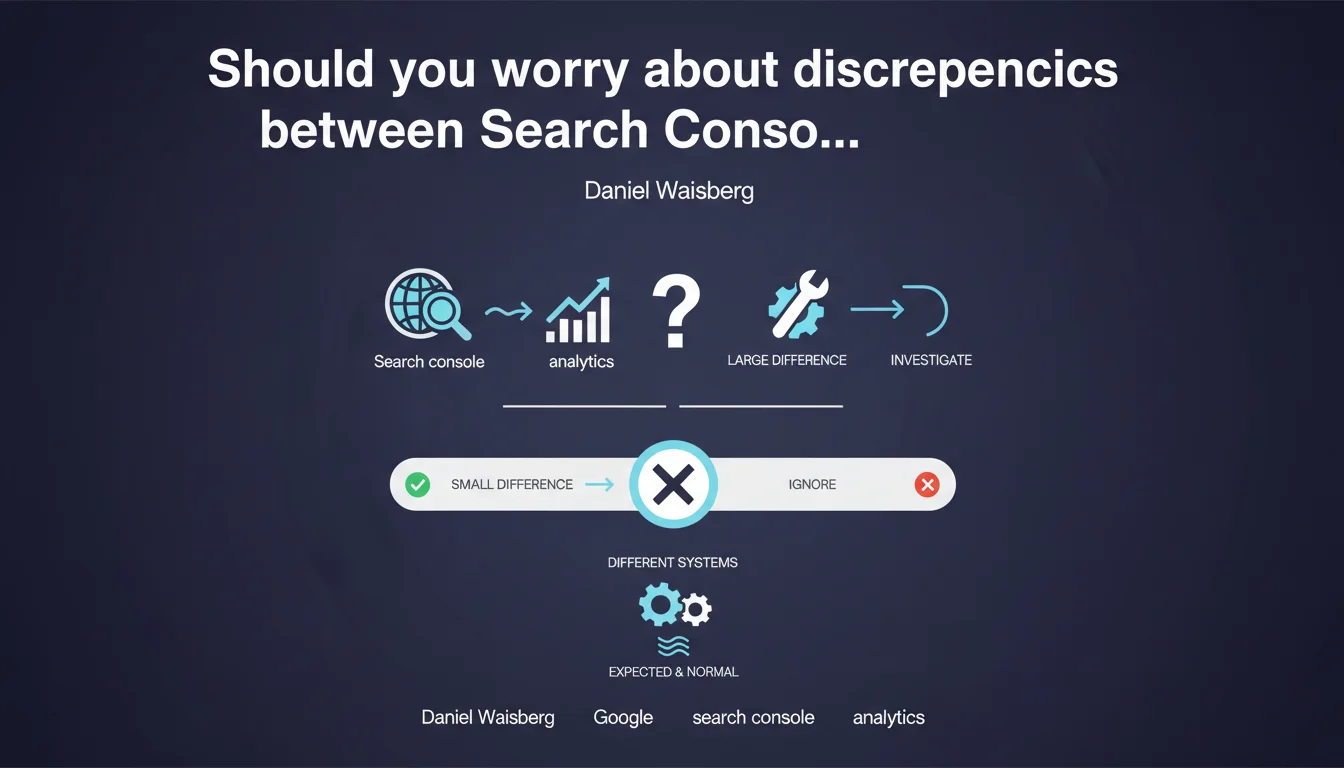
Google confirms that data differences between Search Console and Analytics are normal and expected. If the discrepancy remains small, there's no reason to be alarmed — the two tools measure differently. Let's be honest: it's a statement that doesn't teach us anything new, but it validates what we've been observing for years.
What you need to understand
Why do these two tools give different numbers?
Search Console and Google Analytics operate on radically different measurement architectures. Search Console collects data server-side, directly from Google search results — it captures impressions and clicks before the user even arrives on your site.
Analytics, on the other hand, relies on a JavaScript tag that fires once the page loads in the browser. Ad blockers, tracking refusals, loading issues — all of this filters the data before it reaches your reports.
What counts as a "small" discrepancy according to Google?
And that's where it gets tricky. Google never defines this threshold. 5%? 15%? 30%?
In practice, we observe divergences of 10 to 20% on most well-configured sites. Beyond 30%, there's likely a technical problem (double tagging, faulty GA4 configuration, untracked redirects).
Does this statement change how we work?
No. Experienced SEOs have long known that you should never rely on a single tool. What's new is that Google says it officially — which legitimizes this approach with clients or decision-makers who worry about seeing different numbers.
- Search Console measures exposure in the SERPs, not actual traffic
- Analytics measures post-click behavior, with filtering
- Sessions, unique visitors, and duration are never directly comparable
- A discrepancy of up to 20-30% is considered normal on healthy configurations
- Beyond that, look for a technical or configuration anomaly
SEO Expert opinion
Does this statement really answer the question?
Not really. Saying "it's normal" without quantifying the acceptable threshold is dodging the real problem. A 5% discrepancy and a 40% discrepancy are not the same thing — and Google gives us no numerical benchmark. [To verify] against your own sector benchmarks.
In fact, I've seen sites with 50% discrepancies between Search Console and Analytics due to tagging problems, untracked redirects, or poorly configured GA4 setups. Saying "it's normal" in these cases means missing critical optimization opportunities.
Can you really "ignore" these discrepancies as Google suggests?
Only if you've verified your tracking integrity. Ignoring a discrepancy without auditing your configuration risks piloting with false data.
The danger — and I've seen it too often — is accepting these divergences through analytical laziness. If your Analytics data shows 30% fewer sessions than your Search Console clicks, maybe your GA4 is only capturing part of the traffic. Maybe your UTM tags are overwriting your organic sources. Maybe your cookie consent is blocking too many visitors.
What are the real causes of abnormal discrepancies?
Large discrepancies (beyond 30-35%) often come from identifiable technical problems: double GA4 tagging, poorly configured filters, 302 redirects not being tracked, scripts blocked by CSP, overly restrictive cookie consent.
I've also observed massive divergences on sites with lots of mobile traffic, where ad blockers and tracking refusals are more frequent. In these cases, Search Console remains reliable — Analytics underestimates actual traffic by 40% or more.
Practical impact and recommendations
What should you actually do with this information?
First, measure the current discrepancy between your Search Console clicks and your Analytics organic sessions. If it's below 25-30%, you're probably in the clear. Beyond that, dig deeper.
Next, never rely on a single tool for making strategic decisions. Cross-reference Search Console, Analytics, and if possible your server logs. All three tell different stories — and it's by comparing them that you understand what's really happening.
What mistakes should you avoid when interpreting this data?
Never compare clicks and sessions as if they measure the same thing. A Search Console click can generate multiple page views, or none if the user leaves immediately. An Analytics session can include multiple traffic sources.
Also avoid panicking over a 10% discrepancy. That's noise, not signal. However, if your discrepancy suddenly jumps from 15% to 45%, that's a symptom — usually of a recent change in your tracking or server configuration.
How do you verify that your configuration is healthy?
- Compare Search Console clicks vs Analytics organic sessions over a 30-day rolling period
- Verify that your GA4 tag loads correctly with a debug tool (GA Debugger, Tag Assistant)
- Check your Analytics filters: are you accidentally excluding legitimate traffic?
- Test tracking on mobile: are ad blockers too impactful?
- Audit your 301/302 redirects: are they being tracked by Analytics?
- Compare data across multiple segments (desktop/mobile, key pages) to identify where the discrepancy widens
- Document your typical discrepancies to quickly detect anomalies
❓ Frequently Asked Questions
Quel est le seuil d'écart acceptable entre Search Console et Analytics ?
Pourquoi Search Console affiche-t-il plus de clics qu'Analytics de sessions organiques ?
Dois-je me fier davantage à Search Console ou à Analytics pour mesurer mon SEO ?
Un écart qui augmente soudainement est-il un problème ?
Les logs serveur peuvent-ils aider à résoudre ces divergences ?
🎥 From the same video 9
Other SEO insights extracted from this same Google Search Central video · published on 29/01/2025
🎥 Watch the full video on YouTube →
💬 Comments (0)
Be the first to comment.