
Official statement
Other statements from this video 9 ▾
- □ Search Console est-elle vraiment LA référence pour mesurer le trafic organique Google ?
- □ Search Console ne mesure-t-elle vraiment que les données avant l'arrivée sur le site ?
- □ Pourquoi les clics Search Console et les sessions Analytics ne correspondent-ils jamais ?
- □ Search Console traite-t-il vraiment les données de la même façon pour tous les sites ?
- □ Pourquoi Search Console et Analytics affichent-ils des écarts de trafic sur vos contenus non-HTML ?
- □ Pourquoi les données de trafic diffèrent-elles entre Search Console et Analytics ?
- □ Pourquoi Search Console et Google Analytics affichent-ils des chiffres de trafic différents ?
- □ Faut-il s'inquiéter des écarts entre Search Console et Google Analytics ?
- □ Faut-il vraiment croiser les données de Search Console et Google Analytics pour optimiser son SEO ?
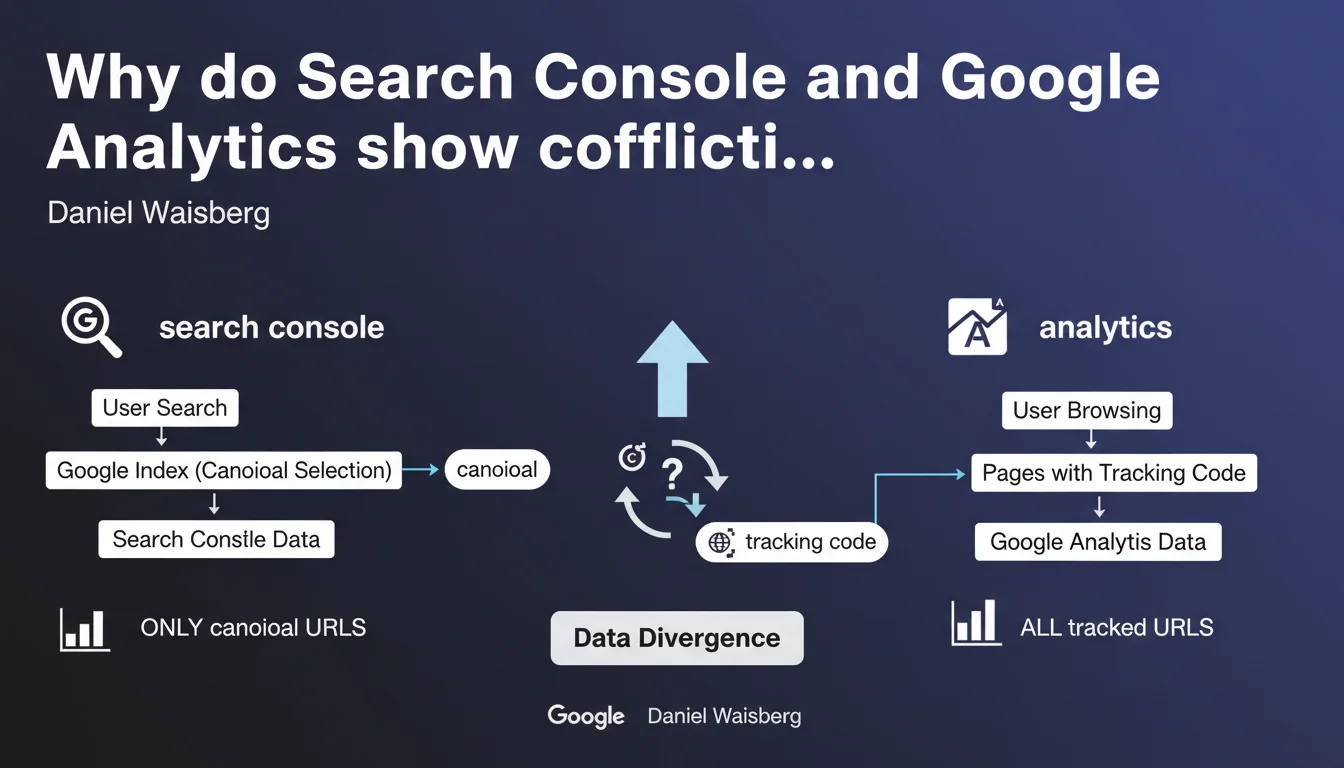
Search Console reports only data for the canonical URL chosen by Google in search results, while Google Analytics records all URLs containing the tracking code. This structural difference explains the frequent discrepancies between the two tools — and why you shouldn't compare them directly without understanding this mechanism.
What you need to understand
What is the fundamental difference between Search Console and Google Analytics?
Search Console operates on a canonicalization logic: Google selects one representative URL among all possible variants (with or without trailing slash, UTM parameters, http/https versions, etc.) and consolidates statistics on this single URL.
Google Analytics, on the other hand, has no concept of canonicalization. It records every hit on every distinct URL where the tracking code is loaded. If your product page exists in 5 technical variants, GA counts them separately — even if Google only indexes one in Search Console.
Why does this divergence create confusion?
Many SEO professionals directly compare organic traffic figures between Search Console and Google Analytics, then alarm at the gaps. Let's be honest: it's comparing apples and oranges.
Search Console shows you the performance of the URL that Google decided to promote in search results. GA shows you where users actually land — and if your site generates non-canonical variants that are accessible, GA counts them.
Which cases generate the biggest gaps between the two tools?
- UTM parameters: Search Console ignores tracking parameters, GA records them as distinct pages
- Delayed redirects: A user may land on a non-canonical URL before being redirected — GA counts both pages
- Multilingual or multi-domain sites: Google may canonicalize to one domain while traffic actually enters through another
- Paginated or filtered pages: If Google canonizes to page=1 but users bookmark page=3, the gap widens
- Internal navigation post-landing: GA records the session URL, not necessarily the one indexed by Google
SEO Expert opinion
Is this statement consistent with field observations?
Yes, completely. It's actually one of the most frequent explanations for divergences observed between Search Console and Analytics. But — and here's where it gets tricky — Google documents nowhere the exact logic for canonical selection.
We know Google can ignore your canonical tag and choose its own version. We know it can change its mind over time. But the precise criteria? [To verify] — Google intentionally remains vague on this point, probably to prevent manipulation.
In which cases does this rule become problematic?
If your site generates indexable non-canonical URLs and Google doesn't consolidate them correctly, you end up with skewed reporting on both sides. Search Console under-reports (it ignores variants), GA over-reports (it counts everything).
Real case encountered: an e-commerce site with GET parameter filters. Google had canonicalized to the page without filters, but 40% of organic traffic landed on filtered URLs via external backlinks. Search Console showed 1000 clicks/day, GA recorded 1700. Neither was lying — they were measuring two different things.
What nuance should be added about data reliability?
Search Console samples certain low-volume queries. GA can lose hits if the tracking code doesn't load before the user leaves the page. Both tools have their flaws — but for different reasons.
What Google doesn't explicitly say: Search Console can also group URLs you consider distinct if Google deems them sufficiently similar. Example observed: product pages with minor variations (color, size) consolidated under a single URL in Search Console even though they were technically separate.
Practical impact and recommendations
How do you diagnose whether your gaps are normal or concerning?
Start by isolating URLs where Search Console reports clicks but where GA reports zero organic sessions. If this list is long, you probably have a tracking or redirect issue that's invisible to users but detected by Googlebot.
Then do the opposite: identify URLs receiving organic traffic in GA but absent from Search Console. If these URLs aren't UTM parameter variants, you may have a case of forced canonicalization by Google against your intent.
What should you do concretely to align the two tools?
- Audit your canonical tags: verify they point to the URL you want to appear in Search Console
- Use the URL inspection tool in Search Console to confirm which URL Google actually selected as canonical
- Clean up URL variants generated by unnecessary parameters (filters, tracking, session IDs) via robots.txt, noindex, or 301 redirects
- Configure filtered views in GA to group URL variants you consider identical
- Document recurring gaps in a dashboard to monitor deviations over time
- If you use UTM parameters internally, stop immediately — it's a classic source of data pollution
What errors must you absolutely avoid?
Never force canonicalization to a URL that Google cannot crawl or index. If your canonical points to a page blocked by robots.txt or behind authentication, Google will choose its own version — and your data will be unmanageable.
Another common error: ignoring forgotten 302 temporary redirects. Google may treat them as de facto canonicals if they last too long, which completely distorts your reporting.
Reconciling Search Console and Google Analytics requires a fine understanding of canonicalization and impeccable technical hygiene. If your site shows persistent gaps despite an internal audit, or if you manage a complex ecosystem (multilingual, multi-domain, dynamic filters), these optimizations can quickly exceed the scope of a one-time intervention.
In these cases, calling on a specialized SEO agency may prove worthwhile: they have the tools and field experience to diagnose canonicalization anomalies, align your technical configurations, and establish reliable reporting over the long term. It's an investment that pays for itself once your strategic decisions depend on accurate data.
❓ Frequently Asked Questions
Pourquoi Search Console affiche-t-il moins de clics que Google Analytics ?
Est-ce que Google Analytics est plus fiable que Search Console pour mesurer le trafic organique ?
Comment savoir quelle URL Google a choisie comme canonique ?
Les paramètres UTM impactent-ils le reporting dans Search Console ?
Un écart de combien de pourcent entre Search Console et GA est considéré comme normal ?
🎥 From the same video 9
Other SEO insights extracted from this same Google Search Central video · published on 29/01/2025
🎥 Watch the full video on YouTube →
💬 Comments (0)
Be the first to comment.