
Official statement
Other statements from this video 11 ▾
- □ Le fichier robots.txt empêche-t-il réellement l'indexation de vos pages ?
- □ Votre outil de test SEO est-il vraiment un crawler aux yeux de Google ?
- □ Googlebot suit-il vraiment les liens ou fonctionne-t-il autrement ?
- □ Le parser robots.txt open source de Google est-il vraiment utilisé en production ?
- □ Pourquoi Google abandonne-t-il les directives d'indexation dans robots.txt ?
- □ Publier un site web équivaut-il juridiquement à autoriser Google à le crawler ?
- □ Comment Googlebot ajuste-t-il sa fréquence de crawl pour ne pas faire planter vos serveurs ?
- □ Peut-on indexer une page sans la crawler ?
- □ Pourquoi Google refuse-t-il des directives robots.txt trop granulaires ?
- □ Le robots.txt est-il vraiment suffisant pour contrôler le crawl de votre site ?
- □ Qui a vraiment créé le parser robots.txt de Google ?
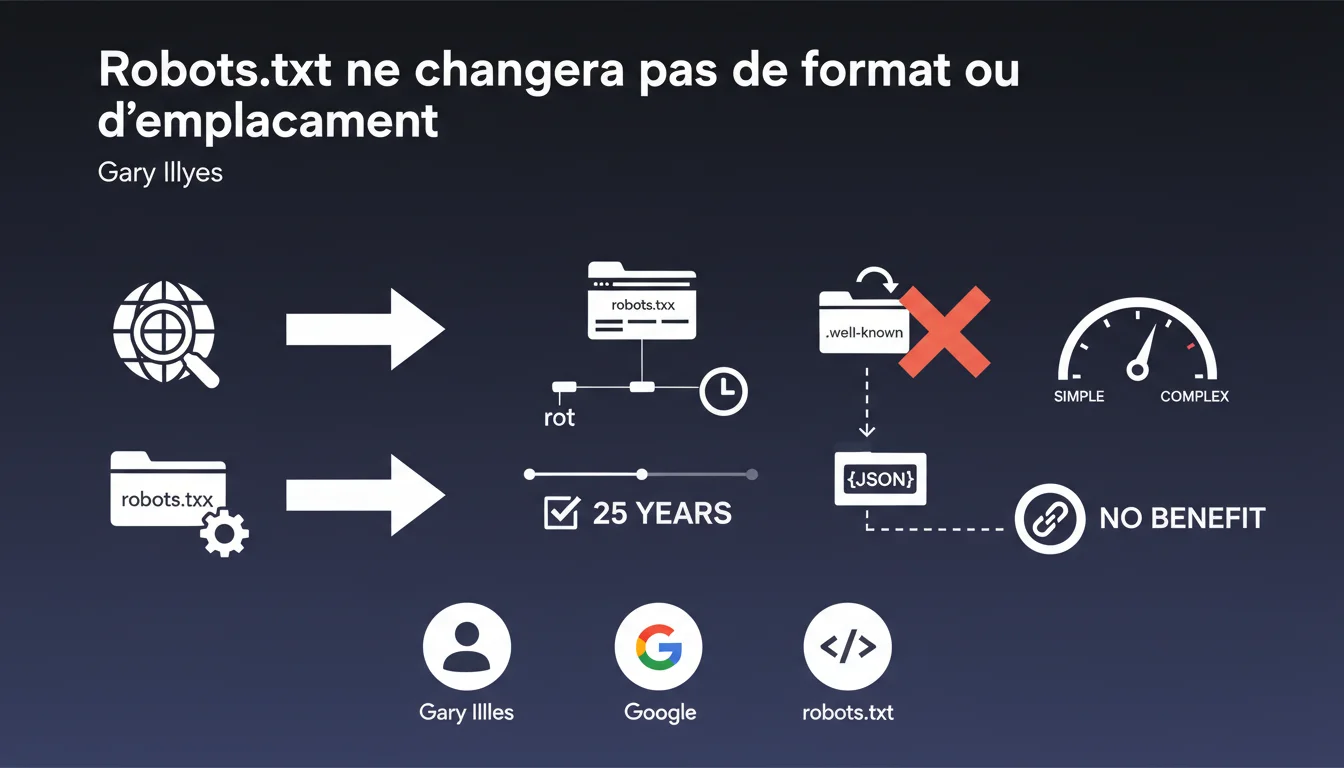
Google rejects any evolution of robots.txt: no move to .well-known, no JSON format. The text file at the root of the site remains mandatory after 25 years of existence. For Google, adding complexity to a system that works brings no value—a position that may surprise in the age of automation.
What you need to understand
What fuels the drive to modernize robots.txt?
Voices within the technical community regularly suggest moving robots.txt to the .well-known directory — a standardized location for web metadata. Others propose switching to a JSON format to facilitate automated parsing.
The idea stems from good intentions: harmonizing web standards, allowing richer configurations, and easing integration into modern build pipelines. However, Google dismisses these proposals outright.
What is Google’s official stance on these evolutions?
The answer is unequivocal: no change. The robots.txt file will remain in plain text format at the root of the domain. Gary Illyes justifies this position with a stability argument: the system has worked for a quarter of a century, why break it?
This statement puts an end to any debate. Google has no plans for gradual migration, dual support, or evolution of the standard. Period.
Why could this rigidity pose problems?
This is a valid question. Complex sites juggle hundreds of rules, approximate regex patterns, and comments that resemble homegrown versioning. The text format quickly becomes a maintenance nightmare.
But here’s the thing — Google doesn’t care. Their logic: if it works, don’t touch it. And technically, it works. Even if it’s not elegant.
- Imposed format: plain text only, no JSON or XML
- Fixed location: /robots.txt at the root of the domain, no .well-known
- Complete backward compatibility: no evolution of the standard planned
- Priority on simplicity: Google refuses to add complexity for marginal benefits
- Guaranteed stability: the current format will continue to function indefinitely
SEO Expert opinion
Is this position truly consistent with Google's practices?
Let’s be honest: Google has an ambiguous relationship with standards. On one hand, they push Schema.org, Core Web Vitals, and the move to HTTPS—evolutions that add complexity. On the other hand, they refuse to touch a 25-year-old text file.
Consistency? Debatable. Business logic? Clearer. Modifying robots.txt would force Google to maintain backward compatibility for years, with zero ROI. Why bother when the current format serves its purpose?
What are the real arguments behind this refusal?
The official line—"it works, let’s not change anything"—hides technical realities. Moving to .well-known would break millions of existing configurations. Switching to JSON would require a different parser, tests, and updated documentation.
And for what gain? Allowing developers to generate JSON instead of concatenating strings? Google sees no added value for crawling. [To be verified]: No data indicates that the current format poses performance or reliability issues on the Googlebot side.
In what scenarios could this decision become problematic?
Multi-regional sites with hundreds of subdomains struggle with file duplication. Teams automating deployment via CI/CD would prefer a structured format. Open-source projects that generate robots.txt on-the-fly would favor JSON.
But here’s the thing — Google isn’t building its engine for exotic use cases. They optimize for the common denominator: the average webmaster who edits a text file via FTP. And in this scenario, simplicity prevails.
Practical impact and recommendations
What should you concretely do with your robots.txt?
No revolution in sight. Continue to place your robots.txt at the root of the domain, in pure text format. If you've migrated to .well-known in anticipation, revert it back to /robots.txt. No CMS or framework should modify this location.
For the syntax, stick to standard directives: User-agent, Disallow, Allow, Sitemap. No fancy stuff, no ambiguous comments that could confuse parsers. The format is deliberately limited — accept this constraint.
What mistakes should be avoided in managing the file?
Don’t venture into complex regex thinking that Google will interpret them like your web server. The wildcard * and $ at the end of the line work, but lookaheads or capture groups? Forget it. Test with Search Console before deploying.
Another pitfall: managing robots.txt via a CDN that aggressively caches. If you block /admin/ and the cache serves an outdated version, Googlebot may crawl sensitive pages. Check the Cache-Control headers and test under real conditions.
How can you verify that the configuration is correctly interpreted?
The Search Console offers a robots.txt testing tool — use it consistently after each modification. Compare what you want to block with what Google truly understands. Surprises are frequent.
Also, monitor crawl errors in the reports. If Googlebot repeatedly attempts to access blocked URLs, it’s either a syntax problem or internal links pointing to these resources. Both deserve correction.
- Check that /robots.txt is accessible via HTTP and HTTPS
- Test each directive with the Search Console tool before deployment
- Document the reasons for each blocking rule (clear comments)
- Set up alerts if the file returns a 404 or 500
- Avoid blocking essential CSS/JS resources for rendering
- Reference your XML sitemap(s) with the Sitemap directive
- Regularly check that your CDN isn’t caching the file for too long
❓ Frequently Asked Questions
Google supporte-t-il le format JSON pour robots.txt ?
Peut-on déplacer robots.txt vers le répertoire .well-known ?
Pourquoi Google refuse-t-il de moderniser ce format vieux de 25 ans ?
Cette position de Google peut-elle évoluer dans le futur ?
Quels sont les risques si je déplace quand même mon robots.txt ?
🎥 From the same video 11
Other SEO insights extracted from this same Google Search Central video · published on 21/12/2021
🎥 Watch the full video on YouTube →
💬 Comments (0)
Be the first to comment.