
Official statement
Other statements from this video 13 ▾
- □ Should you really be worried about your SEO provider?
- □ Should you really stop measuring SEO success by SERP positions?
- □ What questions should a competent SEO provider really be asking before diving in?
- □ Why should your SEO provider understand your business before optimizing your website?
- □ Why can't anyone guarantee your Google rankings?
- □ How can you verify that an SEO provider truly delivers sustainable, long-term results?
- □ Should you really embed SEO into your business strategy instead of treating it as just another acquisition channel?
- □ Should you grant your SEO provider complete Search Console access?
- □ Should you really trust an external provider to audit your site's SEO performance?
- □ Should you really optimize for users instead of Google?
- □ How can you accurately estimate SEO investment and measure real business impact from an audit?
- □ How should you prioritize SEO optimizations to maximize ROI while minimizing resource investment?
- □ Should you really define precise objectives before launching an SEO strategy?
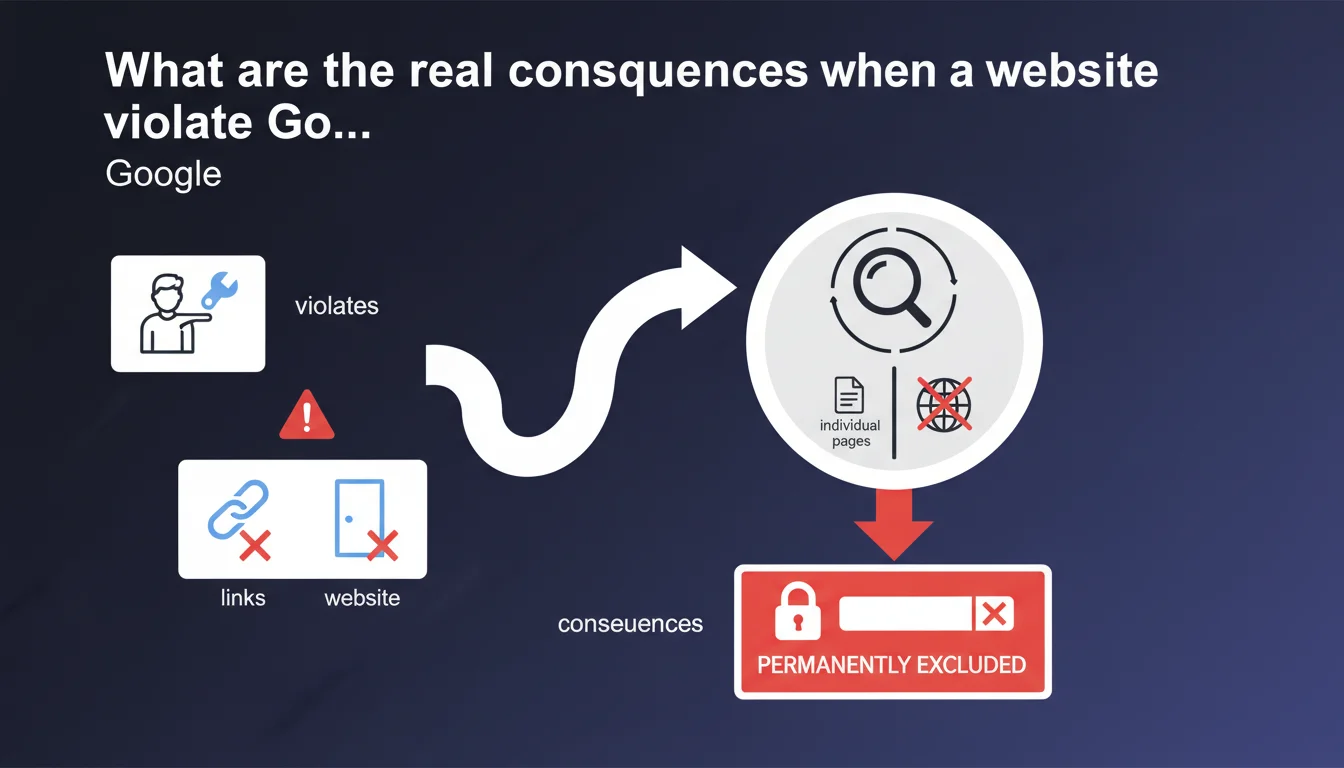
Google is clear: non-compliant techniques = risk of deindexation. Unnatural links and doorway pages can result in penalties ranging from partial ranking drops to complete and permanent exclusion from search results. No second chance announced for serious violations.
What you need to understand
Which specific techniques does this statement target?
Google points to two precise methods: unnatural links (meaning: purchased, massively exchanged, sourced from private networks) and doorway pages (pages created solely to rank and redirect). These practices have violated guidelines since their inception, but this wording emphasizes the consequences.
The underlying message? Some service providers continue using these tactics despite the risks. Google is reminding everyone that sanctions exist and can be drastic.
How serious is a "serious violation" really?
The wording leaves room for ambiguity. A serious violation has no publicly quantified definition. Is it 50 purchased links? 500? A network of 10 doorway pages or 100?
The absence of a clear threshold is strategic on Google's part — impossible to calculate exactly where the red line is. What we know: manual actions for link spam or massive duplicate content fall into this category.
Can deindexation truly be permanent?
Yes, technically. Google uses the term "permanently excluded," which implies a ban with no possible return. In practice, some sites have been reinstated after complete cleanup and reconsideration requests — but nothing is guaranteed.
The risk genuinely exists for repeat offenders or extreme cases (content farms, massive PBN networks). The rarity of documented cases doesn't mean the risk is zero.
- Two techniques explicitly cited: unnatural links and doorway pages
- Graduated sanctions: from ranking drops on isolated pages to complete site exclusion
- Potentially permanent nature of the most severe penalties
- Absence of a public benchmark to qualify a "serious violation"
- Implicit responsibility of the site that engages a non-compliant service provider
SEO Expert opinion
Is this threat credible or merely a deterrent?
Both. Google has the technical means to permanently exclude a domain — and has done so in documented cases (massive spam networks, content farms). But most penalized sites first receive reversible manual actions.
The intentionally alarming wording mainly serves to discourage attempts. [To verify]: no public statistics allow quantifying the proportion of permanent bans versus temporary penalties.
Why does this statement remain so vague?
Because precisely defining the threshold for "serious violation" would offer a roadmap to manipulators. By staying vague, Google maintains an interpretation margin and avoids optimization "just below the limit."
The problem? This opacity makes it difficult for a clean SEO professional to ensure that a former service provider didn't leave toxic traces. The absence of quantified criteria transforms every backlink audit into a paranoid exercise.
Are the mentioned techniques still effective despite the risks?
Let's be honest — some sites continue ranking with questionable link profiles. Well-built PBN networks still escape detection, and some link purchases go unnoticed.
But the risk-to-reward ratio has reversed. What worked at 80% success rate a few years ago may now achieve 40%, with a sanction risk that hasn't decreased. And when it breaks, it breaks hard.
Practical impact and recommendations
How to identify if your site shows risk signals?
First step: complete link profile audit. Look for suspicious patterns — sudden acquisition spikes, identical over-optimized anchors, links from unrelated site footers, links from common IPs (sign of PBN).
Second step: analyze potential doorway pages. Any page created solely to rank on a query without providing real user value falls into this category. If it redirects immediately or contains only links to other site sections, that's a problem.
What if you inherit a questionable history?
Immediate cleanup. Identify all toxic backlinks via Search Console and third-party tools, attempt to have them removed (direct contact with webmasters), then use the disavow file for the rest.
For doorway pages: outright deletion or radical transformation into content with genuine added value. 301 redirects from these pages to the homepage won't save anything — Google still considers them doorway pages.
If a manual action is already in place, a reconsideration request will only work if cleanup is documented, exhaustive, and sincere. Google receives thousands of vague requests — only detailed approaches get a second chance.
What are the alternatives to blacklisted techniques?
For links: creation of linkable content (data studies, free tools, visual resources), digital public relations, editorial guest posting (unpaid, with real value for target audience). Slow, but sustainable.
For organic traffic: rather than doorway pages, develop robust thematic landing pages with substantial content, clear intent, careful user experience. One page that converts beats ten that rank artificially.
- Audit link profile monthly with alerts for suspicious new backlinks
- Verify absence of over-optimized anchor patterns (exact-match ratio
❓ Frequently Asked Questions
Un lien acheté il y a 3 ans peut-il encore déclencher une pénalité aujourd'hui ?
Le fichier de désaveu suffit-il à éviter une pénalité pour liens non naturels ?
Comment distinguer une page satellite d'une landing page légitime ?
Google prévient-il avant une exclusion définitive ?
Peut-on récupérer un domaine définitivement banni en le rachetant sous une nouvelle entité ?
🎥 From the same video 13
Other SEO insights extracted from this same Google Search Central video · published on 24/02/2022
🎥 Watch the full video on YouTube →
💬 Comments (0)
Be the first to comment.