
Official statement
Other statements from this video 13 ▾
- □ Faut-il vraiment craindre son prestataire SEO ?
- □ Faut-il vraiment arrêter de mesurer le succès SEO aux positions dans les SERP ?
- □ Quelles questions un prestataire SEO doit-il vraiment poser avant d'intervenir ?
- □ Pourquoi votre prestataire SEO doit-il comprendre votre business avant de toucher à votre site ?
- □ Pourquoi personne ne peut garantir votre classement sur Google ?
- □ Que risque vraiment un site qui enfreint les directives Google ?
- □ Comment vérifier qu'un prestataire SEO livre vraiment des résultats durables ?
- □ Faut-il vraiment intégrer le SEO à la stratégie business plutôt que de le traiter comme un canal d'acquisition ?
- □ Faut-il donner un accès complet à la Search Console à son prestataire SEO ?
- □ Faut-il vraiment confier l'audit SEO de son site à un prestataire externe ?
- □ Faut-il vraiment optimiser pour l'utilisateur plutôt que pour Google ?
- □ Comment estimer l'investissement SEO et l'impact business d'un audit ?
- □ Comment prioriser les optimisations SEO pour maximiser le ROI avec un minimum de ressources ?
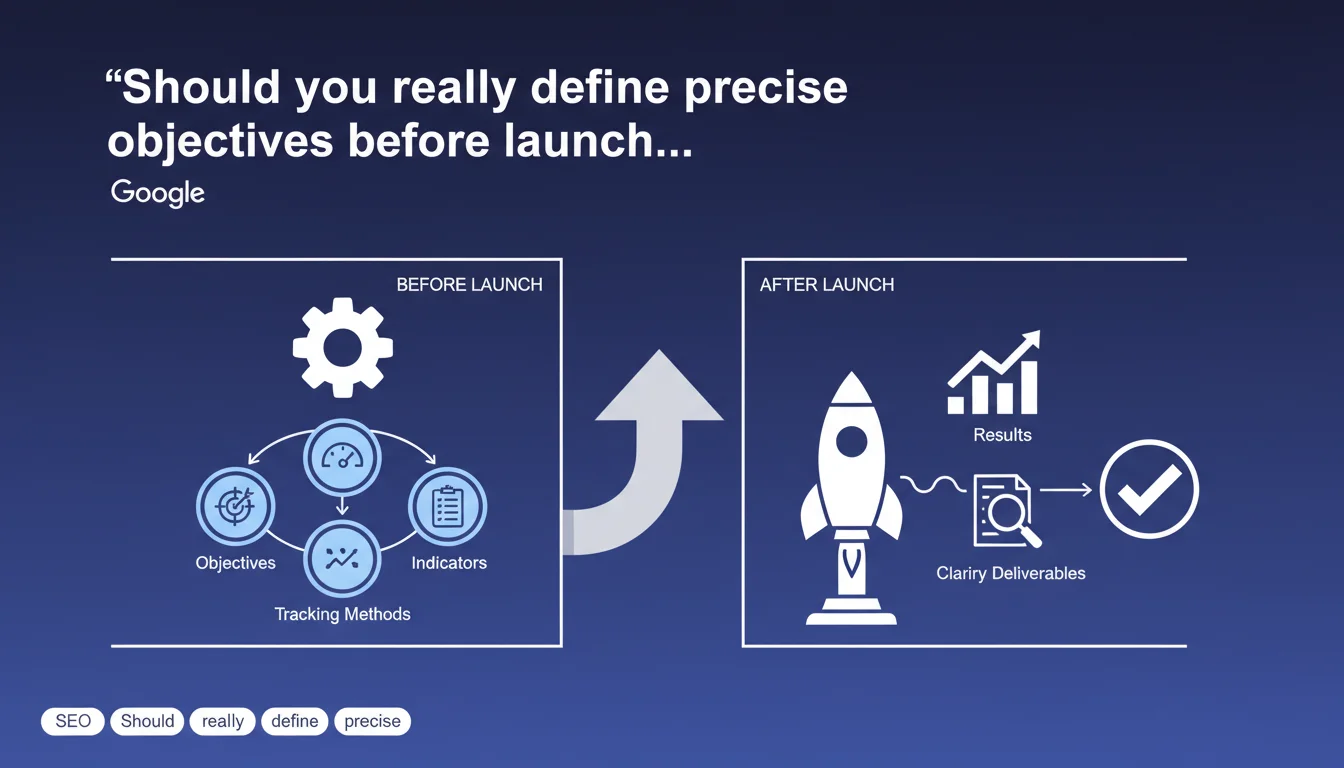
Google emphasizes that before engaging an SEO service provider, it is essential to clearly define objectives, tracking indicators, and measurement methods. What may seem obvious actually hides a gray area: how do you define realistic objectives without prior expertise? The statement points to a real problem but provides no concrete method to solve it.
What you need to understand
Why does Google insist on defining objectives upfront?
This statement aims to protect advertisers from unscrupulous service providers who promise the moon without clear scope definition. Without clear objectives, it's impossible to judge whether an SEO service has truly delivered value. Google seeks to hold both parties accountable: the client must know what they expect, and the provider must formalize what they can deliver.
The problem? An advertiser without SEO expertise often doesn't know which indicators are relevant to their business. Asking for 100,000 visits per month might sound ambitious, but if the traffic doesn't convert, the objective is meaningless. Google knows this—and that's where its statement becomes generic.
What specific indicators does Google mention?
Google cites no specific indicators, making the statement difficult to apply for a non-expert. In SEO, indicators vary depending on context: organic traffic, rankings on strategic queries, conversions from search, click-through rate in SERPs, impressions on target topics, domain authority (even though Google officially denies its existence).
A serious service provider should propose a mix of indicators: some focused on visibility (rankings, impressions), others on business performance (conversions, attributable revenue). But how many advertisers can distinguish a good indicator from a vanity metric?
What does "aligning tracking methods" mean in practice?
Behind this administrative formula lies a real issue: which data source is authoritative? Google Search Console? Google Analytics? A third-party tool like SEMrush or Ahrefs? Each tool provides different numbers, and without prior alignment, conflicts are inevitable.
A service provider might show a 50% increase in organic traffic in GA4 while the client observes a stagnation in revenue. Who's right? Both—but the initial objective was poorly defined. Google insists on this alignment to avoid misunderstandings, but provides no tools to achieve it.
- Clear objectives: define what constitutes measurable success for your business (traffic, conversions, positioning)
- Aligned indicators: choose metrics relevant to your business model (e-commerce vs lead generation vs media)
- Tracking methods: determine which tools will be used and how to reconcile data across different sources
- Reporting cadence: set the frequency of reviews (monthly, quarterly) and format of deliverables
SEO Expert opinion
Is this statement consistent with the reality of the SEO market?
Yes and no. On one hand, setting objectives before starting is a universal best practice in project management. No serious SEO expert would contest this principle. On the other hand, this statement ignores a reality: most advertisers lack the competency to define pertinent SEO objectives on their own.
A client who arrives asking "I want to rank first for shoes" without specifying the shoe type, competitive context, or search intent doesn't define an objective—they express a pipe dream. The role of a good service provider is precisely to educate the client and co-build these objectives. Google acts as if this framing phase is self-evident. [To be verified]: how many SEO RFPs actually include truly SMART objectives (specific, measurable, achievable, relevant, time-bound)?
What nuances should be added to this generic advice?
First point: not all objectives are equal. Targeting a 30% traffic increase in six months may be realistic for a news site with good publishing velocity, but unrealistic for a corporate site publishing only once quarterly. Context is king—and Google omits this entirely.
Second point: some exploratory SEO projects require a diagnostic phase before setting objectives. How can you promise precise results without a prior audit? A site plagued by manual penalties or technical issues cannot have the same objectives as a healthy but under-optimized site. Google's statement implies the advertiser must define objectives before engaging the service provider—which puts the cart before the horse.
In what cases does this rule not fully apply?
For SEO projects in test & learn mode—typically on new markets or new content types—it's impossible to set precise numerical objectives upfront. In these cases, the objective becomes "validate or invalidate a hypothesis" rather than "reach X visitors". Google never mentions this nuance.
Another case: technical overhaul projects where the main objective is defensive (avoid losing traffic) rather than offensive. Hard to sell internally with eye-catching indicators. Yet it's often the number-one priority for mature sites. Google's statement remains anchored in a "growth at all costs" vision that doesn't fit all contexts.
Practical impact and recommendations
What should you concretely do before engaging an SEO service provider?
First step: identify your real business challenges. Are you seeking to increase brand awareness? Generate more qualified leads? Reduce your customer acquisition cost versus paid search? Each challenge demands different strategies and indicators. Be honest about what truly matters for your business.
Second step: ask the service provider for a preliminary free or paid audit (but limited in scope) to evaluate feasibility. It's impossible to set pertinent objectives without understanding the current state of the site. A good provider should propose this scoping phase—if it doesn't exist, negotiate for it.
Third step: jointly formalize an alignment document (often called SOW or Statement of Work) that lists precisely: numerical objectives, selected indicators, data sources, reporting frequency, expected deliverables. This document protects both parties and prevents misunderstandings six months down the line.
What mistakes should you avoid when defining objectives?
Mistake number one: setting purely quantitative objectives without considering quality. "50% more traffic" means nothing if that traffic comes from off-topic queries or bounces immediately. Prefer mixed objectives that include engagement or conversion indicators.
Mistake number two: defining overly short-term objectives. SEO is a marathon, not a sprint. Targeting a #1 ranking in three months on an ultra-competitive query is unrealistic unless using black hat techniques—which contradicts the spirit of Google's statement. Be patient and favor progressive objectives.
Mistake number three: ignoring internal constraints. If your team lacks resources to regularly produce quality content, don't set ambitious objectives on content-heavy strategies. The service provider must know your limits to adjust recommendations accordingly.
How do you verify that defined objectives are pertinent?
Test them with the SMART method: are they Specific (which query, which page?), Measurable (with which tool?), Achievable (against the competition?), Relevant (aligned with business?), and Time-bound (over what period?). If an objective doesn't check all five boxes, rephrase it.
Another test: ask the service provider to explain how they plan to achieve each objective. If they remain vague or use empty jargon, that's a red flag. A serious expert must detail their strategy and the levers they'll activate (technical, content, link building, etc.).
- Clarify your business challenges before discussing SEO indicators
- Request a preliminary audit to assess objective feasibility
- Formalize an alignment document with objectives, indicators, data sources, and reporting frequency
- Prefer mixed objectives (quantitative + qualitative) rather than purely volumetric ones
- Validate that objectives meet the SMART criteria
- Question the service provider on their concrete strategy to achieve each objective
- Schedule regular check-in points and adjustments if necessary
❓ Frequently Asked Questions
Comment définir des objectifs SEO réalistes sans expertise interne ?
Quels indicateurs privilégier pour mesurer le succès d'une stratégie SEO ?
Que faire si le prestataire n'atteint pas les objectifs fixés ?
Faut-il inclure des pénalités contractuelles si les objectifs ne sont pas atteints ?
Comment réconcilier les chiffres entre Google Search Console, Analytics et outils tiers ?
🎥 From the same video 13
Other SEO insights extracted from this same Google Search Central video · published on 24/02/2022
🎥 Watch the full video on YouTube →
💬 Comments (0)
Be the first to comment.