
Official statement
Other statements from this video 13 ▾
- □ Faut-il vraiment craindre son prestataire SEO ?
- □ Faut-il vraiment arrêter de mesurer le succès SEO aux positions dans les SERP ?
- □ Quelles questions un prestataire SEO doit-il vraiment poser avant d'intervenir ?
- □ Pourquoi votre prestataire SEO doit-il comprendre votre business avant de toucher à votre site ?
- □ Pourquoi personne ne peut garantir votre classement sur Google ?
- □ Que risque vraiment un site qui enfreint les directives Google ?
- □ Faut-il vraiment intégrer le SEO à la stratégie business plutôt que de le traiter comme un canal d'acquisition ?
- □ Faut-il donner un accès complet à la Search Console à son prestataire SEO ?
- □ Faut-il vraiment confier l'audit SEO de son site à un prestataire externe ?
- □ Faut-il vraiment optimiser pour l'utilisateur plutôt que pour Google ?
- □ Comment estimer l'investissement SEO et l'impact business d'un audit ?
- □ Comment prioriser les optimisations SEO pour maximiser le ROI avec un minimum de ressources ?
- □ Faut-il vraiment définir des objectifs précis avant de piloter une stratégie SEO ?
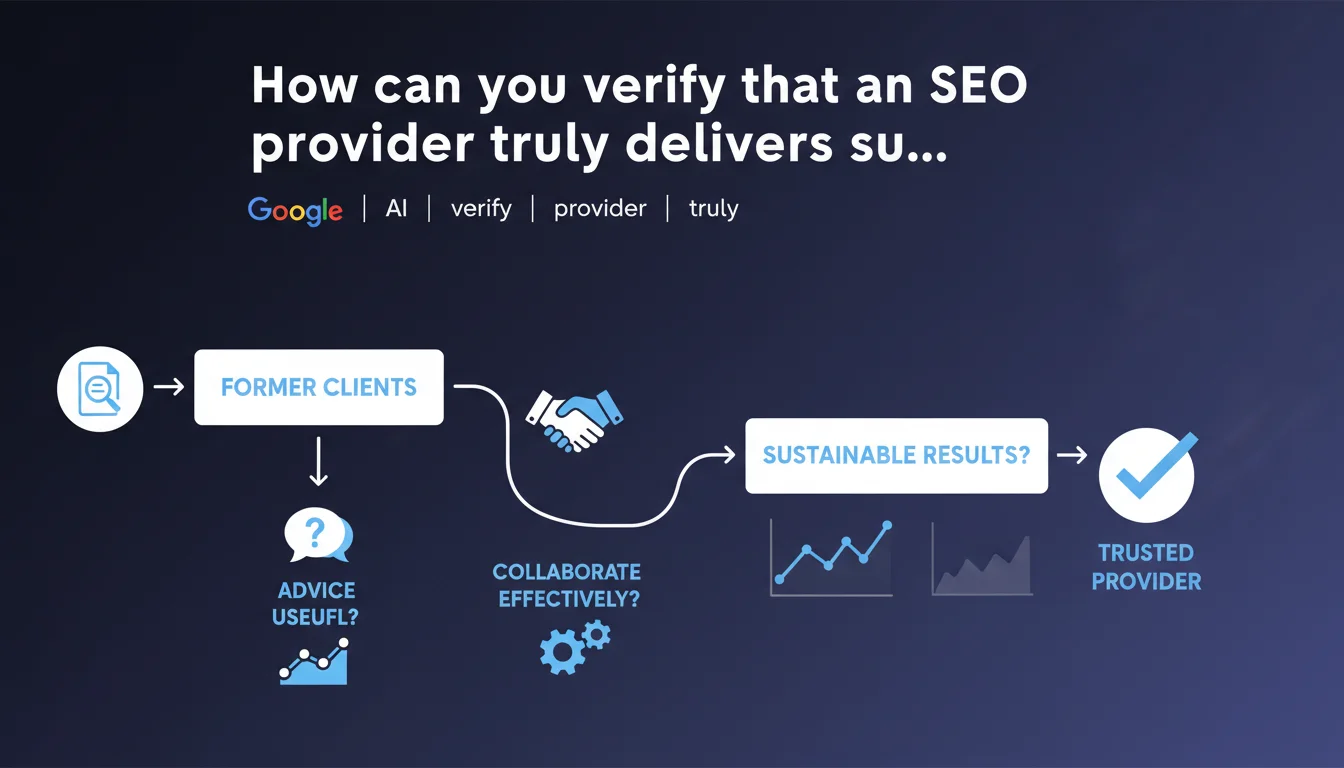
Google recommends directly questioning the former clients of an SEO provider before hiring them. The goal: verify that the advice was useful, that the collaboration went smoothly, and above all that the results obtained are sustainable — not just a temporary spike in traffic. A common-sense approach, but one that raises the question: what exactly is a "sustainable" result in SEO?
What you need to understand
Why does Google insist so heavily on checking references?
This recommendation stems from a simple observation: the SEO marketplace is saturated with providers who promise the moon and deliver ephemeral results. Google seeks to empower clients by giving them a basic yet effective filtering method.
By questioning former clients, you can detect red flags: unmet promises, borderline techniques that ultimately penalized the site, or chaotic collaboration without transparency on the actions taken.
What constitutes a "sustainable" result according to this logic?
Google contrasts temporary gains (often achieved through shortcuts) with structural improvements. A sustainable result is organic traffic growth that is maintained or continues to progress several months after the service engagement ends.
Concretely? A site that gains 50% traffic in 3 months then drops 60% the following quarter has not benefited from a sustainable strategy. Conversely, moderate but stable growth over 12-18 months indicates substantive work.
Does the quality of collaboration really matter that much?
Absolutely. Google explicitly mentions the ability to "collaborate effectively." A provider who works in isolation, doesn't share insights or fails to train your internal teams creates an unhealthy dependency.
Effective collaboration involves transparency about actions taken, clear reporting, and gradual knowledge transfer. If your teams don't understand what the provider is doing, that's a red flag.
- Question multiple former clients, not just the one the provider recommends
- Ask for quantified proof: organic traffic evolution over 12-24 months minimum
- Verify result stability post-engagement, not just during
- Ask questions about methodology and reporting transparency
- Identify whether the provider trained internal teams or created dependency
SEO Expert opinion
Is this recommendation sufficient to evaluate a provider?
No, and that's where it gets tricky. Questioning former clients is useful, but Google remains deliberately vague about evaluation criteria. What constitutes a "useful" result? How do you objectively measure "effective collaboration"?
In practice, I've seen clients thrilled with a provider who had doubled their traffic… by targeting low-intent keywords. Traffic went up, revenue stalled. Client satisfaction doesn't guarantee strategic relevance.
How do you distinguish real sustainability from side effects?
Google contrasts "sustainable" with "temporary," but reality is more nuanced. A well-executed technical overhaul can generate quick and sustainable gains. Conversely, a content strategy may take 6 months to gain traction then stabilize over time.
The true criterion is resilience to algorithmic updates. A site that withstands major Core Updates without significant ranking losses has benefited from solid strategy. If every update causes a sharp drop, the work was either superficial or risky.
[To verify] Google doesn't specify how to identify "temporary" results due to external factors (seasonality, market trends, competitor actions) versus those linked to SEO manipulation. Yet this distinction is crucial.
Is effective collaboration truly a reliable indicator?
Yes and no. A provider can excel at client communication without being an excellent SEO practitioner. I've seen agencies that excelled in client relations but delivered technical audits riddled with errors.
Conversely, some highly competent SEO experts are poor educators. "Effective collaboration" also depends on your internal SEO maturity — a novice client will need more guidance than an experienced team.
Practical impact and recommendations
What concrete questions should you ask former clients?
Skip the "Are you satisfied?" question. Too vague. Ask factual questions that reveal the substance of work delivered. Request precise metrics: organic traffic evolution month by month, rankings gained on strategic queries, impact on conversion rates.
Ask them about methodology: "What types of actions did the provider take?", "Did you understand what was being done and why?", "Was reporting clear and actionable?". If the client can't answer, that's a bad sign.
Also ask: "What happened 6 months after the engagement ended?". That's where sustainability is truly verified. Traffic that collapses post-engagement indicates dependency or risky practices.
How do you objectively verify result sustainability?
Demand access to analytics tools (Google Analytics, Search Console) to verify the data yourself. A transparent provider won't hesitate. Look at traffic curves over 18-24 months, identifying engagement phases and post-engagement periods.
Analyze the backlinks gained: are they still active? Do they come from quality sites or questionable networks? Check the disavow ratio — an abnormally high ratio suggests aggressive practices that required cleanup.
Check rankings on strategic keywords via a third-party tool (Semrush, Ahrefs). If rankings collapsed after a Core Update, it means the strategy wasn't aligned with Google's quality expectations.
What errors should you avoid in this verification process?
Don't rely solely on the client the provider recommends — obviously their best case study. Request a complete list of recent clients and randomly select several.
Beware of anonymized references ("a large e-commerce fashion site"). Demand verifiable references with identified people you can actually contact.
Don't evaluate purely on raw results. A provider may have inherited a technically catastrophic site and delivered remarkable work that only resulted in stabilization. Starting context matters.
- Interview a minimum of 3 former clients, including at least one you selected yourself
- Request direct access to analytics tools to verify declared data
- Verify traffic evolution over 12-24 months, including the post-engagement period
- Analyze site resilience to major Core Updates
- Question methodology and reporting transparency during the engagement
- Verify the quality of acquired backlinks (not just quantity)
- Evaluate knowledge transfer and autonomy gained by the internal team
- Compare results obtained with the site's starting context
❓ Frequently Asked Questions
Combien d'anciens clients faut-il interroger pour se faire une idée fiable ?
Comment savoir si un résultat SEO est durable ou temporaire ?
Un client satisfait garantit-il la qualité du prestataire SEO ?
Que faire si le prestataire refuse de donner des références vérifiables ?
Comment évaluer la collaboration avec un prestataire SEO avant de l'engager ?
🎥 From the same video 13
Other SEO insights extracted from this same Google Search Central video · published on 24/02/2022
🎥 Watch the full video on YouTube →
💬 Comments (0)
Be the first to comment.