
Official statement
Other statements from this video 13 ▾
- □ Faut-il vraiment craindre son prestataire SEO ?
- □ Faut-il vraiment arrêter de mesurer le succès SEO aux positions dans les SERP ?
- □ Quelles questions un prestataire SEO doit-il vraiment poser avant d'intervenir ?
- □ Pourquoi personne ne peut garantir votre classement sur Google ?
- □ Que risque vraiment un site qui enfreint les directives Google ?
- □ Comment vérifier qu'un prestataire SEO livre vraiment des résultats durables ?
- □ Faut-il vraiment intégrer le SEO à la stratégie business plutôt que de le traiter comme un canal d'acquisition ?
- □ Faut-il donner un accès complet à la Search Console à son prestataire SEO ?
- □ Faut-il vraiment confier l'audit SEO de son site à un prestataire externe ?
- □ Faut-il vraiment optimiser pour l'utilisateur plutôt que pour Google ?
- □ Comment estimer l'investissement SEO et l'impact business d'un audit ?
- □ Comment prioriser les optimisations SEO pour maximiser le ROI avec un minimum de ressources ?
- □ Faut-il vraiment définir des objectifs précis avant de piloter une stratégie SEO ?
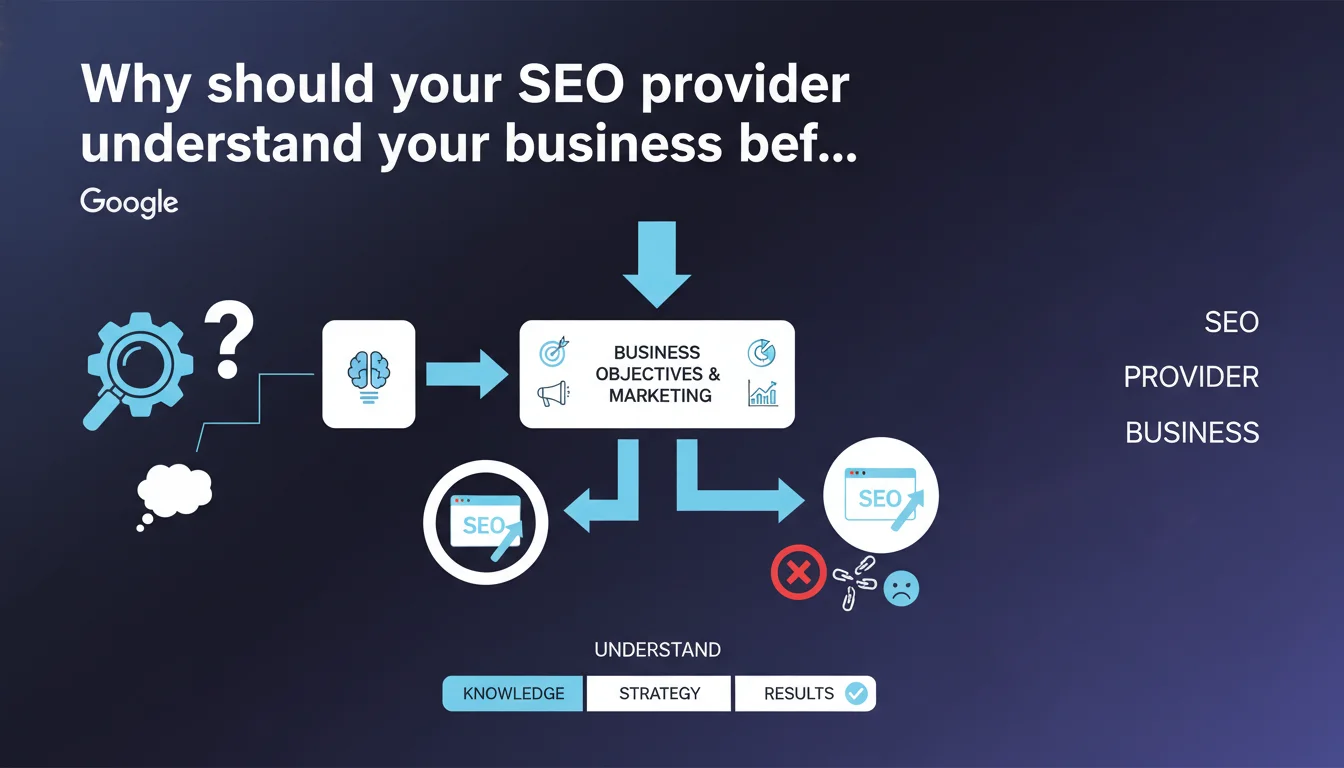
Google states that an SEO provider cannot optimize effectively without a thorough understanding of the company's business objectives and marketing context. A consultant who ignores these strategic dimensions will miss essential levers and risks applying tactics disconnected from real business challenges. The issue is not so much technical as methodological: SEO operates within a business logic, not in an algorithmic vacuum.
What you need to understand
Is Google really saying something new here?
Not really — but that's precisely what makes this statement interesting. Google is placing a requirement for context that goes beyond the strictly technical scope of SEO. Optimization is not just about tagging, structuring, and indexing: it requires a strategic understanding of business priorities, target audiences, and sales cycles.
This positioning reminds us that the algorithm fundamentally seeks to satisfy user intentions, which are themselves tied to purchase journeys, business challenges, and industry contexts. A consultant who ignores these parameters will apply generic recipes — and miss what truly drives results.
What does it mean to "comprehensively understand" a business?
This means grasping the business model, conversion objectives, and decision cycles specific to the sector. A fast-moving B2C e-commerce site is not treated the same way as a B2B site with a long sales cycle. A media platform supported by display advertising doesn't respond to the same imperatives as a SaaS platform seeking qualified leads.
Effective SEO also requires mapping the existing marketing ecosystem: paid campaigns, CRM, content strategies, competitive positioning. If the consultant shows up without asking these questions, they're navigating blind — and risk suggesting optimizations that are counterproductive or misaligned with real business challenges.
Does Google impose a particular methodology?
No. The statement remains deliberately vague about how this understanding should take place. No checklist, no imposed framework. Google simply states a principle: business context comes first.
It's a way of saying that SEO doesn't reduce to a standardized technical audit. It requires in-depth dialogue with the client, a strategic discovery phase, and analysis of medium-term objectives. Without this, you're optimizing in a vacuum — and risk wasting time on poorly prioritized initiatives.
- SEO doesn't work in isolation: it operates within a broader marketing strategy
- A consultant who doesn't ask questions about business objectives lacks the keys to prioritize
- Google implicitly values a consulting-driven approach rather than purely execution-focused: understand before acting
- Business understanding determines the relevance of recommendations, not just their technical validity
SEO Expert opinion
Does this statement reflect an evolution in Google's stance?
Yes and no. Google has always insisted on the need to understand the user, but here it takes a step to the side: it's speaking to the service provider, not the website. It's a posture of indirect regulation of the SEO market.
By pointing out the contextual incompetence of certain consultants, Google is trying to raise the bar for the industry. This is consistent with its recurring discourse against "rogue SEO agencies" that promise miraculous results without asking the right questions. But let's be honest: this statement remains wishful thinking as long as Google doesn't clarify which measurable criteria distinguish a good provider from a bad one.
In which cases does this rule become questionable?
It applies perfectly to medium to long-term strategic missions. But it becomes less relevant in one-off intervention contexts: technical migrations, fixing critical errors, restructuring. A provider can very well solve an indexing problem without knowing the company's product roadmap.
The risk is transforming this recommendation into a pretext to extend the discovery phase and charge for strategic consulting where technical diagnosis would suffice. It depends on the scope of intervention: if we're talking about content strategy or SEO-driven redesign, then yes, business context is essential. If we're talking about fixing canonicals or unblocking crawl budget, it's less critical.
Does Google provide indicators to measure this "global understanding"?
[To verify] — No, and that's the main weakness of this statement. Google remains in moral injunction without providing companies with tools to concretely evaluate a provider's competence. How do you know if a consultant "really understands" your business? No objective criteria are provided.
The risk is that this recommendation is co-opted by consultants who simulate understanding without technical execution capability. You need to reverse the logic: a good SEO provider doesn't just ask business questions — they must also demonstrate they can translate these challenges into measurable SEO actions.
Practical impact and recommendations
How do you evaluate if a provider really understands your business?
Ask reverse questions. If a consultant doesn't interrogate you about your conversion objectives, sales cycles, and priority audiences, that's a red flag. A good provider starts with a discovery phase — not a standardized technical audit.
Also verify that they can link their SEO recommendations to your business KPIs. If they only talk about rankings and traffic without ever mentioning revenue, qualified leads, or conversion rates, it means the consultant is thinking in silos — not strategically.
What mistakes should you avoid in the initial brief with a provider?
Don't just hand over a technical specification. An effective brief should include your business strategy, marketing priorities, and budget constraints. If you don't provide this context, the provider will work blind — and you'll also bear some responsibility for the failure.
Also avoid artificially separating SEO from other marketing channels. If your SEO provider has no visibility into your paid campaigns, social media strategy, or CRM, they'll optimize in a silo — which inevitably limits impact.
What should you concretely do to align SEO with business objectives?
Organize a strategic kickoff with all stakeholders: marketing, sales, product. SEO shouldn't be managed solely by the web team — it must align with your company's overall vision.
Then define aligned business KPIs: not just organic traffic, but conversion metrics, average order value, and retention rates. A good provider must be able to link their SEO actions to these indicators — and adjust their strategy based on observed results.
- Require a strategic discovery phase before any technical work
- Verify that the provider asks questions about your business objectives and sales cycles
- Ask how SEO recommendations align with your business KPIs
- Involve marketing, sales, and product teams in the initial brief
- Ensure the consultant has access to analytics data, CRM, and paid campaigns
- Define measurable SEO objectives aligned with your overall strategy
- Be wary of consultants who promise results without asking contextual questions
❓ Frequently Asked Questions
Un consultant SEO peut-il être efficace sans comprendre mon secteur d'activité ?
Comment savoir si un prestataire SEO pose les bonnes questions lors du brief ?
Faut-il partager des données confidentielles avec un prestataire SEO ?
Cette exigence de compréhension business s'applique-t-elle aussi aux outils SEO automatisés ?
Google pénalise-t-il les sites dont le SEO est déconnecté de la stratégie business ?
🎥 From the same video 13
Other SEO insights extracted from this same Google Search Central video · published on 24/02/2022
🎥 Watch the full video on YouTube →
💬 Comments (0)
Be the first to comment.