
Official statement
Other statements from this video 13 ▾
- □ Faut-il vraiment craindre son prestataire SEO ?
- □ Faut-il vraiment arrêter de mesurer le succès SEO aux positions dans les SERP ?
- □ Quelles questions un prestataire SEO doit-il vraiment poser avant d'intervenir ?
- □ Pourquoi votre prestataire SEO doit-il comprendre votre business avant de toucher à votre site ?
- □ Pourquoi personne ne peut garantir votre classement sur Google ?
- □ Que risque vraiment un site qui enfreint les directives Google ?
- □ Comment vérifier qu'un prestataire SEO livre vraiment des résultats durables ?
- □ Faut-il vraiment intégrer le SEO à la stratégie business plutôt que de le traiter comme un canal d'acquisition ?
- □ Faut-il donner un accès complet à la Search Console à son prestataire SEO ?
- □ Faut-il vraiment confier l'audit SEO de son site à un prestataire externe ?
- □ Faut-il vraiment optimiser pour l'utilisateur plutôt que pour Google ?
- □ Comment prioriser les optimisations SEO pour maximiser le ROI avec un minimum de ressources ?
- □ Faut-il vraiment définir des objectifs précis avant de piloter une stratégie SEO ?
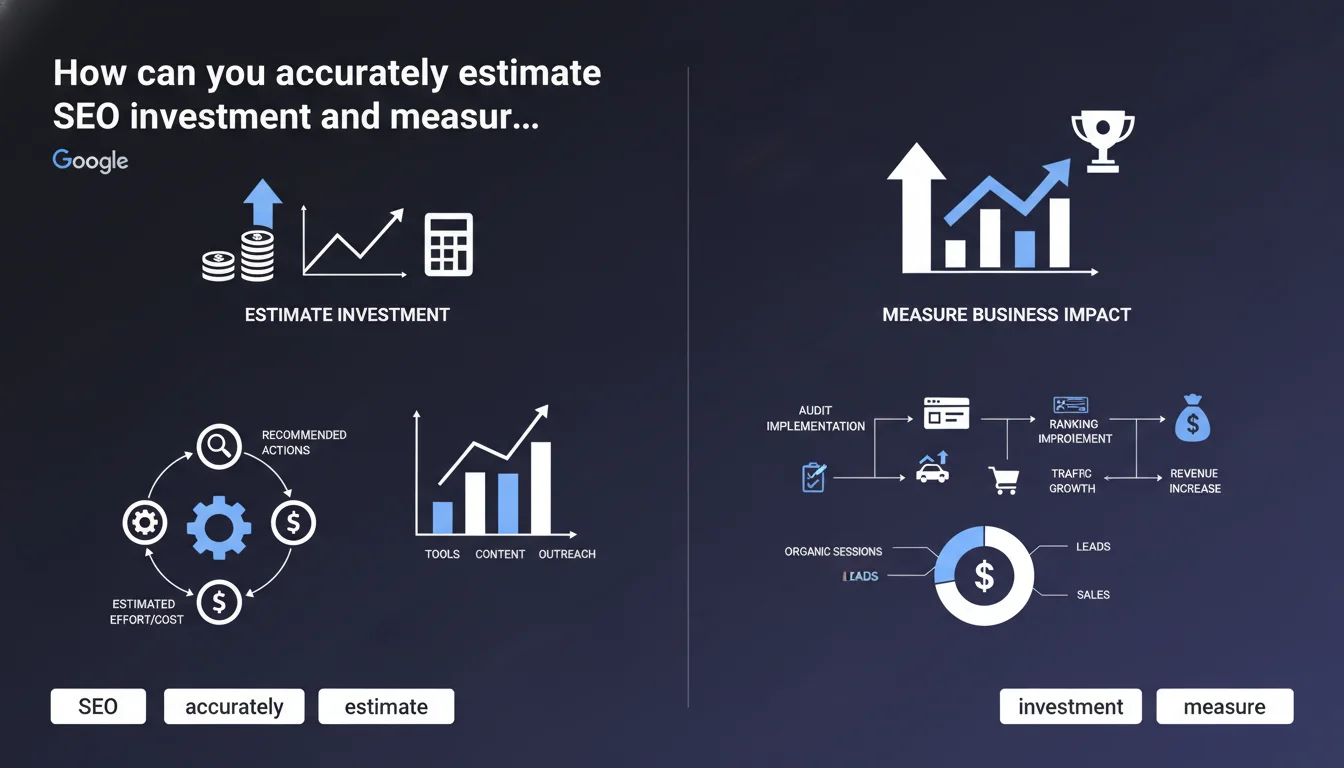
Google recommends integrating into every SEO audit a quantified estimate of the total investment required and the expected positive business impact. This approach transforms an audit from a simple technical report into a strategic decision-making tool. The challenge: Google provides no concrete methodology to achieve this.
What you need to understand
Why does Google emphasize budget estimation in SEO audits?
Google seeks to anchor SEO in a ROI-driven logic rather than a purely technical approach. The idea is to force practitioners to think "business" before "technical fixes." An audit that simply lists problems without evaluating their real impact on revenue or conversions becomes difficult to defend to executive leadership.
Concretely, this means a modern audit must have two axes: technical diagnosis and financial projection. The first says "here's what's broken," the second answers "what does it cost us to do nothing?"
What exactly is meant by "global investment"?
Global investment covers all costs: developer time, internal resources mobilized, external services, tools, content to be created, and potential technical migrations. Many audits overlook hidden costs — such as accumulated technical debt or coordination time between teams.
Google doesn't explicitly state how to calculate these costs. It's up to the auditor to build their own estimation matrix based on client context.
How can you credibly measure "positive business impact"?
This is the trickiest point. Impact can be measured in additional organic traffic, additional conversions, incremental revenue, or gained positions on strategic keywords. You must isolate the SEO effect from other channels (paid, seasonality, campaigns).
Without access to historical traffic, conversion, and revenue data, any projection remains hypothetical. A serious SEO expert will always qualify their estimates: conservative, median, and optimistic scenarios.
- Integrate budget estimation into every audit to facilitate decision-making
- Project business impact in traffic, conversions, or revenue based on available data
- Distinguish visible and hidden costs (technical debt, internal coordination)
- Always qualify the assumptions behind projections to avoid over-promising
SEO Expert opinion
Is this recommendation realistic for all audit types?
Let's be honest: no. On a large e-commerce site with clean history and Analytics access, estimating impact from gaining positions in a category is feasible. On a SME brochure site launched three months ago, any projection is pure guesswork. Google generalizes a principle that only applies properly to a segment of mature sites.
Moreover, many SEO consultants don't master financial modeling methods. Result: fantasy projections that discredit the profession. [To verify]: Google provides no framework, no methodology to frame these estimates — it's a pious wish without an instruction manual.
What are the practical limitations of this approach?
First limitation: attribution. It's impossible to guarantee that a traffic gain comes solely from audit fixes. A competitor may disappear, an algorithm may shift, a brand campaign may boost branded searches. Pure SEO impact is rarely isolable.
Second limitation: timing. SEO results take 3 to 12 months to materialize. In the meantime, the market evolves, priorities shift, budgets get reallocated. Promising ROI within 6 months in a volatile environment is risky.
In what cases does this approach really add value?
It becomes relevant on sites with reliable historical data, a clear conversion funnel, and long-term vision. Typically: mature e-commerce, B2B lead gen with integrated CRM, media with tracked ad revenue. In these contexts, modeling impact becomes a credible exercise.
For others — new sites, ultra-competitive sectors, clients without strategic vision — it's better to focus on intermediate objectives: indexation, crawl quality, positions on a basket of pilot keywords. Business impact will come, but it's premature to quantify it.
Practical impact and recommendations
How do you structure this section concretely in an audit?
Create a dedicated page titled "Budget Summary and Impact Projection." Include: a summary table of costs by work stream (technical, content, link building), a deployment timeline, and traffic/revenue projections based on 3 scenarios (pessimistic, realistic, optimistic).
Each scenario must rest on explicit assumptions: "If we gain 5 average positions on this cluster of 20 keywords with a stable conversion rate of 2.3%, here's the expected monthly revenue uplift." Complete transparency.
What tools and methods should you use for these estimates?
For costs: base on internal benchmarks (average developer time to fix X 404 errors, cost to write a 1500-word article, price of an in-depth technical audit). For impact: leverage Search Console data to estimate traffic potential on target positions.
For revenue forecasts, cross-reference projected additional traffic with the site's average conversion rate (from Analytics or Matomo) and average order value. If this data is missing, use sector averages — specifying these are external assumptions.
What mistakes should you absolutely avoid in this approach?
Never promise ROI without mentioning implementation conditions: budget actually released, resources allocated, schedule respected, no algorithmic penalty. An audit is not a results contract.
Another trap: underestimating recurring costs. Many audits quantify one-time fixes but forget continuous SEO maintenance — monitoring, fresh content, position tracking, technical adjustments. SEO is never "done."
- Create a dedicated "Budget & Impact" section in every audit
- Present 3 scenarios (pessimistic, realistic, optimistic) with explicit assumptions
- Quantify both visible AND hidden costs (coordination, technical debt, maintenance)
- Cross-reference Search Console data, Analytics, and sector benchmarks to project traffic
- Clearly specify implementation conditions and estimation limitations
- Document the methodology used to ensure credibility
Integrating a budget and projective dimension into an SEO audit requires dual expertise: technical on one hand, analytical and financial on the other. Few consultants master this full spectrum.
These estimates also require deep access to client business data — which isn't always granted during initial audit phases. To maximize the reliability of these projections and build a SEO strategy truly aligned with business objectives, engaging a specialized SEO agency capable of mobilizing complementary profiles (data analyst, ROI consultant, technical expert) can prove decisive.
❓ Frequently Asked Questions
Faut-il toujours inclure une estimation budgétaire dans un audit SEO ?
Comment estimer l'impact SEO si le site n'a aucun historique de trafic ?
Quelle est la méthode la plus fiable pour projeter le CA additionnel ?
Un audit SEO peut-il servir de base contractuelle pour un engagement de résultats ?
Quels coûts sont souvent oubliés dans les estimations budgétaires SEO ?
🎥 From the same video 13
Other SEO insights extracted from this same Google Search Central video · published on 24/02/2022
🎥 Watch the full video on YouTube →
💬 Comments (0)
Be the first to comment.