
Official statement
Other statements from this video 10 ▾
- □ Why does Google keep emphasizing 'the right keywords' in SEO?
- □ Why does Google place such strong emphasis on practical information being displayed on websites?
- □ Are descriptive page titles really the game-changer for your SEO visibility?
- □ Does enriching your business information with coordinates and descriptions really impact local SEO rankings?
- □ Is your site losing Google Images traffic because of missing alt text?
- □ Why does Google place so much emphasis on descriptive keywords for product images?
- □ Does Google always penalize hidden text and deceptive content practices?
- □ Can Google really detect all ranking manipulation techniques?
- □ Is black hat SEO really a waste of time and money?
- □ Is Search Console really enough to manage your site's SEO effectively?
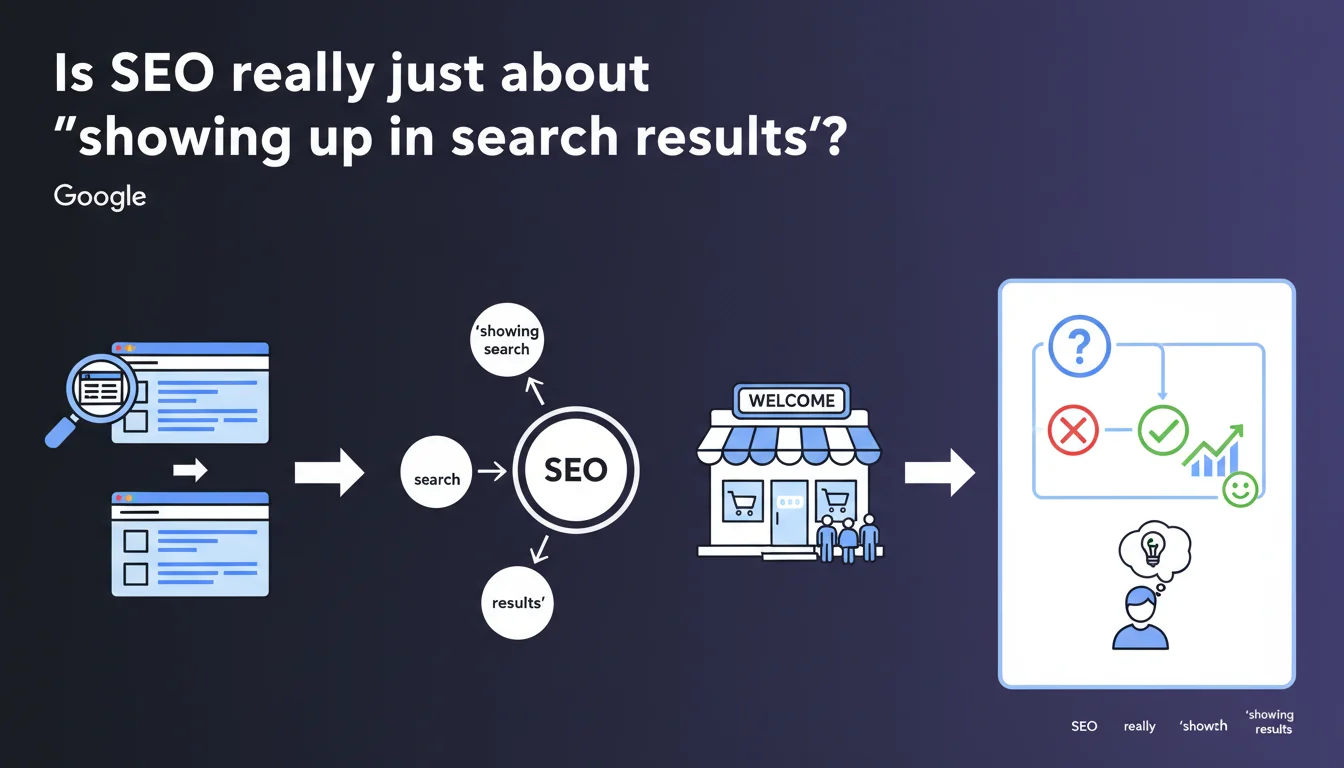
Google defines SEO as a technique to make a site appear in search results when users search for products or services. An ultra-simplified definition that deliberately omits algorithmic complexity and hundreds of ranking factors. This 'attractive storefront' vision is more about mass-market marketing than a technical explanation usable by practitioners.
What you need to understand
Google offers a deliberately accessible definition of SEO here, almost childlike. The analogy with an "attractive storefront" speaks to the average business owner, but completely sidesteps technical reality.
This statement fits into institutional communication aimed at beginners — not professionals who understand the difference between crawlability, indexability, and rankability.
Why does this definition pose a problem for professionals?
Because it conflates visibility with positioning. Appearing in search results isn't enough — you need to be visible on the first page, ideally in the top 3.
A site can technically "appear" on page 47 of the SERPs and meet this definition. But realistically? Zero organic traffic. Google's wording deliberately sidesteps the notion of ranking and competition.
Does this simplification reflect algorithmic reality?
No. Modern SEO integrates hundreds of signals: technical architecture, topical authority, user experience, page load speed, link profile, search intent.
Reducing all of that to "making your site appear" is marketing storytelling. Google knows full well that SEO is a complex ecosystem where each optimization impacts dozens of other variables.
What does "appearing in search results" concretely mean?
Technically, it requires three distinct steps: the crawl (exploration by Googlebot), indexation (addition to the database), then ranking (attribution of a position).
Google's statement merges these three processes into a single catch-all verb. For practitioners, that's problematic — diagnosing an indexation issue has nothing to do with a positioning problem.
- SEO isn't limited to "appearing" — it aims to dominate strategic positions
- The notion of ranking is absent from this definition, yet it drives 95% of organic traffic
- The "attractive storefront" analogy ignores the technical dimension (crawl, indexation, structure)
- Google over-simplifies for a non-technical audience, risking a misleading vision
- A site can be indexed and "appear" without ever generating traffic if it remains invisible on page 5+
SEO Expert opinion
Is this definition consistent with real-world practices?
Let's be honest: no. In reality, SEO doesn't just mean "appearing" somewhere in Google's index. It's about conquering dominant positions on queries with high volume and strong commercial intent.
Click-through rate data speaks volumes — position 1 captures roughly 28% of traffic, position 10 less than 2%. So "appearing" on page 2 essentially means you don't exist. [To verify]: Google never provides official stats on CTR distribution by position, but all third-party datasets converge.
What nuances should we add to this simplified view?
First, the distinction between indexation and real visibility. Google indexes billions of pages that generate zero traffic. Second, the idea that SEO is a single "technique" — when it actually aggregates dozens of disciplines: web development, copywriting, data analysis, content strategy, link building.
And that's where the problem lies. This definition glosses over the role of backlinks, semantics, E-E-A-T, Core Web Vitals. As if optimizing a site just meant ticking a few basic boxes.
When does this definition become downright misleading?
In ultra-competitive markets (finance, health, insurance, e-commerce). "Appearing" against competitors with six-figure SEO budgets and solid link profiles? Good luck with just an "attractive storefront".
Same issue with queries dominated by SERP features: Featured Snippets, People Also Ask, Local Pack, Google Shopping. You might technically "appear" at organic position 1… under a carousel capturing 60% of clicks. Google's definition completely ignores this reality.
Practical impact and recommendations
What should you concretely do beyond this minimalist definition?
Stop thinking in terms of "appearance" and start thinking position conquest. That means a complete technical audit: crawlability, URL structure, crawl budget management, internal linking optimization.
Next, work on content strategy with a detailed search intent analysis. Google doesn't say "appearing" is enough — but implicitly, you need to match user intent better than your competitors.
What mistakes should you avoid given this simplified view?
Believing that a well-indexed site is enough to generate traffic. Indexation is a prerequisite, not an end goal. Thousands of technically sound sites stagnate on page 3+ because they lack topical authority or a robust link profile.
Another trap: neglecting Core Web Vitals and mobile experience under the pretense that "all that matters is appearing". Spoiler — a slow site with poor CLS will never rank in the top 5 on a competitive query.
How do you measure your SEO's real effectiveness?
Forget vanity metrics like "number of indexed pages". Focus on actionable KPIs: average positions on target queries, qualified organic traffic, conversion rate from organic search.
Use Search Console to track impressions vs clicks evolution — and identify queries where you "appear" between positions 8 and 15. That's where growth potential lies.
- Audit crawlability and fix indexation errors (robots.txt, noindex, canonicals)
- Analyze real positioning on your strategic queries, not just indexation
- Optimize Core Web Vitals (LCP, FID, CLS) to stay competitive
- Develop intent-driven content strategy — not just "create pages"
- Build a coherent, thematic link profile to gain authority
- Monitor SERP features on your queries and adapt strategy accordingly
- Measure ROI with business KPIs (conversions, revenue generated) rather than technical metrics
Google's definition remains a pedagogical entry point, but it doesn't reflect the operational complexity of modern SEO. To transform simple "appearance" into profitable visibility, you need to orchestrate a coherent technical, editorial, and off-site strategy.
Faced with this complexity — and permanent algorithmic evolution — many choose to work with specialists. A specialized SEO agency can precisely diagnose priority levers, avoid costly mistakes, and drive a long-term strategy tailored to your sector. Because between "appearing" and "dominating your niche," there's a world of difference.
❓ Frequently Asked Questions
Apparaître dans Google suffit-il pour générer du trafic ?
Quelle différence entre indexation et ranking ?
Pourquoi Google simplifie-t-il autant sa définition du SEO ?
Faut-il optimiser pour apparaître ou pour bien se positionner ?
Un site peut-il être bien indexé mais invisible dans les SERP ?
🎥 From the same video 10
Other SEO insights extracted from this same Google Search Central video · published on 24/02/2022
🎥 Watch the full video on YouTube →
💬 Comments (0)
Be the first to comment.