
Official statement
Other statements from this video 10 ▾
- □ Le SEO se résume-t-il vraiment à « apparaître dans les résultats de recherche » ?
- □ Pourquoi Google insiste-t-il autant sur les informations pratiques des sites web ?
- □ Les titres de page descriptifs sont-ils vraiment le facteur déterminant pour votre visibilité SEO ?
- □ Les coordonnées et descriptions d'entreprise influencent-elles vraiment le référencement local ?
- □ Pourquoi le texte alternatif des images et vidéos reste-t-il un levier SEO sous-exploité ?
- □ Pourquoi Google insiste-t-il autant sur les mots-clés descriptifs pour les images produits ?
- □ Le texte caché et le contenu trompeur sont-ils toujours sanctionnés par Google ?
- □ Google peut-il vraiment détecter toutes les techniques de manipulation du classement ?
- □ Le black hat SEO est-il vraiment une perte de temps et d'argent ?
- □ Search Console suffit-il vraiment à gérer le SEO de votre site ?
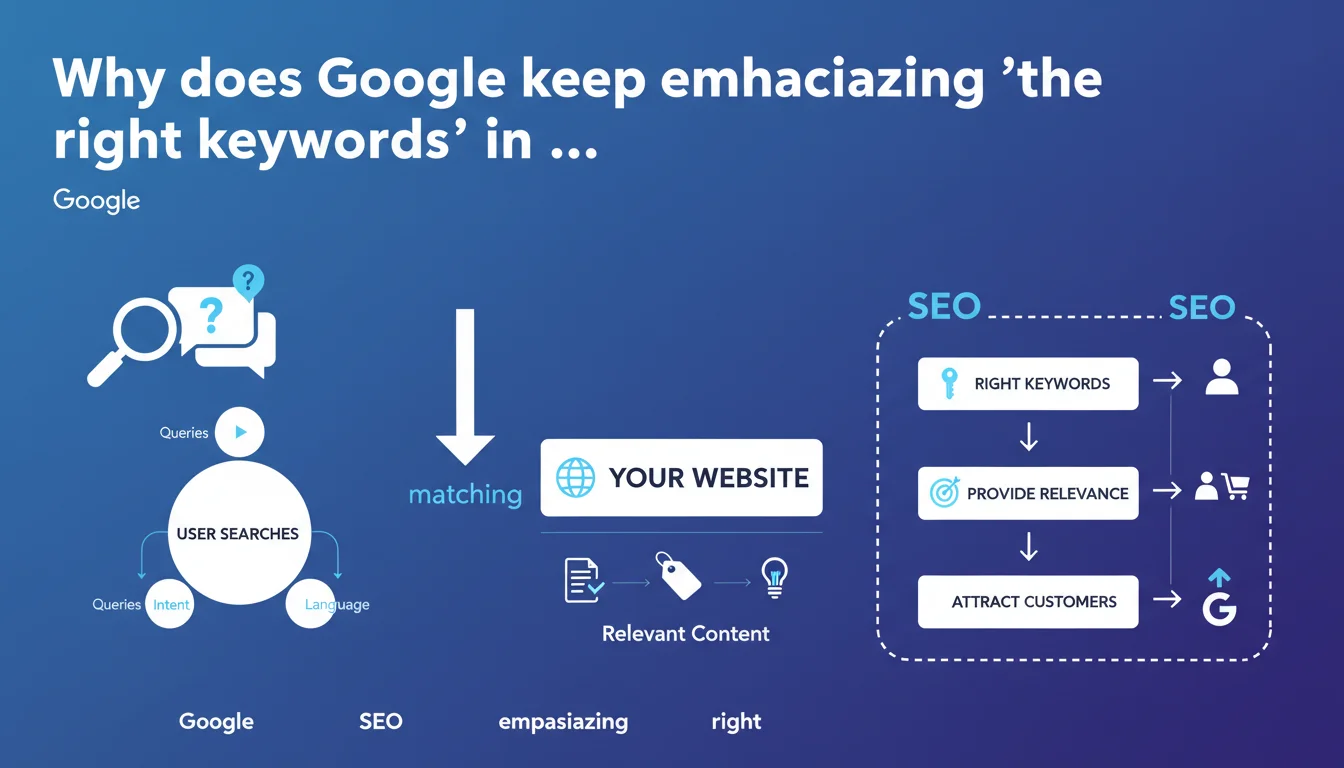
Google reminds us that SEO relies on using keywords that match what users actually search for. This basic statement underscores the importance of vocabulary for making a website relevant. Behind this obvious truth lies a deeper issue: semantics trump keyword stuffing, yet Google remains vague about how it evaluates this 'relevance'.
What you need to understand
Isn't this statement just stating the obvious?
Yes, and that's precisely what raises questions. Google is reaffirming a fundamental SEO principle: keywords must match search intent. Nothing revolutionary here — any practitioner knows that a site selling running shoes should use "running shoes" rather than "athletic footwear" if no one is actually searching for that latter phrase.
This reminder likely reflects a recurring observation by Google: many websites continue to use vocabulary misaligned with actual user queries. Corporate jargon, incomprehensible technical terms, or conversely overly generic language — all of these mistakes harm visibility.
What does 'appropriate vocabulary' mean to Google?
Google provides no metrics, no thresholds, no concrete examples. The term "appropriate" deliberately remains fuzzy. Is it exact matching? Synonyms? Broader semantic fields? The answer probably lies in semantic analysis and Natural Language Processing, but Google doesn't detail its approach.
In practice, this means you should analyze the SERPs for your target queries and identify the vocabulary used by well-ranking competitors. If everyone uses "SEO training" and you stubbornly stick with "learning curriculum in search engine optimization," you're creating a gap that Google will struggle to bridge.
How is this different from keyword stuffing?
Google mentions "relevant information," not "keyword density." The distinction is crucial. Stuffing (keyword stuffing) consists of mechanically repeating a term to force rankings. The recommended approach here aims to answer user intent with natural vocabulary.
Concretely: an article on "how to choose trail running shoes" should mention "trail," "paths," "grip," "cushioning," "rugged terrain" — because that's what the user wants to learn about. Not because an SEO tool tells you to reach 3% density on "trail running shoes."
- Keywords remain essential — they allow Google to understand the topic
- Relevance takes priority — repeating a term 50 times won't help if your content doesn't address the intent
- SERP analysis reveals expected vocabulary — observe what your competitors rank for
- Google provides no numerical rules — everything comes down to "common sense" according to them
SEO Expert opinion
Is this statement consistent with observed practices?
Yes and no. In principle, it's indisputable: using your users' vocabulary improves visibility. A/B tests show that adapting titles and descriptions to actually searched terms boosts click-through rate and often rankings too.
But here's the catch: Google claims SEO "consists of" using the right keywords, as if it were the be-all and end-all. Yet we know modern SEO integrates hundreds of signals — backlinks, Core Web Vitals, E-E-A-T, freshness, structure, UX. Reducing SEO to keywords alone, even "appropriate" ones, is an oversimplification.
Where does this approach show its limitations?
First case: niche markets where search volume is low or nonexistent. If you're creating an innovative product without established terminology, you can't rely on existing queries — you sometimes need to establish your own vocabulary.
Second case: multimodal search intent. On certain complex informational queries, users employ varied phrasings. Google can now understand that a page optimized for "fix leaky faucet" also answers "faucet that drips solution." Exact matching is no longer essential everywhere. [To verify]: how far does this semantic understanding capability extend? Google remains quiet on the limits of its NLP.
Should we still do traditional keyword research?
Absolutely. Even though Google understands semantics better, keyword research remains the starting point of any SEO strategy. How can you identify search intentions without analyzing actual queries? How can you prioritize content without evaluating volume and competition?
But be careful — don't stop at an isolated list of keywords. Think semantic clusters, thematic groupings, long-tail variations. Google values pages that cover a subject in depth rather than those that mechanically target an exact term.
Practical impact and recommendations
How do you identify 'appropriate' keywords for your site?
First step: analyze queries already generating traffic via Google Search Console. Identify terms where you rank 8-20 — these are your quick wins. Strengthen these pages with missing vocabulary.
Second step: study the SERPs for your target queries. What terms appear consistently in titles, descriptions, and content of the top 3 results? Google shows you directly the vocabulary it considers relevant.
Third step: cross-reference with suggestion tools — Google Suggest, "People Also Ask," "Related Searches." These features reveal actual user variations and questions. Don't overlook them.
What mistakes should you avoid in semantic optimization?
Mistake #1: Mechanically inserting keywords without editorial coherence. If your text becomes artificial or repetitive, you degrade user experience — and Google detects this through behavioral signals (bounce rate, time on page).
Mistake #2: Ignoring search intent. A high-volume keyword might seem attractive, but if it matches transactional intent while your page is informational, you won't convert anyone — and your ranking will remain unstable.
Mistake #3: Neglecting regional or sectoral variants. "Lawyer" doesn't mean the same thing depending on whether the user is seeking a legal professional or a fruit. Always contextualize your keywords.
What should you do concretely starting today?
- Audit your top 10 pages — does your vocabulary match actual user searches?
- Check Search Console — identify queries ranking 8-20 and optimize those pages
- Analyze 3 well-ranking competitors — what terms do they use consistently?
- Create a sector glossary — list industry vocabulary vs. general audience vocabulary
- Integrate long-tail variations — they often capture more precise, less competitive intent
- Test your changes — compare performance before/after via Search Console
Semantic optimization remains a pillar of SEO, but it's part of a broader strategy incorporating technical elements, authority, and user experience. Adapt your vocabulary to actual user searches, but don't neglect other visibility levers.
These semantic optimizations, while fundamental, require in-depth analysis and methodical implementation. Between auditing existing content, identifying opportunities, and coherently integrating target vocabulary, the workload can quickly become substantial — especially on high-volume sites. If you want to structure a complete approach without tying up your teams for weeks, support from a specialized SEO agency can save you valuable time and ensure execution aligned with best practices.
❓ Frequently Asked Questions
Faut-il encore optimiser la densité de mots-clés ?
Comment savoir si mon vocabulaire correspond aux recherches utilisateurs ?
Google comprend-il les synonymes et variantes de mots-clés ?
Les mots-clés longue traîne sont-ils toujours pertinents ?
Peut-on se passer de recherche de mots-clés avec l'IA de Google ?
🎥 From the same video 10
Other SEO insights extracted from this same Google Search Central video · published on 24/02/2022
🎥 Watch the full video on YouTube →
💬 Comments (0)
Be the first to comment.