
Official statement
Other statements from this video 10 ▾
- □ Le SEO se résume-t-il vraiment à « apparaître dans les résultats de recherche » ?
- □ Pourquoi Google insiste-t-il encore sur les « bons mots-clés » en SEO ?
- □ Pourquoi Google insiste-t-il autant sur les informations pratiques des sites web ?
- □ Les titres de page descriptifs sont-ils vraiment le facteur déterminant pour votre visibilité SEO ?
- □ Les coordonnées et descriptions d'entreprise influencent-elles vraiment le référencement local ?
- □ Pourquoi Google insiste-t-il autant sur les mots-clés descriptifs pour les images produits ?
- □ Le texte caché et le contenu trompeur sont-ils toujours sanctionnés par Google ?
- □ Google peut-il vraiment détecter toutes les techniques de manipulation du classement ?
- □ Le black hat SEO est-il vraiment une perte de temps et d'argent ?
- □ Search Console suffit-il vraiment à gérer le SEO de votre site ?
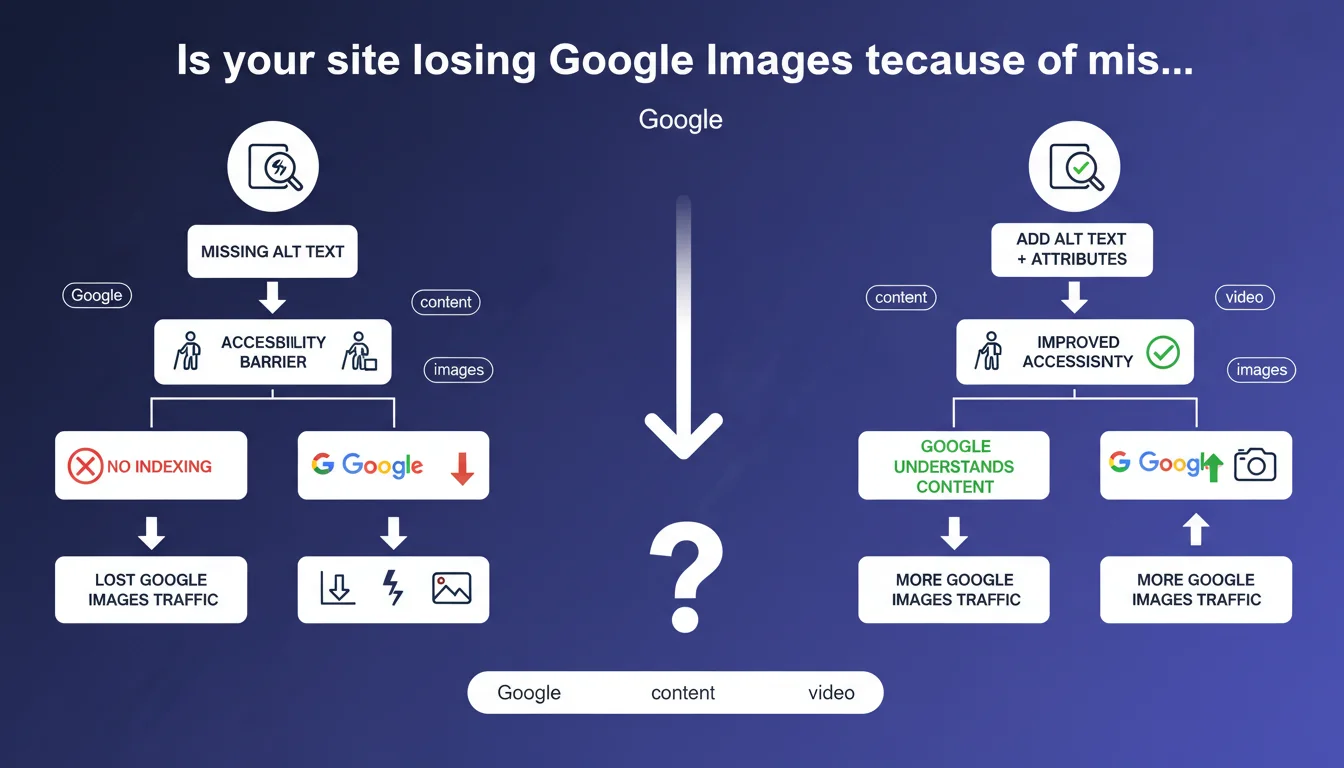
Google emphasizes that alt tags and other descriptive attributes on images and videos are essential for SEO and accessibility. Without these elements, the search engine cannot understand visual content — and you're missing out on ranking opportunities, especially in Google Images.
What you need to understand
Why does Google place so much emphasis on alt text?
Google's crawlers don't "see" images the way we do. They rely on alternative text (alt attribute) to understand what they represent. Without this information, an image remains an anonymous binary file — impossible to properly index in Google Images or contextualize within a page.
Accessibility plays a major role too. Screen readers used by visually impaired people read alt tags aloud. A site without alternative text excludes part of its audience — and Google knows it. For several years now, accessibility has been part of the indirect Core Web Vitals that the search engine monitors.
What attributes does Google expect beyond the alt tag?
Alternative text is just one piece of the puzzle. Google also recommends providing the title, captions (figcaption tag), and textual context around the image. For videos, transcriptions, subtitles, and descriptive metadata play the same role.
These elements enrich semantic context. An isolated image with a generic alt ("photo1.jpg") adds nothing. But an image with descriptive alt text, a caption, and an explanatory paragraph around it becomes a relevance signal that the search engine can leverage.
Does this practice really impact organic rankings?
Directly? Yes, in Google Images — a traffic channel that's often overlooked. Indirectly? Yes, too, because a well-described image improves Google's overall understanding of the page. The search engine connects entities, concepts, and media to assess relevance.
An e-commerce site with product pages lacking alt tags loses ground against a competitor who properly optimizes their visuals. It's measurable — and it's one of the easiest quick wins to implement.
- Alt tags allow Google to understand and index images
- Accessibility is an indirect quality criterion for the search engine
- Textual context (captions, adjacent paragraphs) strengthens relevance
- Videos require transcriptions and subtitles to be usable
- Google Images is a traffic channel in its own right — don't neglect it
SEO Expert opinion
Is this statement consistent with what we observe in practice?
Absolutely. SEO audits reveal systematically catastrophic coverage rates for alt tags — even on high-budget sites. We still see CMSs generating empty alt attributes, agencies forgetting to brief editorial teams, migrations where alt attributes disappear.
A/B testing shows that adding descriptive alt tags to product catalogs improves Google Images traffic by 15 to 30% within weeks. This isn't anecdotal — it's a volume lever, especially in e-commerce, travel, or real estate.
What nuances should we add to this recommendation?
Let's be honest: the quality of alt text matters more than its presence. A generic alt ("image", "photo", "banner") serves no purpose. Google looks for precise, contextualized descriptions that enhance page understanding — not keyword stuffing.
Another point: not all images deserve alt text. Decorative images (icons, separators, purely visual elements) should have empty alt text (alt="") to avoid cluttering screen reader experience. Google doesn't penalize this practice — quite the opposite, it improves accessibility.
In what cases does this rule not fully apply?
Images in lazy loading or loaded via JavaScript can cause problems. If Google doesn't detect the alt attribute during the initial crawl, the image remains invisible. Make sure your alt tags are present in the source HTML, not injected afterward by a script.
For videos, Google favors structured formats: VideoObject in schema.org, integrated transcriptions, WebVTT subtitles. A simple alt attribute on a <video> tag isn't enough — it requires more effort.
Practical impact and recommendations
What should you do concretely to optimize alt tags?
Start with an exhaustive audit of your images: how many have an alt tag? How many are empty or generic? Use Screaming Frog or an equivalent crawler to extract all <img> tags and analyze their alt attribute.
Next, define a writing methodology. Good alt text describes the image in 10-15 words maximum, integrates page context, and avoids unnecessary phrases ("image of", "photo of"). Example: instead of "photo of shoes", write "black Nike Air Zoom Pegasus 40 running sneakers".
What mistakes should you absolutely avoid?
Don't fall into keyword stuffing. Repeating your target keyword 5 times in a 50-word alt is counterproductive — Google detects this over-optimization and may devalue the page.
Also avoid automatic alt text from filenames ("IMG_1234.jpg"). If you use a CMS, configure it to require manual entry of alternative text with every upload. WordPress plugins like SEO Framework or Yoast can help — but don't do the heavy lifting for you.
How do you verify your site complies with these recommendations?
Test your site with a screen reader (NVDA, JAWS, VoiceOver). If images aren't properly described aloud, your alt tags are insufficient. This is the most reliable test — and the one Google values.
On the SEO side, monitor your performance in Google Images via Search Console. A traffic increase after optimizing alt text confirms Google better understood your visuals. If nothing changes after 4-6 weeks, the issue is elsewhere (image quality, competition, weak surrounding text).
- Audit all site images to identify missing or empty alt tags
- Write descriptive, contextualized alternative text without keyword stuffing
- Leave decorative images with empty alt text (alt="") for accessibility
- Add captions (figcaption) and textual context around key images
- Integrate transcriptions and subtitles for videos
- Ensure alt tags are present in source HTML (not injected via JS)
- Test your site with a screen reader to validate accessibility
- Track performance in Google Images via Search Console
❓ Frequently Asked Questions
Faut-il ajouter une balise alt sur toutes les images sans exception ?
Quelle est la longueur idéale d'un texte alternatif ?
Les balises alt ont-elles un impact direct sur le classement dans la recherche classique ?
Les outils d'IA générative peuvent-ils rédiger les balises alt à ma place ?
Comment gérer les balises alt sur un site multilingue ?
🎥 From the same video 10
Other SEO insights extracted from this same Google Search Central video · published on 24/02/2022
🎥 Watch the full video on YouTube →
💬 Comments (0)
Be the first to comment.