
Official statement
What you need to understand
This statement from Google repositions alt text (the alt attribute) within its primary function: web accessibility. The alt attribute allows visually impaired people using screen readers to understand the content of images.
Google reminds us that the main motivation for writing alt text should not be search engine optimization, but rather user experience and accessibility. This position aligns with the logic of compliance with W3C standards.
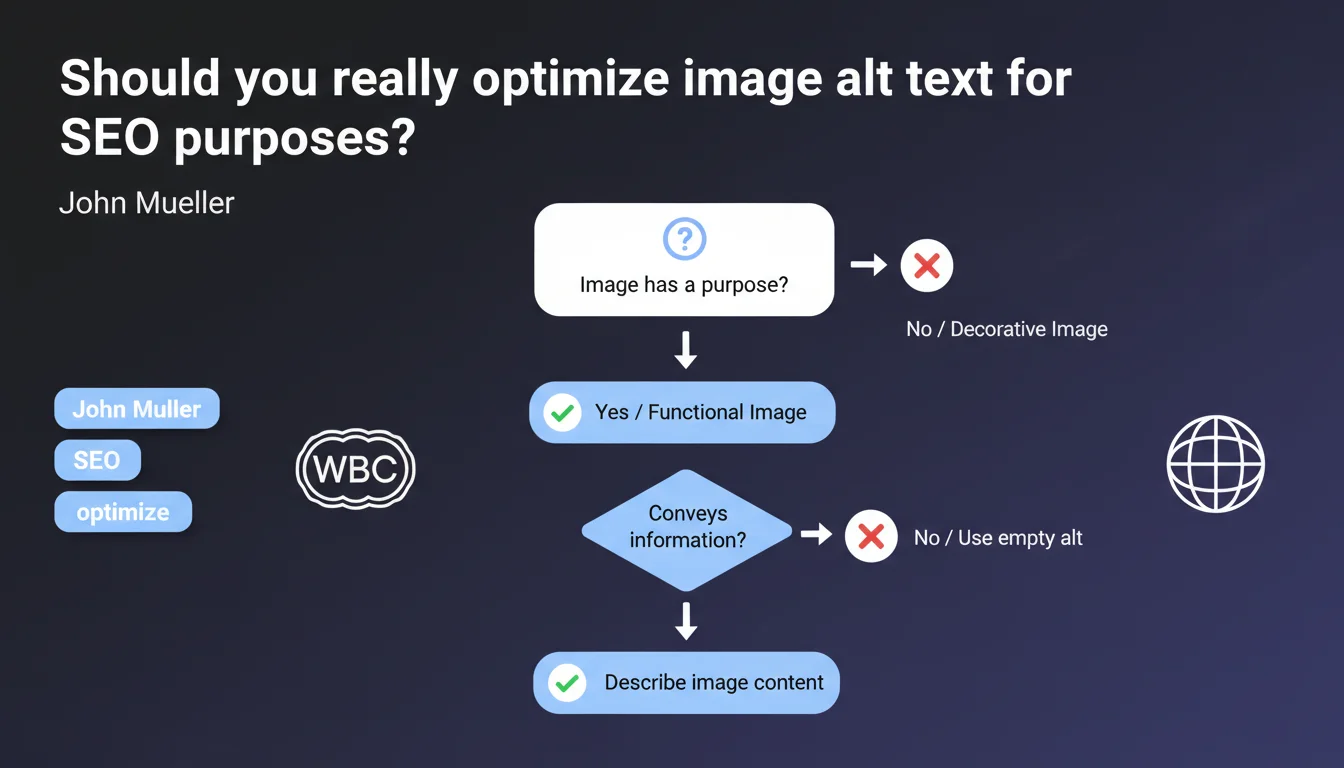
The search engine even shares the W3C decision tree that helps determine what type of alt text to use depending on the context and function of the image on the page.
- Alt text is primarily an accessibility element, not an SEO tool
- Google encourages following W3C recommendations for appropriate use
- The quality and relevance of alt text should take priority over optimization for search engines
- Well-crafted alt text for the user will naturally benefit SEO
SEO Expert opinion
This position from Google is perfectly consistent with the algorithm's evolution in recent years. The search engine now prioritizes overall user experience rather than purely technical optimizations.
However, this needs to be nuanced: well-written alt text for accessibility also serves image SEO in Google Images. The SEO/accessibility opposition is therefore artificial. Good descriptive text helps both visually impaired users and the search engine understand the image.
In practice, decorative images should not have alt text (alt=""), while informative images require a precise and natural description. This approach simultaneously satisfies accessibility and SEO.
Practical impact and recommendations
- Audit your existing alt text and remove any unnatural keyword stuffing
- Use the W3C decision tree to determine whether an image requires alt text and what type
- Write concise and precise descriptions that genuinely explain the visual content of the image
- Leave the alt attribute empty (alt="") for purely decorative images (borders, spacing, etc.)
- Naturally integrate the page context into the description without forcing keyword insertion
- Train your editorial teams in accessibility best practices rather than "SEO techniques"
- Test your pages with a screen reader to verify the relevance of your alt text
- Prioritize quality over quantity: relevant alt text is better than artificially optimized text
💬 Comments (0)
Be the first to comment.