
Official statement
Other statements from this video 10 ▾
- □ Le SEO se résume-t-il vraiment à « apparaître dans les résultats de recherche » ?
- □ Pourquoi Google insiste-t-il encore sur les « bons mots-clés » en SEO ?
- □ Pourquoi Google insiste-t-il autant sur les informations pratiques des sites web ?
- □ Les titres de page descriptifs sont-ils vraiment le facteur déterminant pour votre visibilité SEO ?
- □ Les coordonnées et descriptions d'entreprise influencent-elles vraiment le référencement local ?
- □ Pourquoi le texte alternatif des images et vidéos reste-t-il un levier SEO sous-exploité ?
- □ Pourquoi Google insiste-t-il autant sur les mots-clés descriptifs pour les images produits ?
- □ Google peut-il vraiment détecter toutes les techniques de manipulation du classement ?
- □ Le black hat SEO est-il vraiment une perte de temps et d'argent ?
- □ Search Console suffit-il vraiment à gérer le SEO de votre site ?
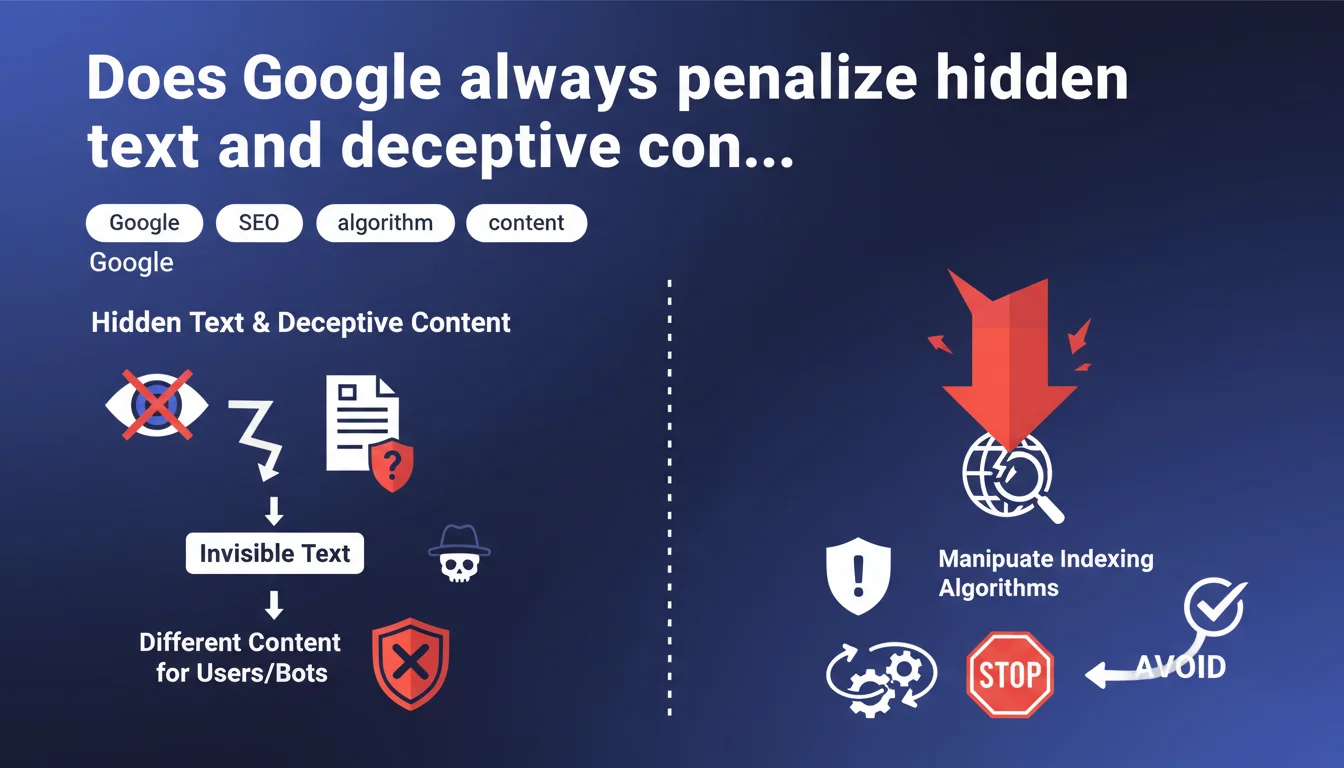
Google explicitly condemns invisible text and cloaking techniques as black hat SEO aimed at manipulating algorithms. These practices—hiding content from users while making it visible to search bots—expose sites to manual and algorithmic penalties. The challenge: distinguishing between legitimate optimization techniques and prohibited manipulation.
What you need to understand
What exactly does Google mean by "hidden text"?
Hidden text refers to any content rendered invisible or nearly invisible to human visitors but accessible to search engine crawlers. Classic techniques include: white text on white background, zero font size, off-screen positioning via CSS, and overlapping elements.
Google distinguishes between intentionally concealed text and content that is technically hidden but accessible through user interaction (accordions, tabs, dropdown menus). The former constitutes manipulation, while the latter represents legitimate interface design.
Why does Google consider these practices black hat?
The objective is transparent: stuffing a page with additional keywords without degrading user experience. This asymmetry between what humans see and what the crawler indexes represents an attempt to manipulate rankings.
Cloaking—displaying different content depending on whether the visitor is a bot or a human—amplifies this deception. Google views this as a direct violation of its quality guidelines, subject to manual penalties.
What gray areas cause problems for SEO professionals?
Certain legitimate technical implementations flirt with the boundary. ARIA-label attributes for accessibility, JavaScript-deferred content loading, image alt text—all invisible but functional elements.
The distinguishing criterion: intent. If hidden content serves user experience (accessibility, performance, mobile UX), Google tolerates it. If its only purpose is artificially inflating keyword density, it's prohibited.
- Invisible text via color, size, or positioning = sanctionable black hat
- Cloaking (different content for bots vs. humans) = serious violation of guidelines
- Hidden but accessible content via interaction (accordions, tabs) = acceptable if justified by UX
- Technical attributes (aria-label, alt, schema markup) = legitimate if they serve accessibility or understanding
- The discriminating criterion remains intent: improve experience or manipulate rankings?
SEO Expert opinion
Does this statement reflect actual penalty practices?
In practice, manual penalties for hidden text remain rare but exemplary. Google targets mainly flagrant cases where hundreds of keywords are concealed. Automatic sanctions via quality algorithms (Helpful Content, Page Experience) more often indirectly penalize such sites—through degraded engagement signals.
Let's be honest: automated detection is not foolproof. Sites with slightly hidden text (light gray on white, for example) sometimes escape radar. But the risk-reward balance is skewed—the potential gain never justifies exposure to manual action.
What nuances are missing from this official communication?
Google doesn't precisely define where the boundary lies for modern JavaScript implementations. Does content loaded via lazy-load, technically invisible on initial page load, pose a problem? [Verify]—guidelines remain vague on the timing of dynamic content indexing.
Another gray area: accordions and tabs. John Mueller has confirmed multiple times that Google indexes this content, but does it assign the same weight as directly visible text? A/B testing shows performance variations—suggesting differentiated weighting that Google doesn't explicitly acknowledge.
In what cases does this rule create practical dilemmas?
E-commerce sites with complex navigation filters often generate hidden content. Search facets, collapsed category descriptions by default, user reviews loaded on demand—all technically "hide" text.
Mobile complicates things further. Hiding secondary content to improve Core Web Vitals and LCP is common practice. Google recommends responsive design...but penalizes mobile-desktop cloaking. Practitioners must navigate these contradictory constraints without clear guidance.
Practical impact and recommendations
How can you verify a site doesn't contain problematic hidden text?
First reflex: audit via Google Search Console. Manual actions for "hidden text" appear there explicitly. But the absence of notification guarantees nothing—algorithms can demote without alerting.
Technically, compare the user rendering to the Googlebot rendering. The "URL Inspection" tool in GSC lets you visualize the indexed version. Any significant gap between what a human sees and what the bot scrapes constitutes a red flag.
What technical implementations must be absolutely avoided?
Classic errors persist. display:none on keyword-stuffed content, negative text-indent to project text off-screen, font-size:0—these techniques date from the 2000s but still circulate in some questionable SEO forums.
More insidious: user-agent cloaking. Serving an enriched version to Google bots while displaying a stripped-down page to visitors. Detection tools (like User-Agent Switcher) allow testing, but Google has far more sophisticated detection systems.
What legitimate alternatives exist for optimizing without risk?
To enrich a page semantically without visual overload, prioritize legitimate interactive content. Well-implemented accordions (details/summary tags), keyboard-accessible tabs, expandable "Learn more" sections—anything that genuinely improves UX passes inspection.
Schema markup provides a royal road to contextualizing content without displaying it. Structured data (FAQ, HowTo, Product) enriches bot understanding without polluting the interface. It's the exact opposite of hidden text: visible to Google, useful to users via rich snippets.
- Regularly audit with GSC's URL Inspection tool to compare user rendering and bot rendering
- Remove all hidden content via display:none, visibility:hidden, or negative text-indent if it doesn't serve UX
- Verify accordions and tabs use semantic HTML tags (details/summary, aria-controls)
- Implement schema.org structured data to enrich contextual understanding
- Test accessibility with a screen reader—if content isn't useful visually or via voice synthesis, it's suspect
- Avoid all cloaking: content served to bots must strictly match what's accessible to humans
- Document implementation choices (why certain content is hidden by default) to justify during audits
❓ Frequently Asked Questions
Google pénalise-t-il le contenu dans des accordéons fermés par défaut ?
Le lazy-loading d'images ou de texte est-il considéré comme du texte caché ?
Comment distinguer le cloaking d'une simple adaptation responsive ?
Les attributs aria-label peuvent-ils être considérés comme du texte caché manipulateur ?
Quelle sanction risque-t-on concrètement pour du texte caché détecté ?
🎥 From the same video 10
Other SEO insights extracted from this same Google Search Central video · published on 24/02/2022
🎥 Watch the full video on YouTube →
💬 Comments (0)
Be the first to comment.