
Official statement
Other statements from this video 10 ▾
- □ Le SEO se résume-t-il vraiment à « apparaître dans les résultats de recherche » ?
- □ Pourquoi Google insiste-t-il encore sur les « bons mots-clés » en SEO ?
- □ Pourquoi Google insiste-t-il autant sur les informations pratiques des sites web ?
- □ Les titres de page descriptifs sont-ils vraiment le facteur déterminant pour votre visibilité SEO ?
- □ Les coordonnées et descriptions d'entreprise influencent-elles vraiment le référencement local ?
- □ Pourquoi le texte alternatif des images et vidéos reste-t-il un levier SEO sous-exploité ?
- □ Pourquoi Google insiste-t-il autant sur les mots-clés descriptifs pour les images produits ?
- □ Le texte caché et le contenu trompeur sont-ils toujours sanctionnés par Google ?
- □ Google peut-il vraiment détecter toutes les techniques de manipulation du classement ?
- □ Search Console suffit-il vraiment à gérer le SEO de votre site ?
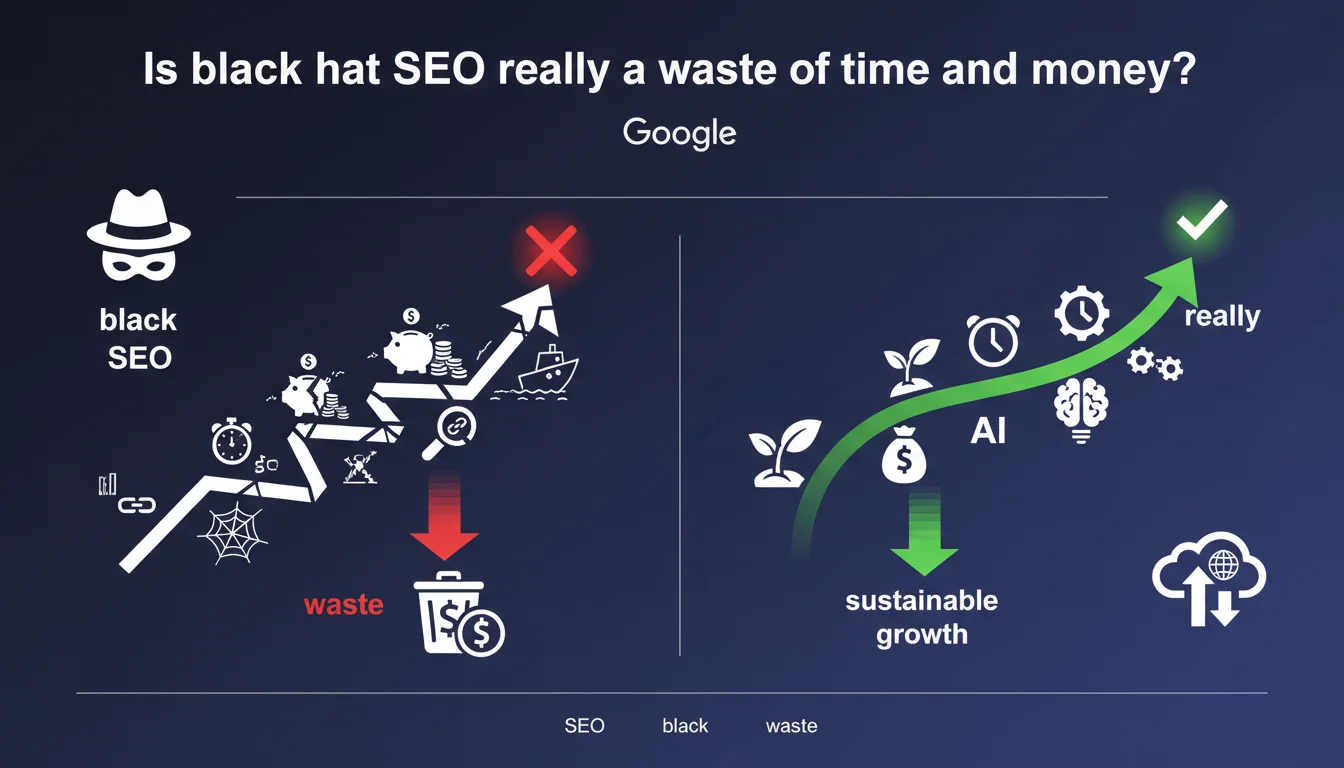
Google claims that black hat techniques don't work and ultimately cost time and money without delivering sustainable results. The recommended approach: prioritize legitimate SEO practices that withstand algorithmic updates. A statement worth nuancing based on context and objectives.
What you need to understand
Google has been hammering this message for years, and this statement is part of a communication strategy designed to discourage manipulative practices. The official objective? Direct webmasters toward approaches that comply with guidelines.
But behind this simplistic statement lies a more complex reality. Black hat has evolved, algorithms have too, and the boundary between aggressive optimization and pure manipulation has become considerably blurred.
What exactly does Google mean by "black hat"?
Here's where it gets sticky — Google deliberately remains vague on this definition. Officially, it's any practice aimed at manipulating search results by circumventing guidelines. In concrete terms? Cloaking, artificial link networks, comment spam, hidden text, massive keyword stuffing.
The problem: some techniques once considered black hat are commonplace today. Link buying existed before Penguin and still exists. PBNs have evolved into "editorial networks." Automatically generated content? It's now called "generative AI" and everyone uses it.
Is this claim that black hat "doesn't work" actually accurate?
[Requires verification] This part of the statement is questionable in the real world. Sites using aggressive tactics continue to rank, sometimes for months or even years. The real risk isn't that it "doesn't work," but rather the long-term consequences.
Let's be honest: if black hat never worked, nobody would use it. The reality? It works until it doesn't — and when it stops, the damage can be catastrophic. Manual penalties, brutal drops after a core update, partial or complete deindexation.
Why does Google communicate this way on this topic?
Two main reasons. First, limit index pollution by massively discouraging manipulation attempts. Less spam = fewer resources needed to detect and neutralize it.
Second, protect user experience. A search engine infested with manipulated sites loses credibility and usage. Google has every incentive to ensure results reflect genuine quality, not technical tricks.
- Black hat SEO encompasses all techniques aimed at manipulating algorithms by circumventing official guidelines
- Google remains intentionally vague on the precise definition to maintain flexibility
- Some practices once considered black hat have become normalized or evolved into other acceptable forms
- The "doesn't work" message is excessive oversimplification — the real question is the risk/benefit ratio
- This communication aims to massively discourage to reduce the volume of spam to process
SEO Expert opinion
Does this statement actually reflect what we observe in the field?
Only partially. In fifteen years of practice, I've seen black hat sites dominate competitive SERPs for surprisingly long periods. The "doesn't work" claim is false — the correct formulation would be "doesn't work sustainably without major risk."
Detection is improving constantly, that's undeniable. Algorithms better identify suspicious patterns, SpamBrain grows more efficient, manual penalties fall faster on flagrant cases. But between a crude amateur PBN and a sophisticated editorial network, the gap in detectability remains enormous.
What nuances should we add to this official position?
First nuance: it's not binary. Between pure white hat (which often resembles inertia) and destructive black hat, there's a massive gray zone where most high-performing sites operate. Proactive link building, aggressive technical optimizations, content strategies oriented toward algorithms rather than users — where do you draw the line?
Second nuance: context matters tremendously. In low-stakes niches with weak competition, gray hat tactics can work indefinitely without consequences. In ultra-monitored YMYL sectors, the slightest misstep is punished quickly.
[Requires verification] Google claims these techniques "waste time and money," but for certain short-term actors (aggressive affiliate marketing, ad arbitrage), the ROI can be positive even with a limited lifespan. It's cold math: traffic acquisition cost vs. revenue generated before penalty.
In what cases doesn't this general rule fully apply?
On disposable-by-nature projects — event sites with limited lifespan, one-off campaigns, rapid market testing — the question of sustainability doesn't even arise. If the site should live three months, it doesn't matter if it's burned after six.
Another case: less-monitored geographic or linguistic environments. Google doesn't deploy the same control intensity across all markets. Some languages or regions tolerate practices that would be immediately sanctioned in English or on the American market.
Finally, the very definition of black hat evolves. What Google considered manipulation five years ago may be tolerated today, and vice versa. The framework constantly shifts, making any absolute rule quickly outdated.
Practical impact and recommendations
What should you concretely do in response to this recommendation?
Start with an honest audit of your current practices. List all your backlink sources, content techniques, technical optimizations. For each element, ask yourself: "If Google examined this closely tomorrow, what would the risk be?"
Then prioritize by risk/impact ratio. A network of 50 low-quality PBNs? Massive risk, needs to be dismantled progressively. A few links bought on legitimate editorial sites? Moderate risk, worth monitoring but not necessarily removing immediately.
Invest in parallel in solid foundations: clean technical architecture, genuinely useful content (not just algorithm-optimized), thoughtful user experience, naturally diversified link profile. These elements withstand updates and create a sustainable base.
What mistakes must you absolutely avoid in this context?
First mistake: excessive panic. Massively disavow all your links out of fear, rewrite all your content overnight, delete pages that rank well. The cure can be worse than the disease — every SEO action has consequences, even the "good practices."
Second mistake: inertia through fear. Some interpret "no black hat" as "do nothing active." Result: zero link building, minimal content, timid technical optimizations. You risk no penalties, but you don't progress either against more aggressive competitors.
Third mistake: blindly believing "white hat = guaranteed success". Google nowhere promises that scrupulously following guidelines guarantees good rankings. You can do everything "right" and stagnate, while a gray hat competitor explodes. It's frustrating but it's the reality of the game.
How do you verify your approach is viable long-term?
Monitor your stability metrics rather than just absolute traffic. A site progressing steadily 5-10% per quarter for two years is healthier than one that spikes +200% then collapses. Smooth curves are reassuring, sudden spikes are suspicious.
Analyze your resistance to core updates. If each major update causes huge swings (±30%), that signals your site is surfing on unstable or manipulable signals. Robust sites experience minor variations, rarely dramatic drops.
Test the diversification of your traffic sources. A site dependent 90% on Google SEO is structurally fragile, even with impeccable practices. One penalty, one algorithm change working against you, and your entire operation collapses.
- Conduct a complete audit of your current practices and identify risk areas
- Prioritize corrections by risk/impact ratio, not by fear
- Invest in solid technical and editorial foundations that withstand updates
- Avoid excessive panic and drastic strategy changes
- Don't fall into inertia through fear — stay proactive in a measured approach
- Monitor stability metrics and core update resistance
- Diversify traffic sources to reduce dependency on Google SEO
- Document all actions to trace the history in case of problems
❓ Frequently Asked Questions
Le black hat SEO peut-il encore fonctionner en 2025 ?
Quelle est la différence concrète entre grey hat et black hat ?
Dois-je désavouer tous mes liens suspects après cette déclaration ?
Un concurrent utilise du black hat et me dépasse — que faire ?
Le content spinning avec IA est-il considéré comme black hat ?
🎥 From the same video 10
Other SEO insights extracted from this same Google Search Central video · published on 24/02/2022
🎥 Watch the full video on YouTube →
💬 Comments (0)
Be the first to comment.