
Official statement
Other statements from this video 10 ▾
- □ Are snippets really the most underestimated SEO lever to boost your CTR?
- □ How do you write page titles that won't get truncated by Google?
- □ Do you really need to repeat your keywords in titles to rank higher on Google?
- □ Why does Google insist so strongly on having unique title tags for every page?
- □ Does Google really generate different snippets for the same page based on each search query?
- □ Can Google really override your title tags and meta descriptions?
- □ Should your meta description really be a sales pitch?
- □ Should you really write meta descriptions as complete sentences?
- □ Should you really write a unique meta description for every single page?
- □ How can you technically optimize title tags and meta descriptions to maximize their SEO impact?
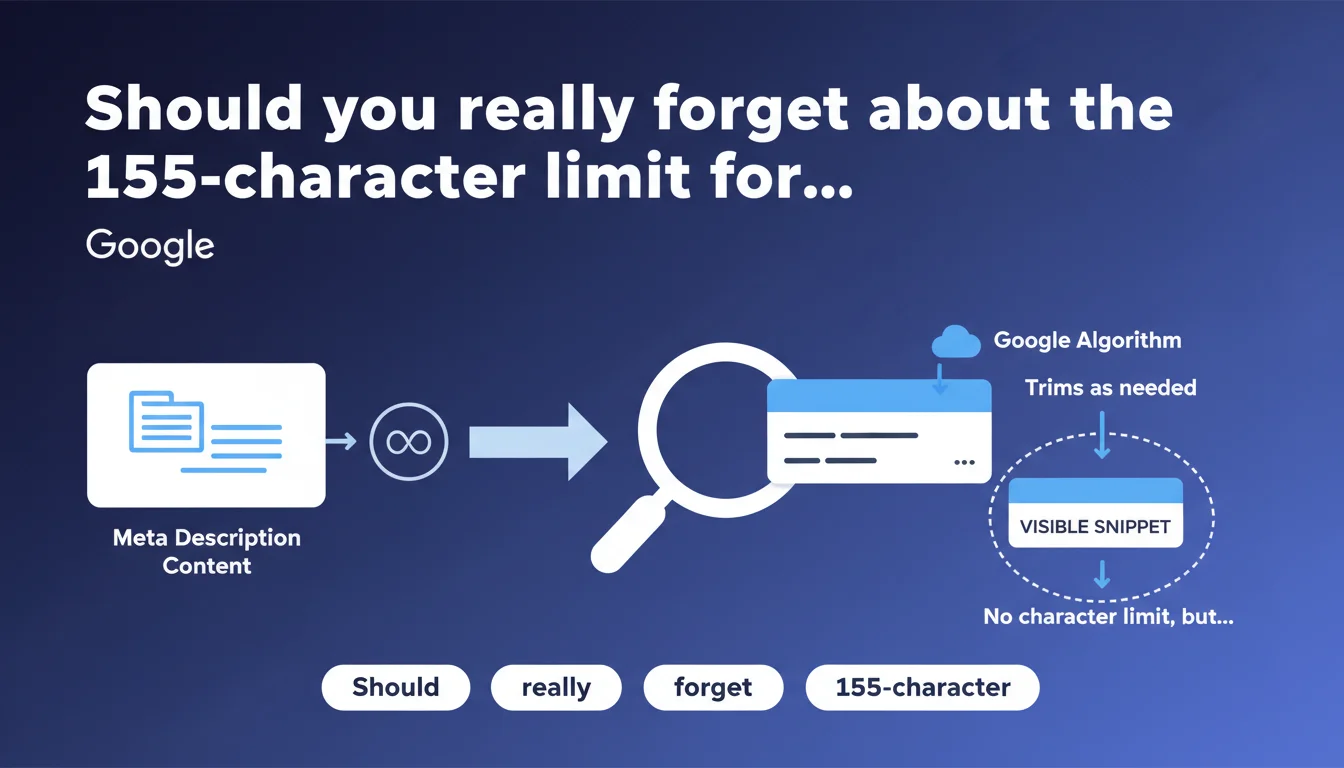
Google confirms that no technical character limit exists for meta descriptions. The snippets displayed in search results are truncated based on available space, which varies depending on context (desktop, mobile, featured snippets). The optimal length therefore remains empirical, not absolute.
What you need to understand
What's the difference between a technical limit and a display limit?
Google clarifies that it imposes no technical constraints on meta description length. You can write 500 characters if you want — the HTML code will accept it all. The search engine reads the entire content.
The real constraint is the display space in SERPs. Google truncates the snippet based on device, result type, and viewport width. On desktop, we typically observe 155-160 characters displayed. On mobile, it's more like 120-130. But these numbers fluctuate.
Why doesn't Google set a clear threshold?
Because the algorithm dynamically adjusts the displayed length. If Google believes that a specific portion of your description better matches search intent, it can pull content from elsewhere in your page — sometimes completely ignoring your meta description altogether.
The statement therefore leaves total freedom to publishers while reminding them that the final output escapes their control. This is consistent with Google's approach: provide loose guardrails rather than rigid rules.
What does this change practically for an SEO professional?
- No penalty if your meta description exceeds 160 characters — Google won't penalize you for going over
- The main risk remains truncation that cuts your message at the wrong point, creating an awkward or incomprehensible snippet
- You can test longer descriptions for specific contexts (detailed product pages, long-form articles) where Google sometimes displays more text
- Short descriptions (80-100 characters) remain valid if they convey the essentials — no obligation to artificially inflate the length
SEO Expert opinion
Is this absence of a limit true freedom or a trap?
Let's be honest: this statement doesn't change anything about the on-ground practices observed for years. SEO professionals already know that Google truncates snippets according to its own criteria. What's missing here is actionable data: at what point does the probability of truncation become critical?
The absence of a clear threshold leaves each practitioner facing their own tests. Some sites find that descriptions of 200 characters display fully on certain long-tail queries. Others see their 140 characters cut short. The variability is such that no universal rule holds.
What nuances should we add to this statement?
Google doesn't clarify how it decides on the displayed length. Multiple hypotheses coexist: pixel width rather than character count (the letters "i" and "w" don't take up the same space), query context, device type, and viewport width. [To verify]: no large-scale study has isolated the determining variables.
Another point — Google can automatically generate a snippet from page content, completely ignoring your meta description. This practice intensifies when the algorithm believes your description doesn't adequately answer search intent. So even a perfectly calibrated 155-character description can disappear in favor of an excerpt from your body text.
In what cases doesn't this rule apply?
Featured snippets and rich results follow their own display logic. Your meta description may influence the standard snippet, but once we enter rich formats (FAQ, recipes, products), it's other structured markup that takes over.
On Google Discover or Google News, the rules differ again. Snippets can be longer, or conversely shorter if the image takes up a lot of space. Google's statement thus primarily targets standard organic SERPs.
Practical impact and recommendations
What should you actually do with meta descriptions?
Stick to the 150-160 character range as your baseline for most pages. This is the comfort zone where you maximize your chances of full display on both desktop and mobile. But don't self-censor if context justifies going beyond.
For strategic pages or competitive queries, test variations: a short version (120 characters), a long version (180-200 characters). Measure actual CTR in Search Console. If a longer description improves click-through rate despite truncation, keep it.
What mistakes should you avoid?
Don't end your description with crucial information. If Google cuts at 155 characters and your call-to-action or key differentiator arrives at character 170, you lose the snippet's impact. Always place the essentials at the beginning of the sentence.
Avoid generic formulations that look similar across pages. A truncated description must remain unique and identifiable even when stripped of its ending. Test by arbitrarily cutting your last 20 characters: does the message still stand?
How do you verify that your snippets display correctly?
- Use Search Console to analyze impressions and CTR page by page — an abnormally low CTR might signal a poorly constructed snippet
- Simulate display with tools like Screaming Frog or SERP simulators (desktop + mobile) to visualize truncation
- Manually search your target queries: is Google showing your meta description or generating an alternative excerpt?
- If Google consistently ignores your meta description, rewrite it to better match search intent or enrich your page content
- Test different lengths across similar page groups and compare performance over 3-6 months
The technical freedom offered by Google doesn't dispense with a rigorous empirical approach. Each site, sector, and query type can react differently. Fine-tuning meta descriptions requires constant monitoring, A/B testing, and intelligent interpretation of Search Console data.
If you manage a catalog of thousands of pages or have limited internal resources, this complexity can quickly become a bottleneck. A specialized SEO agency has the tools and on-ground experience to audit your snippets, identify optimization opportunities, and deploy large-scale tests — an investment often recouped through CTR gains achieved.
❓ Frequently Asked Questions
Dois-je absolument respecter la limite de 155 caractères pour mes meta descriptions ?
Que se passe-t-il si ma meta description dépasse 200 caractères ?
Pourquoi Google affiche-t-il parfois un texte différent de ma meta description ?
La longueur optimale est-elle la même sur mobile et desktop ?
Faut-il réécrire toutes mes meta descriptions si elles dépassent 160 caractères ?
🎥 From the same video 10
Other SEO insights extracted from this same Google Search Central video · published on 24/02/2022
🎥 Watch the full video on YouTube →
💬 Comments (0)
Be the first to comment.