
Official statement
Other statements from this video 10 ▾
- □ Les snippets sont-ils vraiment le levier SEO le plus sous-estimé pour booster votre CTR ?
- □ Comment rédiger des titres de page qui ne seront pas tronqués par Google ?
- □ Pourquoi Google insiste-t-il autant sur l'unicité des balises title ?
- □ Comment Google génère-t-il vraiment les snippets de vos pages dans les résultats de recherche ?
- □ Google peut-il vraiment ignorer vos balises title et meta description ?
- □ La meta description doit-elle vraiment être un argumentaire commercial ?
- □ Faut-il vraiment oublier la limite de 155 caractères pour les meta descriptions ?
- □ Faut-il vraiment rédiger les meta descriptions comme des phrases complètes ?
- □ Faut-il vraiment rédiger une meta description unique pour chaque page ?
- □ Comment optimiser techniquement les balises title et meta description pour maximiser leur impact SEO ?
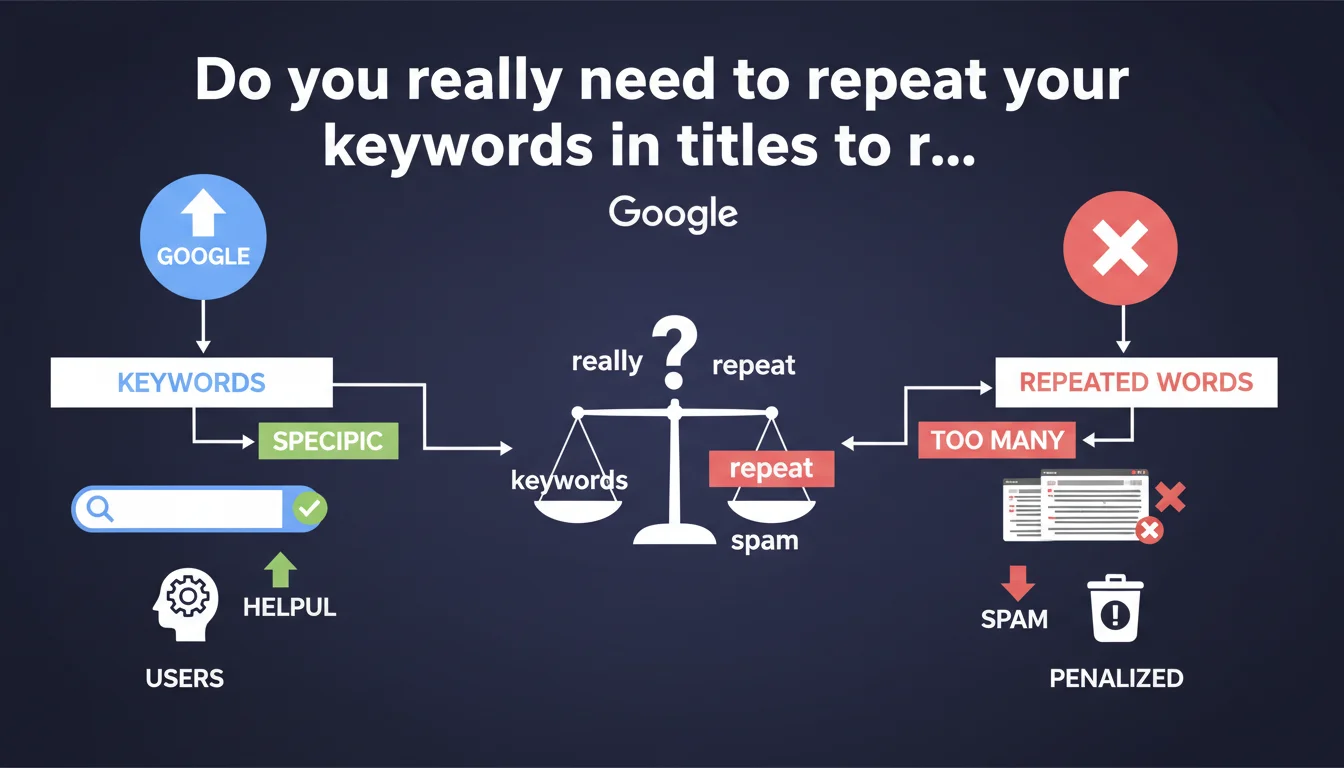
Google recommends using specific keywords in titles, but advises against excessive repetition of the same term or close synonyms. This practice harms user experience and can be interpreted as spam. Balancing optimization with readability remains the key.
What you need to understand
Why does Google insist on this distinction between relevance and repetition?
The statement targets a still-common practice: keyword stuffing in title and H1 tags. Some SEO professionals pile up variants of the same keyword thinking it strengthens thematic relevance. Google asserts that this approach is counterproductive.
The search engine now prioritizes semantic understanding rather than raw density. Repeating "lawyer Paris" three times in a title provides no additional signal — quite the opposite, it dilutes readability and triggers anti-spam filters.
What exactly does Google mean by "too much repetition"?
No numerical threshold is given. It's intentionally vague. We're talking about algorithmic perception: if the title seems designed for robots rather than humans, there's a problem.
A title like "Lawyer divorce Paris | Lawyer divorce 75 | Best divorce lawyer" checks all the wrong boxes. By contrast, "Divorce lawyer specializing in family law in Paris" remains optimized without overdoing it.
Are synonyms really problematic?
Google explicitly mentions synonyms, which deserves attention. The algorithm understands semantic relationships — there's no need to write "plumber emergency repair urgent intervention fast service" to cover all angles.
That said, a well-placed synonym can improve clarity for the user. It's the artificial accumulation that causes concern, not the natural use of lexical variations.
- Titles should prioritize the main keyword without repeating it mechanically
- Over-optimization triggers spam signals rather than strengthening rankings
- Google analyzes semantic coherence, not just the raw presence of terms
- User experience remains the validation criterion — if the title seems odd to a human, it is to the algorithm
SEO Expert opinion
Does this recommendation truly reflect algorithm behavior?
Fundamentally, yes. Field tests show that over-optimized titles perform worse than before, especially on competitive keywords. The anti-spam filter has become more refined, and some sites have seen their rankings drop after forcing keyword repetition.
But — and this is a big but — context matters. On niche, low-competition queries, I've seen keyword-stuffed titles continue to rank without visible penalty. [To verify]: Does Google apply this filter uniformly or only on certain verticals?
Where's the line between legitimate optimization and spam?
It's the usual gray zone. Google never gives a precise threshold — two mentions of a keyword might be acceptable in one context, excessive in another.
My approach: if you have to justify a word's presence in the title ("but it helps for this keyword!"), it's probably too much. A well-designed title explains itself through its primary function: inform the user, not manipulate rankings.
Do synonyms really cause problems in practice?
The mention of synonyms is interesting because it reveals the semantic maturity of the algorithm. Google understands that "repair," "troubleshooting," and "service call" cover similar nuances — no need to cram them all in.
However, this recommendation can be misinterpreted. Using a synonym to enrich meaning ("Online SEO training and hands-on workshops") remains relevant. It's artificial stacking ("SEO training course learning teaching education") that triggers alerts.
Practical impact and recommendations
How do you write an optimized title without falling into spam?
First rule: one main keyword, one strategic position. Place it at the beginning of the title when natural, but don't repeat it just to "reinforce the signal." If you need to mention a variant, it should add real complementary information.
Second rule: read the title aloud. If it sounds like a robot wrote it, rewrite it. A good title should read naturally in conversation — if it doesn't, you've pushed optimization too far.
What concrete errors must you absolutely avoid?
Titles built like keyword lists: "Plumber Paris | Plumber 75 | Plumbing repair Paris." That doesn't work anymore. Even if some competitors still do it, it's a risky bet long-term.
Accumulating synonyms without added value: "Expert specialist professional certified in SEO." Choose ONE relevant qualifier, not four that say the same thing. Google isn't impressed by redundancy.
How do you verify your titles comply with this directive?
Audit your title and H1 tags with an outside perspective. Ask someone unfamiliar with your industry if they immediately understand the subject without stumbling over odd wording.
Use Search Console to spot pages that impress but don't get clicks. Abnormally low CTR can signal a poorly optimized title — either too vague or too spammy.
- Limit each title to one clearly identifiable main keyword
- Avoid repeating the same term more than once, unless context clearly justifies it (brand, double geographic location)
- Replace synonym lists with a single, precise formulation
- Prioritize clarity for the user before algorithmic optimization
- Test readability by reading the title aloud — if it sounds artificial, rework it
- Analyze competitor titles that rank well to identify balances that work
❓ Frequently Asked Questions
Combien de fois puis-je répéter un mot-clé dans un titre sans risque ?
Les variantes de mots-clés (singulier/pluriel, masculin/féminin) comptent-elles comme répétition ?
Un titre optimisé pour Google nuit-il forcément au taux de clic ?
Dois-je réécrire tous mes titres existants suite à cette recommandation ?
Cette règle s'applique-t-elle aussi aux balises H1 et H2 ?
🎥 From the same video 10
Other SEO insights extracted from this same Google Search Central video · published on 24/02/2022
🎥 Watch the full video on YouTube →
💬 Comments (0)
Be the first to comment.