
Official statement
Other statements from this video 10 ▾
- □ Les snippets sont-ils vraiment le levier SEO le plus sous-estimé pour booster votre CTR ?
- □ Comment rédiger des titres de page qui ne seront pas tronqués par Google ?
- □ Faut-il vraiment répéter ses mots-clés dans les titres pour ranker ?
- □ Pourquoi Google insiste-t-il autant sur l'unicité des balises title ?
- □ Comment Google génère-t-il vraiment les snippets de vos pages dans les résultats de recherche ?
- □ Google peut-il vraiment ignorer vos balises title et meta description ?
- □ Faut-il vraiment oublier la limite de 155 caractères pour les meta descriptions ?
- □ Faut-il vraiment rédiger les meta descriptions comme des phrases complètes ?
- □ Faut-il vraiment rédiger une meta description unique pour chaque page ?
- □ Comment optimiser techniquement les balises title et meta description pour maximiser leur impact SEO ?
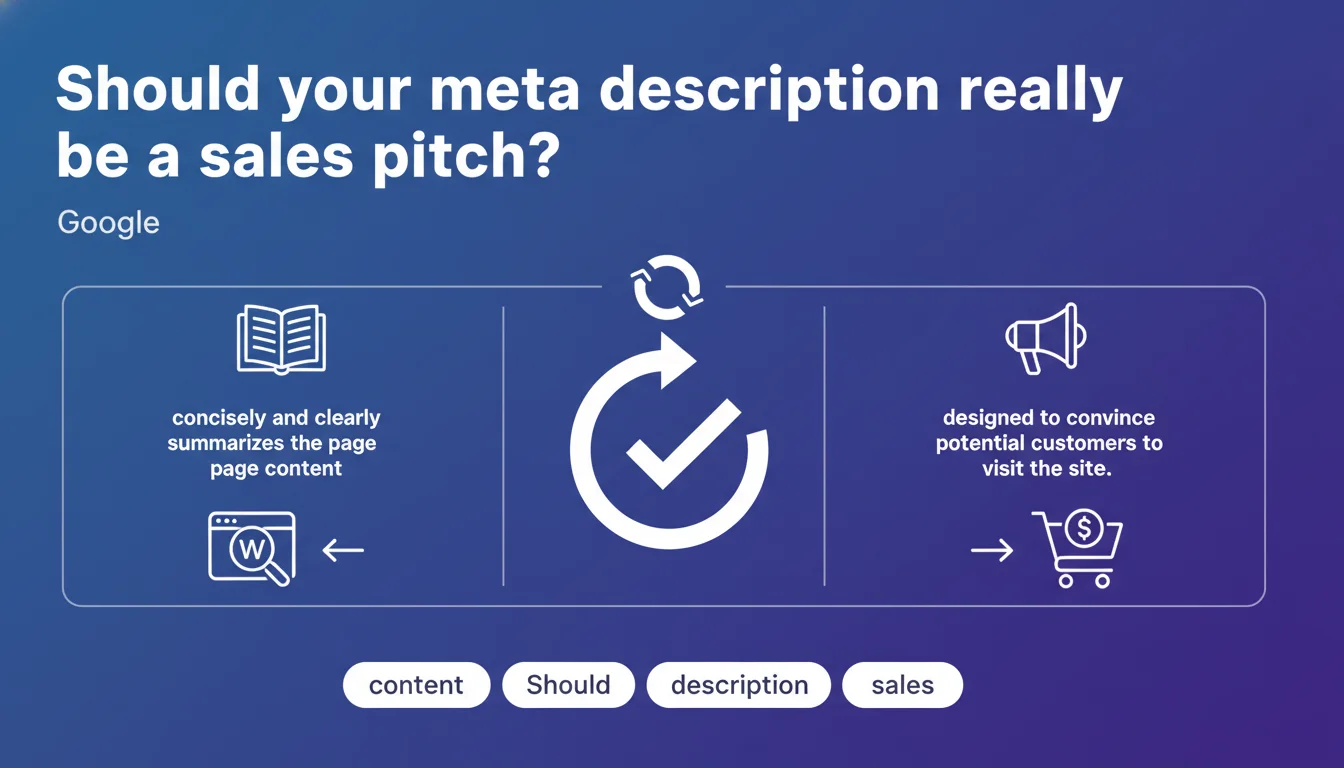
Google states that the meta description should summarize page content concisely while serving as a sales pitch to convince users to click. This dual constraint — informing AND persuading — requires a delicate balance between factual accuracy and compelling copywriting.
What you need to understand
Why does Google frame a technical element as a sales pitch?
The meta description has never been a direct ranking factor. Google has stated this repeatedly. Yet this declaration explicitly repositions this HTML element as a marketing tool rather than a simple technical tag.
The objective is clear: maximize click-through rate (CTR) from the SERPs. A high CTR sends indirect positive signals — even if Google remains vague about their actual weight in the algorithm. What truly matters is that more users click, and Google measures satisfaction (or disappointment if they bounce immediately).
What does "summarize concisely and clearly" actually mean?
Google enforces a display limit of approximately 155-160 characters on desktop, sometimes less on mobile. Beyond that, the description is truncated. The summary must therefore be not only informative but also immediately understandable without additional context.
Clarity trumps jargon. If your page covers a technical topic, the meta description should simplify just enough for users to grasp the value — without sacrificing accuracy. It's an exercise in brutal synthesis.
Does Google always use the meta description you provide?
No. And that's where things get tricky. Google frequently rewrites meta descriptions based on the user's search query. It pulls from your page content to generate an excerpt it deems more relevant.
Result: even if you craft a perfect description, Google may discard it to display something else. The official statement conveniently omits this uncomfortable detail — which partially undermines the advice to "treat it as a sales pitch" if Google decides to ignore it anyway.
- The meta description does not impact ranking, only potential CTR from the SERPs.
- Google recommends a concise format (155-160 characters) oriented toward persuasion.
- Google frequently rewrites the meta description based on the query — your text is not guaranteed to appear.
- The challenge is twofold: inform precisely AND drive clicks, without resorting to clickbait.
SEO Expert opinion
Is this statement consistent with real-world practices?
Partially. In practice, well-crafted meta descriptions do effectively improve CTR — this is measurable in Search Console. But the idea that they must be a "sales pitch" raises concerns.
Google penalizes clickbait and exaggerated promises. If your description oversells and users bounce immediately, you risk medium-term visibility drops. The "persuade" element must never become marketing deception. [To verify]: Google never specifies where the line between legitimate persuasion and manipulation lies.
What nuances should be added to this advice?
First, not all pages deserve equal effort. For low-stakes informational pages (e.g., legal notices, privacy policies), perfecting a sales pitch is wasteful — a factual description suffices.
Second, Google massively rewrites descriptions for long-tail queries. If your page targets 50 different intents, your generic meta description will be replaced anyway. Better to invest in content rich with featured snippet potential than obsess over a static description.
In what cases does this rule not apply?
Pages with very high brand recognition (major brands, institutions) don't need a sales pitch — users click by reflex. A factual description suffices.
Local or transactional result pages (e.g., e-commerce product pages) benefit more from structured data (price, availability, reviews) than persuasive text. Google often displays this information in rich snippets, making the meta description secondary.
Practical impact and recommendations
What should you do concretely to optimize meta descriptions?
Start by auditing strategic pages: those driving traffic or those you prioritize. Don't rewrite 10,000 descriptions at once — focus on the 20-30 critical pages.
For each page, formulate a clear value proposition in one sentence: what will users learn, solve, or achieve? Then add a differentiating element (statistic, concrete benefit, authority argument) to justify the click.
What mistakes must you absolutely avoid?
Never duplicate meta descriptions across multiple pages — Google hates this and may rewrite all of them. Each page needs its unique description, even if it's time-consuming.
Avoid generic phrases like "Discover our range" or "Everything you need to know about…". They provide no concrete information and give no reason to prefer your result over a competitor's.
Finally, don't keyword-stuff the description. Google ignores it for ranking, and users immediately detect spam. Write for humans, not algorithms.
How do you verify your meta descriptions are effective?
Use Google Search Console to identify pages with abnormally low CTR despite good rankings. This often signals an unconvincing (or missing) description.
Test different versions through manual A/B tests: modify the description, wait a few weeks, compare CTR. At high volumes, impact is measurable quickly.
- Audit the 20-30 strategic pages and identify those without meta descriptions or with weak ones.
- Write a unique value proposition per page, in 155-160 characters maximum.
- Include a concrete differentiating element (statistic, benefit, social proof) to justify the click.
- Ensure each description is unique — no duplication across pages.
- Monitor CTR in Search Console and adjust descriptions for underperforming pages.
- Test display on mobile and desktop to avoid unfortunate truncations.
❓ Frequently Asked Questions
La meta description influence-t-elle directement le positionnement dans Google ?
Quelle est la longueur idéale pour une meta description ?
Google utilise-t-il toujours la meta description que j'ai rédigée ?
Faut-il absolument rédiger une meta description pour chaque page ?
Peut-on inclure des mots-clés dans la meta description pour améliorer le SEO ?
🎥 From the same video 10
Other SEO insights extracted from this same Google Search Central video · published on 24/02/2022
🎥 Watch the full video on YouTube →
💬 Comments (0)
Be the first to comment.