
Official statement
Other statements from this video 7 ▾
- □ Is Google Search Console really giving you the full picture of your organic performance?
- □ Can Search Console really become your business decision-making engine?
- □ Are you actually tracking which search queries are your real traffic drivers?
- □ What backlinks is Search Console really showing you about your site?
- □ Is your mobile site hurting your search rankings without you even knowing it?
- □ Is Search Console really the best way to get your content indexed faster by Google?
- □ Does Google Search Console really catch malware and spam threats before they tank your rankings?
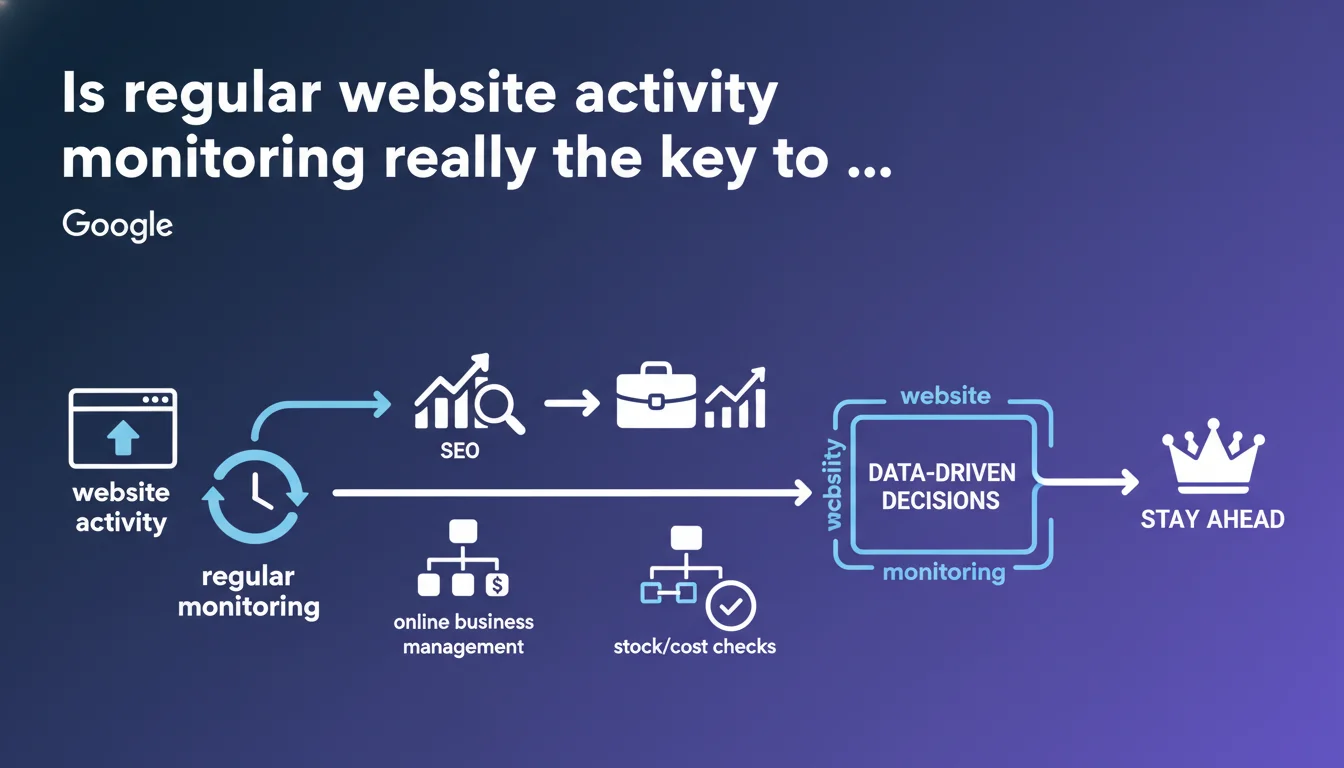
Google compares monitoring a website's activity to managing a company's inventory: it's a necessity for making informed decisions. This statement emphasizes the data-driven dimension of modern SEO, but remains vague about the exact metrics to track and the optimal monitoring frequency.
What you need to understand
What does Google really mean by "monitoring" a site's activity?
Google uses an intentionally broad business metaphor. A site's activity encompasses several dimensions: user behavior, technical performance, crawl and indexation evolution, incoming backlinks, and SERP positions.
The parallel with inventory management suggests this monitoring must be regular and methodical, not sporadic. But unlike physical inventory, web metrics are available in real-time — which makes the advice somewhat generic.
Which data points are truly priorities for an SEO professional?
The statement prioritizes no specific metrics. Yet not all signals carry equal weight. Organic traffic, crawl budget, Core Web Vitals, indexation of strategic pages, and server errors form the core.
Everything else — social interactions, bounce rate, time on page — provides context but rarely offers direct SEO leverage. The angle about "data-driven business decisions" implies we don't monitor just to monitor, but to identify opportunities or fix problems.
How often should you really check these indicators?
Google mentions "weekly," which remains vague. Some signals deserve daily checks — 5xx errors, sudden traffic drops, massive deindexation. Others, like link profile evolution, can be analyzed monthly.
Frequency also depends on your site velocity. A news outlet publishing 50 articles daily doesn't operate on the same rhythm as an e-commerce store with 200 stable product pages. The one-size-fits-all approach Google suggests lacks nuance.
- Minimum weekly monitoring recommended to stay responsive to algorithm shifts
- Prioritize actionable metrics over vanity metrics
- Adapt frequency based on site type and publishing pace
- Cross-reference multiple data sources (Search Console, Analytics, server logs) for reliable insights
SEO Expert opinion
Does this statement really bring anything new to the table?
Let's be honest: no. Any SEO professional beyond beginner level already knows they need to monitor their site. This advice falls into the category of basic business sense rather than technical insight.
What's missing here is granularity. Google could have specified which indicators they consider critical for their algorithm, or how their systems interpret certain metrics. Instead, we get a generic formula that could apply to virtually any online activity. [To verify]: Is Google offering this advice to push webmasters toward using Search Console more and generating additional exploitable data for themselves?
What are the blind spots in this recommendation?
The business metaphor suggests a website is managed like physical inventory. That's misleading. Inventory decreases when sold — a website can generate traffic without consuming proportional resources.
Plus, Google doesn't mention the downsides of excessive monitoring. Too many metrics kill metrics. I've seen SEO teams drown in dashboards with 40 KPIs, losing sight of the 5 that truly matter. Obsessive monitoring can also lead to overreaction: panicking over a 10% fluctuation that falls within normal variance.
In which cases does regular monitoring become counterproductive?
For small sites (under 1,000 visits/day), detailed weekly monitoring may generate more anxiety than actionable insights. Fluctuations are often statistically insignificant.
Another case: sites in ultra-stable niches where traffic barely moves. Spending 2 hours weekly analyzing flat curves provides nothing. Time would be better invested in content creation or on-page optimization. Monitoring should remain a means, not an end.
Practical impact and recommendations
Which tools enable effective monitoring without drowning in data?
The minimum viable stack: Google Search Console for indexation and search performance, Google Analytics 4 for user behavior, and a rank tracking tool (SE Ranking, SEMrush, Ahrefs depending on budget). Add server log monitoring for large sites with tight crawl budgets.
The classic mistake? Multiplying dashboards without defining clear workflows. Each tool should answer a specific decision question: "Are my priority pages being crawled?", "Is organic traffic trending positively?", "Are my strategic rankings holding?".
What monitoring routine should you implement concretely?
Quick daily check (10 min): critical errors in Search Console, overall traffic in Analytics, automated alerts configured. Deep weekly analysis (1-2h): position evolution, new keyword opportunities, light technical audit.
Complete monthly audit: published content performance, backlink analysis, Core Web Vitals review, technical optimizations. This cadence avoids analysis paralysis while staying responsive.
How do you know you're monitoring the right metrics?
Ask yourself for each indicator: "If this metric moves 20%, what concrete action do I take?". If you don't have a clear answer, you're probably tracking a vanity metric.
Actionable metrics trigger decisions: crawl drop leads to robots.txt audit, CTR decline prompts title tag rework, 404 spike launches redirect campaign. Everything else is noise.
- Configure automatic alerts on critical metrics (traffic drop >30%, massive indexation errors)
- Create a single dashboard centralizing your 5-7 priority KPIs
- Document actions taken following observed variations to build a decision history
- Schedule monthly team reviews to adjust monitoring priorities based on business objectives
- Automate data collection as much as possible to focus on interpretation and action
Regular site monitoring is non-negotiable in modern SEO. But it must remain proportional, focused on actionable metrics, and fit into a clearly defined routine. The goal isn't to accumulate data, but to make informed decisions quickly.
For many businesses, structuring this monitoring and especially correctly interpreting signals represents a significant challenge. Tools are accessible, but true expertise lies in contextual analysis and action prioritization. This is often where working with a specialized SEO agency makes sense, particularly for defining the right monitoring framework and avoiding dead-end paths that waste precious time.
❓ Frequently Asked Questions
Quelle est la fréquence minimale pour surveiller un site sans passer à côté de problèmes critiques ?
Quels sont les indicateurs prioritaires à surveiller en premier lieu ?
Google Search Console suffit-il pour un monitoring efficace ?
Comment distinguer une fluctuation normale d'un vrai problème à corriger ?
Faut-il surveiller les sites concurrents avec la même rigueur que son propre site ?
🎥 From the same video 7
Other SEO insights extracted from this same Google Search Central video · published on 24/02/2022
🎥 Watch the full video on YouTube →
💬 Comments (0)
Be the first to comment.