
Official statement
Other statements from this video 7 ▾
- □ Google Search Console : comment exploiter vraiment ses données de performance ?
- □ Comment identifier précisément les requêtes qui génèrent réellement du trafic sur votre site ?
- □ Comment Search Console révèle-t-elle vraiment les backlinks vers votre site ?
- □ Comment vérifier si votre site mobile pose problème dans les résultats de recherche ?
- □ Faut-il vraiment utiliser Search Console pour soumettre son contenu à Google ?
- □ Comment Search Console peut-il détecter les problèmes de sécurité et spam sur votre site ?
- □ Pourquoi la surveillance régulière de l'activité de votre site est-elle devenue incontournable en SEO ?
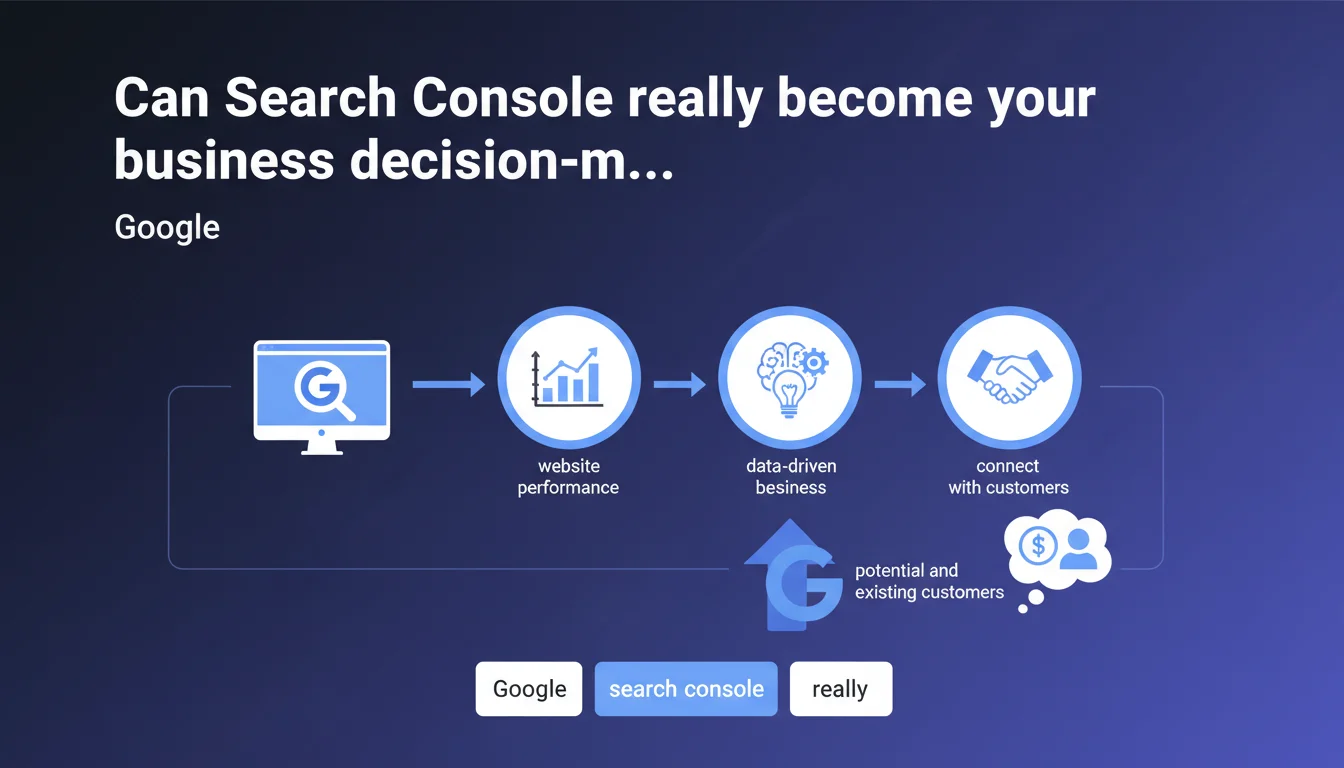
Google claims that Search Console enables commercial decisions based on search data. The tool positions organic search as a direct channel to reach potential and existing customers. The real question is: how far can this data actually influence your strategic choices?
What you need to understand
What exactly is Google saying in this statement?
Google presents Search Console not simply as a technical diagnostic tool, but as a business steering instrument. The emphasis is on the ability to transform search data into concrete business decisions.
The approach explicitly links performance in search results to audience engagement — whether prospective or loyal customers. This is ROI-driven thinking rather than purely technical optimization.
Why does this wording deserve your attention?
The vocabulary used — "data-driven business decisions" — moves beyond typical SEO jargon. Google positions search here as an acquisition and retention channel, not merely a visibility issue.
This perspective suggests that Search Console metrics should influence broader trade-offs: product positioning, editorial strategy, marketing investments. Not just tag adjustments.
Which Search Console data can actually drive business decisions?
Search queries reveal real user intentions — often very different from what product or marketing teams assume. Click and impression trends identify emerging or declining topics.
Average position data per page helps evaluate which content deserves optimization versus complete overhaul. Click patterns reveal whether your messaging resonates with your target audience or needs adjustment.
- Emerging queries : spot new business opportunities before competitors
- Click-through rate by position : measure how well your titles and descriptions match user expectations
- Underperforming pages : detect content that's strategically mispositioned
- Keyword cannibalization : identify inconsistencies in your information architecture
- Temporal trends : anticipate seasonal cycles or shifts in user intent
SEO Expert opinion
Is this vision of Search Console realistic in the real world?
Let's be honest: most companies use Search Console as a technical dashboard, not a strategic tool. Business teams typically don't consult search data to inform their decisions — that's usually left to the digital department, working in isolation.
The gap between Google's promise and organizational reality is substantial. The data exists, but the corporate culture to exploit it strategically is often lacking. Marketing executives look at Analytics, sales teams consult their CRM, and Search Console stays within the SEO team's domain.
What limitations should you keep in mind?
Search Console data contains structural biases you need to understand before basing business decisions on it. Impressions only reflect searches where Google deemed your site potentially relevant — not the complete universe of searches in your market.
Query grouping ("other queries") hides a significant portion of traffic for long-tail heavy sites. Average positions are aggregates that can mask enormous variations based on search context, location, or device. [To verify] : how representative do these aggregates remain for strategic decision-making?
When does this data-driven approach actually work?
Search Console's business value is strongest when there's a direct link between search and purchase intent. E-commerce, B2B SaaS, local services — these sectors can directly correlate queries with business opportunities.
However, for brands with long decision cycles or sectors where organic search plays an educational role far from conversion, the connection remains tenuous. The data informs, but doesn't directly steer business. The nuance matters.
Practical impact and recommendations
How do you concretely leverage Search Console for business decisions?
Start by identifying high-value commercial queries in your reports — those signaling purchase intent or conversion opportunity. Analyze their temporal evolution to spot market shifts or emerging opportunities.
Cross Search Console data with your conversion metrics to identify which query types actually generate business. A query with 10,000 impressions but zero conversions doesn't have the same strategic value as one with 100 impressions and 10 conversions.
What interpretation mistakes should you avoid?
Don't confuse search volume with business value. Generic queries often bring poorly qualified traffic that dilutes conversion rates. Focus on specific intentions and long-tail terms that signal genuine need.
Avoid reacting to daily fluctuations — Search Console data is volatile short-term. Work with weekly or monthly trends to isolate signal from noise. A 20% drop over 3 days might be random; over 3 weeks, it's a signal.
What organizational structure should you put in place?
Create shared dashboards that make Search Console insights accessible to marketing and product teams, not just SEO specialists. Translate technical metrics into business indicators: share of voice on your segments, intent evolution, emerging opportunities.
Establish monthly reviews where search data informs editorial priorities, product trade-offs, and marketing campaigns. Organic search must move out of the technical silo to become a shared market intelligence source.
- Identify your 20-30 most strategically important queries and track their evolution
- Cross Search Console and Analytics data to establish value by query type
- Create segments by intent (informational, navigational, transactional)
- Analyze new emerging queries monthly and assess their commercial potential
- Share search insights with marketing, product, and sales teams
- Document correlations between ranking changes and business KPIs
- Use search data to validate product or editorial hypotheses
- Monitor keyword cannibalization to optimize your information architecture
❓ Frequently Asked Questions
Search Console suffit-il pour piloter une stratégie SEO complète ?
Peut-on vraiment identifier de nouvelles opportunités business via Search Console ?
Quelle différence entre les données Search Console et Google Analytics pour le pilotage business ?
À quelle fréquence faut-il consulter Search Console pour du pilotage stratégique ?
Les données Search Console sont-elles fiables pour mesurer la performance réelle ?
🎥 From the same video 7
Other SEO insights extracted from this same Google Search Central video · published on 24/02/2022
🎥 Watch the full video on YouTube →
💬 Comments (0)
Be the first to comment.