
Official statement
Other statements from this video 8 ▾
- □ How does Google actually discover your pages through crawling and links?
- □ How does Googlebot actually crawl and index your website?
- □ Does Google really build its index the way you think it does, and why does this change everything for your SEO strategy?
- □ How does Google really rank results for any given search query?
- □ Does Google's organic search really rank results based purely on content relevance?
- □ Can you really pay Google to boost your organic search position?
- □ Does Google really make it easy to tell the difference between ads and organic search results?
- □ Are Google's official resources really enough to optimize your SEO visibility?
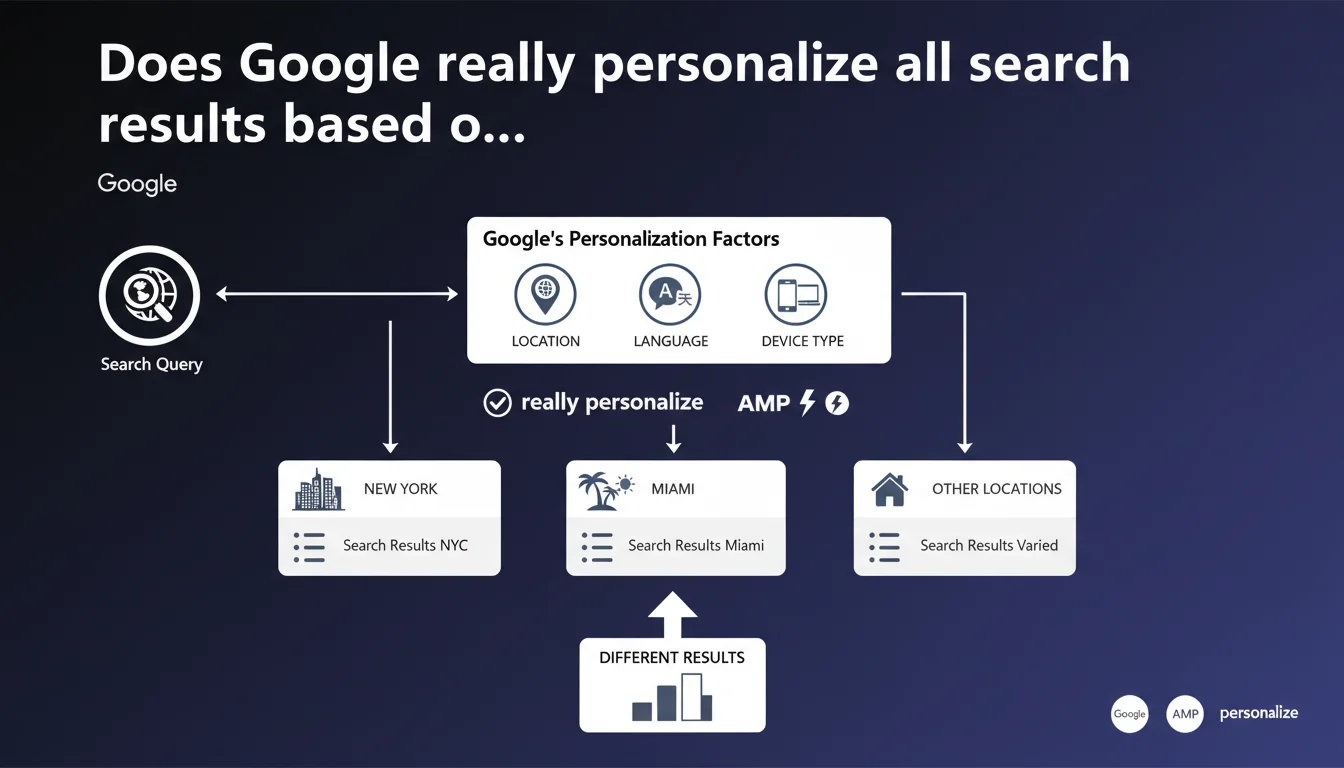
Google adjusts its results based on user location, language, and device type. In practice, the same query can display radically different SERPs depending on where you are and how you search. For SEO professionals, this means that analyzing ranking positions becomes an exercise in variable geometry.
What you need to understand
What exactly are the personalization factors mentioned?
Google mentions three personalization factors: geographic location, interface language, and device type (desktop, mobile, tablet). These criteria are not new, but Google confirms them here as structuring variables in ranking.
Location is the most obvious lever — no one will be surprised that a search for "restaurant" produces different results in Paris and Lyon. What becomes thorny is understanding how far this logic extends for less geo-targeted queries. Will an informational search like "best CMS" prioritize French content in France, English-language content in the United States? Probably, but Google remains vague about the degree of this weighting.
Does this personalization apply to all queries?
Google does not specify a scope. However, we observe that transactional and local queries are massively impacted, while certain very specific informational queries seem less subject to this variability.
The New York vs Miami example is telling for a local query, but what about a B2B technical search? The lack of granularity in this statement leaves the SEO practitioner wanting more. [To verify] depending on your sector and query typology.
Does device type really modify ranking?
Yes, and it is consistent with Mobile First indexing. A site that loads slowly on mobile or whose mobile UX is catastrophic risks plummeting in mobile results, even if its desktop version is impeccable.
But Google does not say whether the algorithm applies different ranking criteria or if it is simply a matter of display adaptation. In practice, we observe that some sites perform better on desktop than on mobile for reasons that go beyond simple loading speed — content format, different user intent depending on device.
- Location modifies results for queries with local or transactional intent
- Language influences the choice of content displayed, but Google remains evasive about the weight of this criterion
- Device type impacts ranking, particularly through Mobile First and Core Web Vitals
- Google does not specify which queries are excluded from this personalization
- Search history and behavioral signals are not mentioned here, even though they play a role in personalization
SEO Expert opinion
Is this statement complete or deliberately partial?
Google states three factors — location, language, device — but deliberately omits other personalization levers that we know are active: browsing history, behavioral signals, preferences linked to the Google account, content freshness depending on context.
Why this omission? Probably because Google wants to avoid giving the impression that results are "too" personalized, which could raise questions about filter bubbles or manipulation. Result: the statement is true but incomplete. An SEO practitioner must keep in mind that these three factors are only the tip of the iceberg.
Are the implications for position tracking underestimated?
Absolutely. If results vary by location, language, and device, tracking a keyword without specifying these parameters becomes absurd. How many SEO agencies still proudly announce "you're ranking 3rd on Google" without specifying: in Paris, on desktop, in French?
Modern rank tracking tools allow you to set these variables, but many clients — and even some junior SEO professionals — do not realize that ranking is no longer a single number. It is a matrix of positions depending on multiple contexts.
In what cases does this personalization become a hindrance rather than an asset?
For a site targeting an international or multi-local audience, this personalization can fragment traffic. If Google systematically prioritizes local content, a global site will need to multiply localized versions to capture traffic in each geographic area.
Another case: highly technical B2B sites. When an engineer in Toulouse searches for "datasheet component X", they probably want the technical sheet from the American manufacturer, not a French distributor. But if Google enforces localization, the relevant result may be relegated. [To verify] based on your field observations — Google has never precisely documented how it arbitrates between thematic relevance and geographic relevance.
Practical impact and recommendations
How to adapt your SEO strategy in the face of this personalization?
First step: segment your keywords based on their sensitivity to personalization. A query like "divorce lawyer" will be hyper-localized, a search for "quantum theory" much less so. Adjust your positioning objectives accordingly.
Second lever: optimize hreflang markup and geographic signals (Google My Business, local mentions, local backlinks) if you are targeting multiple areas. Do not let Google guess your geographic intent — give it clear indicators through technical structure.
Third point: test your pages on multiple devices and from multiple locations. Use VPNs or simulation tools to verify that your content displays correctly in your target contexts. A site that performs brilliantly on desktop in Paris but disappears on mobile in Lyon has a structural problem.
What critical errors must be avoided?
Error number one: tracking your positions without context. If you do not set location, language, and device parameters in your tracking tool, your data is unusable. Worse, it can mislead you into thinking you are progressing when you are actually stagnating in the context that really matters.
Second error: neglecting mobile experience. With Mobile First, a site that performs poorly on mobile will not just lose mobile traffic — it will also lose overall ranking, including on desktop. Core Web Vitals should be monitored on mobile as a priority.
Third trap: believing that a single strategy is sufficient for all markets. If you are targeting multiple countries or regions, duplicating the same translated content will not be enough. You need to adapt the substance (local examples, cultural references) and form (content structure preferred locally, formats given priority locally).
What checklist should be applied concretely?
- Configure your rank tracking tools with precise location, language, and device settings
- Audit your Core Web Vitals on mobile — it is the priority device for Google
- Verify hreflang markup implementation if you are targeting multiple languages/countries
- Create or optimize your Google My Business listing to strengthen local signals
- Test your SERPs from multiple locations (VPN, simulation tools) to understand variations
- Segment your positioning KPIs by context (Paris mobile vs Lyon desktop, etc.)
- Adapt your content to local intentions if you are targeting multiple geographic areas
- Monitor performance gaps between desktop and mobile to identify UX weaknesses
❓ Frequently Asked Questions
La personnalisation s'applique-t-elle aux résultats de recherche universelle (images, vidéos) ?
Un utilisateur peut-il désactiver la personnalisation des résultats ?
Faut-il créer des versions de contenu différentes pour desktop et mobile ?
Comment Google détermine-t-il la localisation d'un utilisateur ?
La personnalisation affecte-t-elle les résultats payants (Google Ads) ?
🎥 From the same video 8
Other SEO insights extracted from this same Google Search Central video · published on 24/02/2022
🎥 Watch the full video on YouTube →
💬 Comments (0)
Be the first to comment.