
Official statement
Other statements from this video 8 ▾
- □ Comment Google découvre-t-il réellement vos pages via le crawling et les liens ?
- □ Comment le Googlebot crawle-t-il et indexe-t-il réellement votre site web ?
- □ Comment Google construit-il réellement son index et pourquoi ça change tout pour votre SEO ?
- □ Comment Google classe-t-il réellement les résultats pour une requête donnée ?
- □ Google personnalise-t-il vraiment tous les résultats selon l'utilisateur ?
- □ Les résultats organiques Google reposent-ils vraiment uniquement sur la pertinence du contenu ?
- □ Google distingue-t-il vraiment ses annonces des résultats organiques de manière efficace ?
- □ Les ressources officielles Google suffisent-elles vraiment à optimiser votre visibilité SEO ?
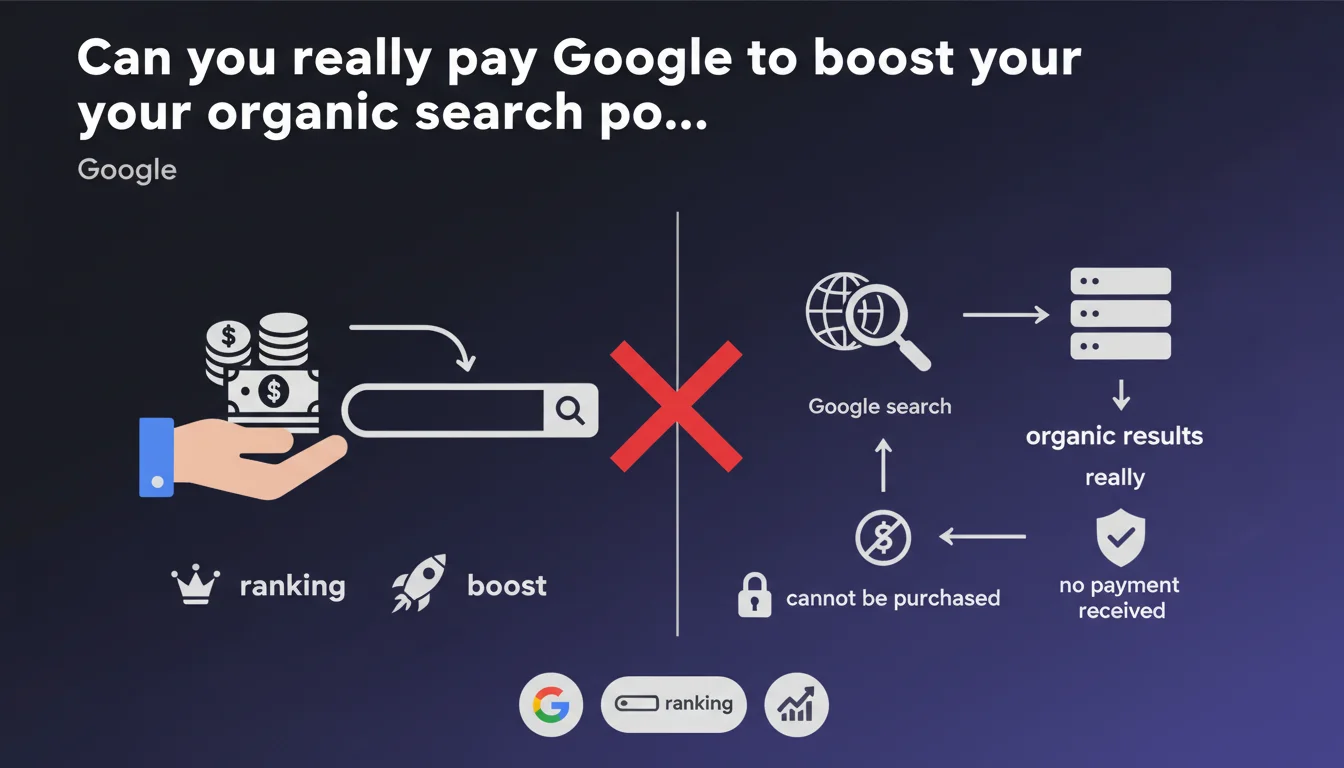
Google categorically states that no payment can influence organic rankings. Natural results remain strictly separated from paid placements, and any promise to the contrary is pure fraud. This clear boundary is core to Google's business model and credibility.
What you need to understand
Why does Google insist so strongly on this distinction?
The separation between organic results and paid advertisements forms the very foundation of Google's legitimacy. If natural results could be bought, user trust would collapse entirely — and with it, the advertising ecosystem that generates 80% of the company's revenue.
This statement also addresses persistent confusion among the uninitiated: some still believe that paying for Google Ads will improve their natural search rankings. It won't. The two systems operate on completely separate algorithms.
What exactly is free and what isn't?
Appearing in organic results costs nothing — technically speaking. But climbing those rankings requires time, quality content, backlinks, solid technical architecture. In short, considerable human and financial resources.
Google doesn't charge for ranking, but it does charge for clicks through Google Ads. Many decision-makers miss this nuance, conflating immediate paid visibility with long-term organic positioning.
Does this statement actually change anything for SEO professionals?
Not really. For anyone working seriously in natural search, this claim is obvious. But it serves as a legal shield: if an agency promises to buy your position in organic results, you can directly confront them with this official statement.
- Organic results can never be purchased directly from Google
- Google Ads does not influence natural rankings — the two systems remain completely separate
- No payment to Google guarantees better indexation or crawling
- This strict separation protects the credibility of the search engine
SEO Expert opinion
Is this statement consistent with what we observe in the field?
Absolutely. After 15 years of observation, I've never seen a single documented case where a direct payment to Google changed an organic ranking. The correlations sometimes observed between Google Ads budgets and SEO visibility are explained differently: companies investing heavily in Ads typically also have the means to invest in SEO.
What creates confusion is that certain Google paid services can indirectly facilitate SEO. For example, Google Search Console is free, but using Google Cloud to host a site can improve technical performance. Important distinction: this isn't purchased ranking, it's infrastructure.
What gray areas remain despite this statement?
The main gray area concerns paid Google products that indirectly influence visibility. Google Shopping, Google My Business (now Google Business Profile), local listings — all these ecosystems mix free and paid elements in sometimes opaque ways.
Another point: Google doesn't charge to improve ranking, but certain services like priority delisting or advanced technical support remain reserved for large accounts. [To verify]: are there privileged access points to technical support for companies spending heavily on Ads? Officially no, but field feedback varies.
Should this statement be taken literally?
Yes, with one caveat. Google isn't lying here — organic ranking cannot be purchased. But this statement masks a more complex reality: Google's ecosystem structurally favors certain players.
Do sites investing heavily in Google Cloud, using Google Analytics 4, adopting all of Google's technical recommendations benefit from indirect preferential treatment? Impossible to prove formally, but total alignment with the Google ecosystem mechanically creates better measurable performance — and therefore stronger signals for the algorithm.
Practical impact and recommendations
What should you actually do with this information?
Use this statement as a demystification tool with your clients or decision-makers. Many still believe that increasing their Google Ads budget will improve their SEO — this is the moment to clarify with official backing.
Second use: confront any suspicious commercial proposal with this position. If a provider claims to have a "special partnership with Google" allowing them to buy organic positions, you now have an official reference to debunk the scam.
What mistakes should you avoid to not confuse SEO and SEM?
Never transfer your SEO budget to Google Ads expecting organic impact. The two channels are complementary, not interchangeable. A Ads campaign can generate immediate traffic while SEO builds strength, but it will never replace solid work on content and backlinks.
Also avoid neglecting SEO on the grounds that "it costs nothing since it's free." True, Google doesn't charge for ranking, but producing quality content, optimizing technical aspects, obtaining links — all of this represents a substantial investment.
How should you structure investments to maximize overall visibility?
Treat SEO and SEM as two distinct channels with different objectives. SEM offers immediate, controllable visibility but is costly long-term. SEO takes time but generates sustainable, lower-cost traffic once positions are established.
The optimal balance depends on your maturity: new sites often need SEM to exist quickly, while established sites can progressively reduce advertising dependency by capitalizing on their organic authority.
- Clarify with decision-makers that SEO and SEM are two separate budgets with no direct cross-influence
- Document any promise to buy organic ranking and confront it with this official statement
- Invest in SEO with a long-term vision, without expecting paid miracles
- Use Google Ads to bridge SEO delays, not to replace it
- Train marketing teams on the fundamental distinction between organic and paid results
❓ Frequently Asked Questions
Payer Google Ads améliore-t-il mon référencement naturel ?
Existe-t-il des services payants Google qui aident indirectement le SEO ?
Comment vérifier qu'une agence ne promet pas l'impossible ?
Le SEO est-il vraiment gratuit si Google ne facture rien ?
Les gros annonceurs Google Ads ont-ils un avantage SEO caché ?
🎥 From the same video 8
Other SEO insights extracted from this same Google Search Central video · published on 24/02/2022
🎥 Watch the full video on YouTube →
💬 Comments (0)
Be the first to comment.