
Official statement
Other statements from this video 8 ▾
- □ Comment Google découvre-t-il réellement vos pages via le crawling et les liens ?
- □ Comment le Googlebot crawle-t-il et indexe-t-il réellement votre site web ?
- □ Comment Google construit-il réellement son index et pourquoi ça change tout pour votre SEO ?
- □ Comment Google classe-t-il réellement les résultats pour une requête donnée ?
- □ Google personnalise-t-il vraiment tous les résultats selon l'utilisateur ?
- □ Les résultats organiques Google reposent-ils vraiment uniquement sur la pertinence du contenu ?
- □ Peut-on vraiment payer Google pour améliorer son positionnement organique ?
- □ Google distingue-t-il vraiment ses annonces des résultats organiques de manière efficace ?
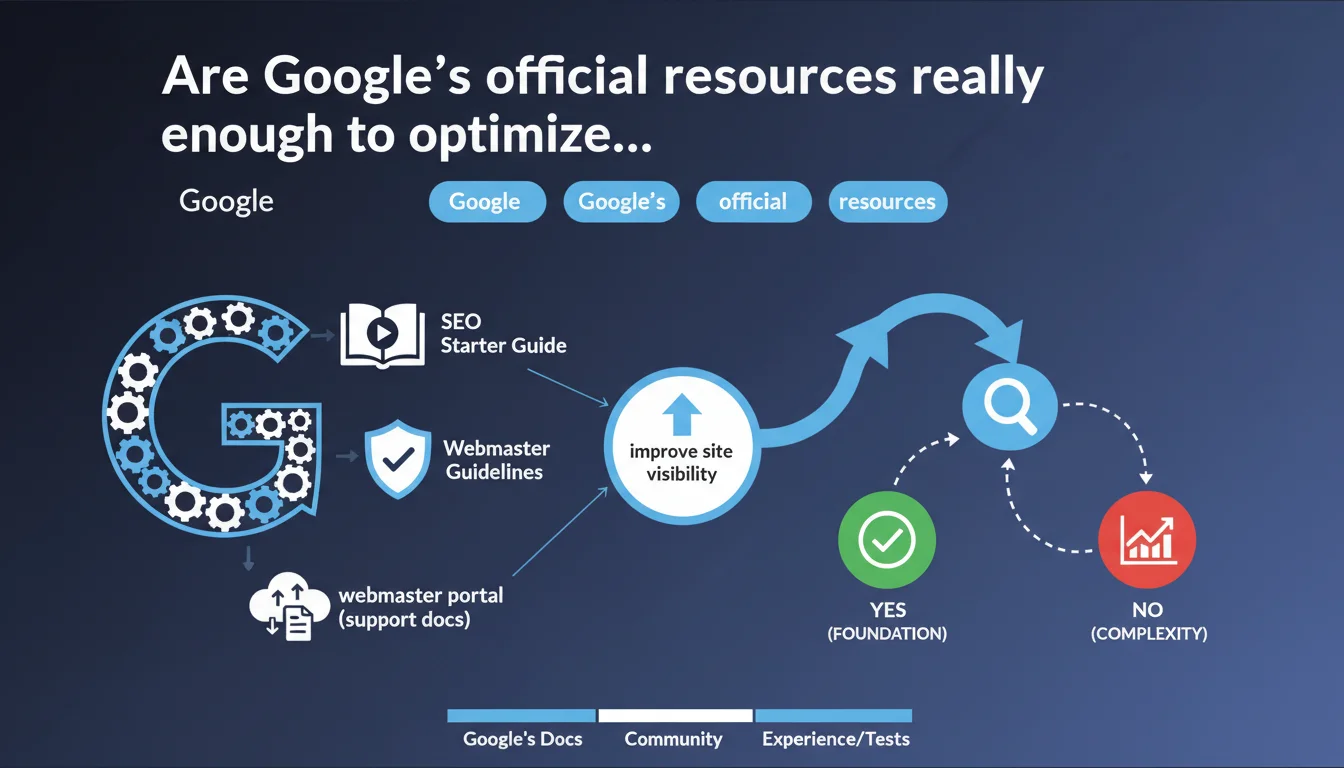
Google recommends following its Webmaster Guidelines, its SEO Starter Guide, and consulting the webmaster portal to improve a site's visibility. This statement remains intentionally general and directs webmasters to official resources without revealing advanced strategies or precise technical criteria.
What you need to understand
Why does Google systematically direct webmasters back to its official resources?
This statement illustrates Google's typical communication strategy: directing webmasters toward centralized resources rather than delivering specific contextualized information. The webmaster portal, Guidelines, and Starter Guide constitute the official documentation foundation.
The objective? To maintain complete control over the SEO narrative and prevent specific statements from being taken out of context. Every detailed recommendation stays within Google's ecosystem, traceable and modifiable.
Do these resources actually cover all aspects of modern SEO?
Google's official documents do effectively address technical and editorial fundamentals: crawlability, indexation, content quality, user experience. They are regularly updated to integrate new algorithmic priorities.
But let's be honest — these guides remain deliberately general and incomplete on certain strategic aspects. The precise ranking mechanisms, signal weighting, critical technical thresholds: all of this remains in a gray zone that Google will never document exhaustively.
What is the main limitation of this documentary approach?
The central problem: these resources assume that all sites have the same needs. Yet an e-commerce site with 50,000 products, a news outlet, and a corporate B2B site do not share the same optimization priorities.
Google provides the general framework, but never states: "For YOUR specific context, prioritize X before Y". This absence of contextual prioritization leaves SEO practitioners to make their own decisions — often through trial and error.
- The Guidelines establish the rules not to break under penalty of manual action
- The SEO Starter Guide covers technical and editorial basics for a standard site
- The webmaster portal centralizes documentation, tools (Search Console), and official announcements
- These resources are necessary but insufficient for an advanced SEO strategy
- None of these sources reveal precise algorithmic mechanisms or signal weighting
SEO Expert opinion
Is this recommendation consistent with practices observed in the field?
Partially. Sites that meticulously follow the Guidelines do effectively avoid manual penalties and build a solid technical foundation. But this does not guarantee good rankings in competitive sectors.
The reality: sites that dominate the SERPs go far beyond official recommendations. They work on semantic architecture, depth of treatment, editorial freshness, authority signals — dimensions that Google guides address only at a surface level.
What nuances should be added to this statement?
Google never explicitly says: "Following our Guidelines is enough to rank". It says: "Follow them to improve your visibility". An important distinction. "Improve" does not mean "maximize" or "guarantee competitive positioning".
Another point: these resources are sometimes outdated and certain sections no longer reflect current algorithmic priorities. For example, the SEO Starter Guide still gives disproportionate attention to meta keywords in certain archived versions, when this signal has been dead for years. [To verify]: the actual frequency of updates to these documents relative to algorithm evolution.
In what cases are these resources insufficient?
For an e-commerce site with facets, the Guidelines say nothing about fine-tuning crawl budget via URL parameters. For a news site, they barely explain how to optimize for Google Discover or Top Stories. For an international site, they barely touch complex hreflang strategies.
And that's where it pinches: these cases represent the majority of professional sites. The Guidelines cover the scope of "standard corporate brochure site" — not the complex architectures that generate business.
Practical impact and recommendations
What should you do concretely with these official resources?
First step: audit your compliance with the Webmaster Guidelines. Verify that your site does not present any at-risk practices (cloaking, hidden text, artificial link schemes). Use Search Console to identify any potential manual actions.
Second step: go through the SEO Starter Guide to validate that all technical fundamentals are in place — unique title tags, meta descriptions, coherent Hn structure, robots.txt file, XML sitemap. This is the minimum foundation.
What mistakes should you avoid by relying on these resources alone?
Never consider these documents as a complete SEO roadmap. They set the compliance framework, not the differentiation strategy. A site can be 100% compliant with the Guidelines and generate zero organic traffic if it has no authority or content depth.
Another trap: mechanically applying recommendations without adapting them to your context. For example, Google recommends "readable" URLs — but for an e-commerce site with 50,000 items, a URL too long integrating all facets becomes counterproductive for crawl budget.
How do you go beyond these official resources?
Supplement Google documentation with active technical SEO monitoring: Google patents, John Mueller interventions, industry case studies, large-scale correlation analyses. Cross-reference official statements with field observations.
Systematically test optimization hypotheses within your specific context. What works for a media site does not necessarily work for a SaaS site. Controlled experimentation remains the only way to validate an advanced SEO strategy.
- Check compliance with Webmaster Guidelines via Search Console
- Apply the technical fundamentals from the SEO Starter Guide
- Subscribe to official announcements from the webmaster portal and Google Search Central blog
- Supplement these resources with external technical SEO monitoring (patents, case studies)
- Test optimizations in your specific context rather than mechanically applying them
- Monitor algorithmic evolutions not documented via SERP tracking tools
❓ Frequently Asked Questions
Les Guidelines pour webmasters de Google sont-elles suffisantes pour bien ranker ?
Le guide de démarrage SEO de Google est-il à jour avec les dernières évolutions algorithmiques ?
Faut-il vraiment tout lire sur le portail webmaster Google ?
Google révèle-t-il tous ses critères de ranking dans ces ressources ?
Puis-je me passer d'un expert SEO si je suis scrupuleusement les ressources Google ?
🎥 From the same video 8
Other SEO insights extracted from this same Google Search Central video · published on 24/02/2022
🎥 Watch the full video on YouTube →
💬 Comments (0)
Be the first to comment.